

The larger pack isn’t automatically the more profitable retail choice. To decide how to price a new supplement product for retail, compare pack sizes against full unit costs, target gross margin, channel deductions, and competitor offers in Singapore. A 6-pack for retail and a 10-pack for online can provide a useful structure to test, but choose the format whose price and expected sales support viable economics.
A shelf price must work for customers and for every business involved in bringing the product to them. A pack may look competitive but leave too little margin once manufacturing, packaging, retailer terms, and other selling costs are included.
This guide explains how to compare pack sizes, calculate prices from costs and target margins, estimate break-even sales, and account for different sales channels. It also shows how to benchmark comparable products so your price reflects both your costs and the value customers perceive.
Key Takeaways
- Compare pack formats by their full costs and likely channel performance, not by shelf appeal alone.
- Set a target gross margin, then use it to calculate a price that covers variable costs.
- Separate fixed from variable costs to estimate break-even sales and understand the volume needed to cover overhead.
- Benchmark products with similar pack sizes, positioning, and perceived value, then adjust your price to reflect meaningful differences.
- Build separate pricing for direct sales and retail so channel margins and selling costs do not erode profitability.
Comparing profit across sales channels
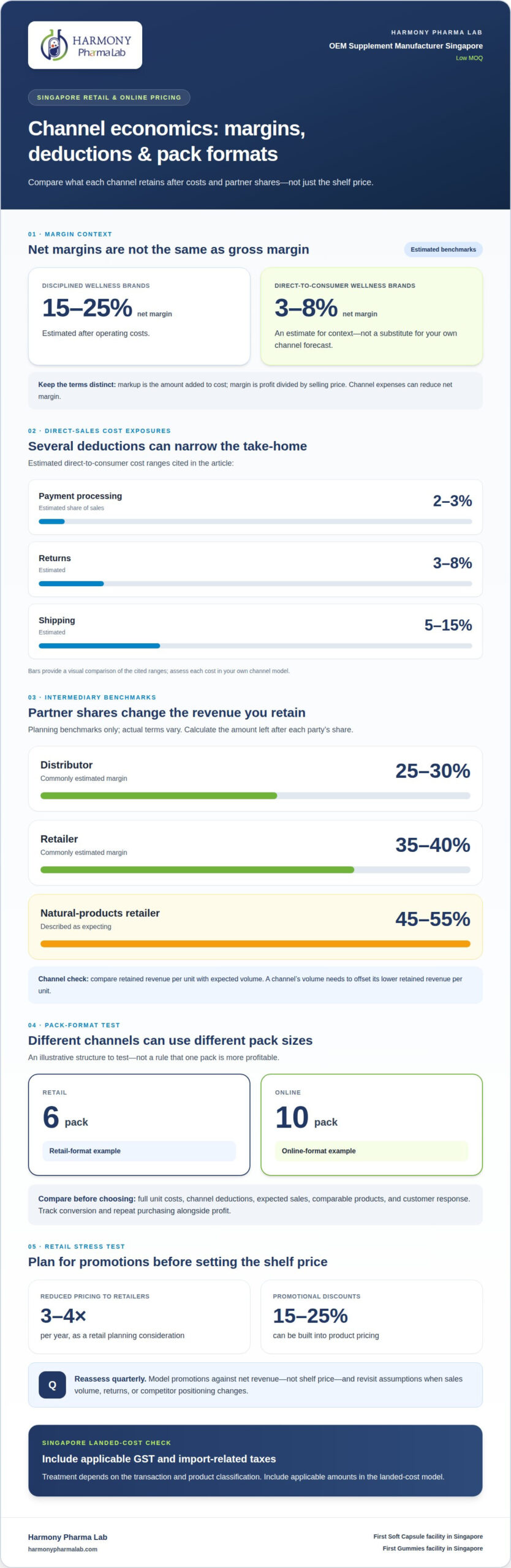
For Singapore sales, include applicable GST and import-related taxes in the landed-cost model. Treatment depends on the transaction and product classification. Compare sales channels using the relevant costs, deductions, and customer response.
-
Set and Assess a Target Profit Margin
Set a target net profit margin for each channel, then work backward from expected sales revenue. Disciplined wellness brands are estimated to achieve net margins of 15-25% after operating costs, while direct-to-consumer wellness brands are estimated at 3-8%. Treat these as context, not a substitute for your own forecast. Assess the result after returns, payment processing, shipping, promotions, and operating expenses.
Keep markup and margin distinct. Markup is the amount added to cost; margin is profit divided by selling price. A high markup does not necessarily mean a healthy net margin if channel expenses consume the difference.
-
Compare Channel and Intermediary Margins
Build a separate profit view for direct sales, retail, and wholesale. Direct-to-consumer sales can incur payment processing costs estimated at 2-3% and shipping costs estimated at 5-15%; returns are estimated at 3-8%. Retail may involve retailer and distributor deductions, so calculate the amount retained after each party’s share.
Distributor margins are commonly estimated at 25-30%, while retailer margins are estimated at 35-40%. Natural-products retailers are described as expecting 45-55%. These are planning benchmarks, not universal terms. Check whether a channel’s volume offsets its lower retained revenue per unit.
- Test the pack and positioning against consumer willingness to pay. A 6-pack for retail and a 10-pack for online sales illustrate how channel-specific formats can differentiate offers. Compare products with similar use, format, and positioning, then test customer response through limited offers or sales trials. Track conversion and repeat purchasing alongside profit; a price that attracts attention can still underperform if promotions erase the margin.
- Stress-test pricing before committing to a channel. Retail sellers should plan for reduced pricing to retailers three or four times per year, and promotional discounts of 15-25% can be built into product pricing. Model each offer against net revenue, not just shelf price. Reassess quarterly, especially when sales volume, returns, or competitor positioning changes.
Pricing formulas based on cost of goods and target gross margin
Calculate a channel-specific price using complete unit costs and a defined gross-margin target. Then account for formulation, production, and labelling decisions that affect those costs.
- Work with scientific and nutrition experts to define the formula before estimating its unit economics. Set the intended serving size, ingredient quantities, and product format, then assess whether each ingredient supports the product’s positioning. This step helps connect the formula to a clear consumer proposition and identifies costly ingredients or production requirements early.
For example, when pricing a vitamin product, include the selected vitamin form and amount per serving in your formulation assumptions. Keep those assumptions consistent when comparing supplier and manufacturing estimates. Otherwise, an apparent cost reduction may simply reflect a different product.
- Calculate the full variable cost for one saleable unit. Include raw materials, manufacturing, packaging, labelling, and distribution, then account for marketing and regulatory-compliance costs in the broader pricing model. Reflect the pack format and order quantity in the per-unit cost, since both affect the cost of each finished unit.
Separate one-time development expenses from costs that rise with each unit. A production partner can help translate the chosen format into a manufacturing cost model; use a supplement manufacturing cost model as one input to your unit assumptions.
- Apply the gross-margin formula: selling price = variable cost ÷ (1 − target gross margin). With a 20% target, divide total variable costs by 0.80. If a unit costs S$C to produce and prepare for sale, the calculation is S$C ÷ 0.80. This sets the price required for the target gross margin before fixed overhead and other operating expenses.
Assess the result using margin, not markup. Gross margin is selling price minus cost, divided by selling price. Compare your calculated price with the planned channel price, then account separately for the retailer’s share and other deductions.
- Plan the label and claims alongside the formula, before finalising artwork and purchase orders. Use clear ingredient and serving-size information, and review proposed health claims against the requirements for the Singapore market. Avoid claims the formula cannot substantiate, since label revisions can affect packaging and launch costs.
Include finished-product stability testing when determining packaged-product shelf life. Choose packaging for stability and usability, and include its material and filling requirements in the unit-cost calculation. Revisit the formula, label, and cost model together whenever an ingredient, serving size, or pack format changes.
Accounting for fixed costs and break-even sales
Separate unit-level expenses from costs that remain even when production pauses. This shows how many units must sell before their contribution covers the business’s fixed costs.
-
Calculate Unit Variable Costs
List every cost that varies with production volume, then divide the batch total by the number of saleable units. Include ingredients, packaging, manufacturing, labelling, and fulfilment or distribution where applicable. Record the order quantity and pack format beside each estimate, since variable costs change with production volume.
Assess ingredient quality as well as price. A premium raw material may raise the cost per unit, while a lower-cost ingredient may change the product’s intended positioning. Compare equivalent specifications and quantities; otherwise, you may not be comparing the same formula or finished product.
-
Calculate Total Production Costs
Combine variable production costs with the expenses required to bring the product to market. Include formulation work, packaging development, label design, stability testing, and any distribution expenses that apply to the launch. Record each item once, separating batch-level charges from per-unit charges to avoid double-counting.
For example, if you pay for packaging artwork once, treat it as a launch cost rather than multiplying it by every unit. If packaging materials are purchased for each unit, include them in variable unit costs. This distinction makes the total production-cost model useful for setting a retail price and evaluating a future reorder.
-
Account for Start-Up Costs and Break-Even Sales
List fixed costs such as business setup, product development, initial design, storage, and ongoing administration. These costs do not vary with production volume, even when sales are slow. Keep a separate launch-cost schedule so one-time expenses remain visible and are not mistaken for per-unit costs.
Calculate break-even units using this formula: fixed costs ÷ contribution per unit. Contribution per unit equals sales revenue per unit minus variable cost per unit. If each sale leaves little contribution after ingredients, manufacturing, and distribution, you will need to sell more units to cover fixed expenses.
Use the result to compare launch plans, not as a sales forecast. Model each pack size and channel separately because prices and variable costs can differ. Then assess whether the expected volume can cover fixed costs and leave room for operating profit.
Benchmarking competitors’ prices
Use comparable products as a competitive reference, then consider whether their positioning matches your launch. A shelf price alone cannot explain why one supplement costs more than another.
- Define your comparison set before recording prices. Select Singapore-market supplements with a similar format, pack size, intended use, and retail channel. For example, compare capsules with capsules rather than with gummies. Record each brand’s product name, pack quantity, serving information, and displayed price. This prevents a larger pack or different format from distorting the benchmark and gives your team a consistent basis for assessing the market.
- Compare what customers receive, not just the pack price. Note servings per pack and the stated amount of key ingredients, such as a named vitamin, when the label provides it. A pack with more servings may cost more overall but offer different value per serving. Focus on label details and pack information rather than assuming that products with similar names have equivalent formulas.
- Record how each brand presents its product alongside its price. Note the intended customer, benefit positioning, ingredient emphasis, pack design, and any visible purchase offer. For example, a specialist product aimed at a specific use may serve a different audience from a general daily supplement. These distinctions help explain price differences without making the lowest displayed price your target.
- Separate direct competitors from reference products. Direct competitors match your intended customer and product purpose; reference products can show how premium positioning or a different ingredient profile is presented. Compare product pages and retail listings using the same criteria. If a product differs substantially in serving count or format, place it in a separate group so its price does not distort your core benchmark.
- Use the comparison to make a launch decision, not to copy another brand. Set a proposed position relative to the closest matches, then record the specific product attributes that support it. Test customer response through a controlled launch offer or sales channel, and track purchases alongside customer feedback. Revisit the benchmark when brands change pack sizes, messaging, or promotional offers so it continues to reflect current Singapore retail conditions.
How do distributor, wholesaler, and retailer margins affect supplement pricing?
Work backward from the consumer-facing retail price for each sales route. This shows how much revenue remains for your brand after each intermediary takes its share.
- Map the channel before setting wholesale terms. A direct retailer purchase involves fewer steps than a route with a distributor and wholesaler. Each intermediary needs room for its margin, so your net revenue falls as more parties enter the chain. Build a separate price waterfall for each route, listing the retail price, each deduction, and the amount your business receives.
- Model retailer margin first, then work backward. A common planning range for retailer margins is 35-40%, while natural-products retailers are described as expecting 45-55%. These are benchmarks, not fixed Singapore-wide terms. For a given proposed shelf price, calculate the retailer’s purchase price using the margin as a share of retail price, then compare that amount with your wholesale cost and required profit.
- Add the distributor or wholesaler share as another deduction. Distributors typically take 20-30% off a brand’s wholesale price; an example range for distributor margin is 25-30%. Avoid treating these ranges as interchangeable with retailer margins. Apply each percentage to the correct transaction price, because sequential deductions produce a different result from adding all percentages together.
- Include broker fees and shelf-access charges in the waterfall. Broker fees are estimated at 3-10%, and retailers may charge listing or slotting fees. A fee charged per product, order, or placement affects net revenue differently, so model its actual basis separately from percentage margins. Also account for payment terms and early-payment discounts when forecasting the cash received from each invoice.
- Check whether the completed route leaves adequate contribution after product costs. Businesses selling through wholesale and retail should maintain separate channel pricing structures, while volume-based discounts can encourage larger retailer orders. Compare the margin retained per unit with the operational cost of serving that channel. Distribution may make sense for brands selling at least 2,000 units per SKU, but lower volumes can make its added deductions harder to absorb.
- Set a suggested retail price that remains competitive while preserving enough room for every channel participant. Recalculate the waterfall when a distributor, retailer, broker, or fee structure changes. A retailer’s keystone approach prices a product at 2× its wholesale purchase price, while flexible keystone pricing for premium supplements is described as 1.8× to 2.2×. Treat these as comparison points, then test whether the resulting retail price fits your positioning and unit economics.
Harmony Pharma Lab: Soft Capsule
Harmony Pharma Lab manufactures custom supplements, including Soft Capsules, for brands planning production around a defined retail price and target margin. Discuss the intended pack size, sales channel, cost assumptions, and product format together so manufacturing decisions support the commercial model. The company also manufactures Gummies, Hard Capsules, Tablets, Powders, and Liquids, offering brands different formats to consider for their product concepts and target customers.
Turn to Harmony Pharma Lab when your pricing model is taking shape and you need to align a supplement format with production planning. Share your product direction and intended sales channel to start a practical manufacturing discussion.
Contact Harmony Pharma Lab to discuss your supplement manufacturing requirements.
Move from pricing model to production plan
Your decision about how to price a new supplement product for retail should guide the next development choices, including pack format, production assumptions, and channel priorities. Use the model as a working commercial brief, then align it with the product you intend to launch. Harmony Pharma Lab manufactures Soft Capsules, Gummies, Hard Capsules, Tablets, Powders, and Liquids for supplement brands.
As your plan takes shape, connect the intended format and target positioning to the requirements for manufacturing the finished product. This gives your team a practical basis for refining the retail offer and preparing for production.
Contact Harmony Pharma Lab to discuss your supplement manufacturing plans. A clear next step can turn your pricing work into a focused product plan.
Frequently Asked Questions
How should I choose a pack size?
Choose a pack size that suits the intended purchase occasion and keeps unit economics viable. To decide how to price a new supplement product for retail, compare the customer’s likely commitment with servings per pack, shelf footprint, and total purchase value. A smaller pack may reduce the initial spend, while a larger pack may suit repeat customers. Model each format separately because pack count can affect packaging, unit cost, and perceived value.
The Price is right?
A price works when customers see value in the offer and the business retains enough revenue to operate. Assess it against customer response, channel deductions, and product positioning rather than relying on a competitor’s shelf price alone. If purchases remain weak, identify whether price, pack size, or presentation is the main barrier. Change one variable at a time so you can assess the effect of each adjustment.
What is the markup on supplements?
There is no single markup that applies to every supplement. Calculate markup as the amount added to unit cost divided by that cost; calculate gross margin as profit divided by selling price. These measures are different. A product can have a high markup but still leave a modest margin after retailer deductions. Use the measure that fits your decision, and compare products on the same cost basis.
What is the typical retail price range for supplements in Singapore?
Retail prices vary with format, pack size, ingredients, positioning, and sales channel, so one price range cannot reliably represent the Singapore market. When assessing how to price a new supplement product for retail, compare local offers with similar formats and serving counts, then consider whether your price reflects your product’s attributes. Include channel deductions in your model, since a competitive shelf price may leave limited revenue after those costs.
How do supplement brands calculate retail price from manufacturing and landed costs?
Add manufacturing and packaging costs to the relevant landed costs for each saleable unit, then include channel-specific deductions in your price model. If costs are recorded by batch, divide them by the expected number of saleable units. Keep fixed launch expenses separate from per-unit expenses. For an imported product, include applicable freight and taxes in the landed-cost calculation, since these charges affect the revenue available to support your margin.
What gross margin do supplement brands and retailers typically target?
Targets differ by channel and should not be confused across the supply chain. Direct-to-consumer wellness products are commonly modelled at a 70-80% gross margin, while retailer margins are often estimated at 35-40%; natural-products retailers may expect 45-55%. These figures describe different businesses and price stages. Calculate your margin using the revenue your brand retains after applicable channel terms.
How should a new supplement’s price compare with competing products in Singapore?
Position your price against comparable products in the Singapore market, not simply the cheapest option in the category. Match format, serving count, intended use, and sales channel before drawing conclusions. Then identify differences customers can understand, such as a distinct pack configuration or ingredient positioning. If your proposed price is higher than comparable offers, explain the rationale in the product presentation and assess customer response through purchasing behaviour.
How do pack size, serving count, and cost per serving affect supplement pricing?
Calculate cost per serving by dividing the pack’s total price by its serving count, then compare products with similar serving definitions. A larger pack may have a lower apparent cost per serving but require a higher upfront purchase. Check that serving information is presented consistently and that pack quantity suits the intended use period. This comparison helps explain value without treating the lowest pack price as the best value.