

A low per-unit quote can still lead to a costly supplement launch. In Singapore, total costs depend on the formulation, dosage format, production volume, packaging and testing scope. Hidden costs in supplement manufacturing often sit outside the headline production figure, so compare the full project cost, not just the unit price.
Ingredient choices and larger orders affect unit economics, but savings can involve trade-offs in inventory, cash flow and product flexibility. Custom formulations, packaging changes and quality testing may also add costs that early estimates overlook.
This guide explains what shapes supplement manufacturing costs, how to compare quotes on a like-for-like basis, and how ingredient, testing and volume decisions affect launch expenses. It also outlines cost considerations for capsules, tablets, gummies, powders and other formats, helping you build a clearer budget before committing to production.
Key Takeaways
- Compare quotes by their full scope, including formulation, packaging, testing and production, rather than focusing only on the unit price.
- Ingredient selection affects both product cost and sourcing complexity; bulk purchasing can lower unit costs but requires sound inventory planning.
- Testing and raw-material documentation are part of a reliable production budget, not optional extras to overlook when assessing a low quote.
- Dosage format influences manufacturing needs, so compare formats in light of the product’s ingredients, packaging and intended production volume.
- Use estimates to frame your launch budget, then assess how each manufacturing and packaging choice affects the total project cost.
What Affects Supplement Manufacturing Cost?
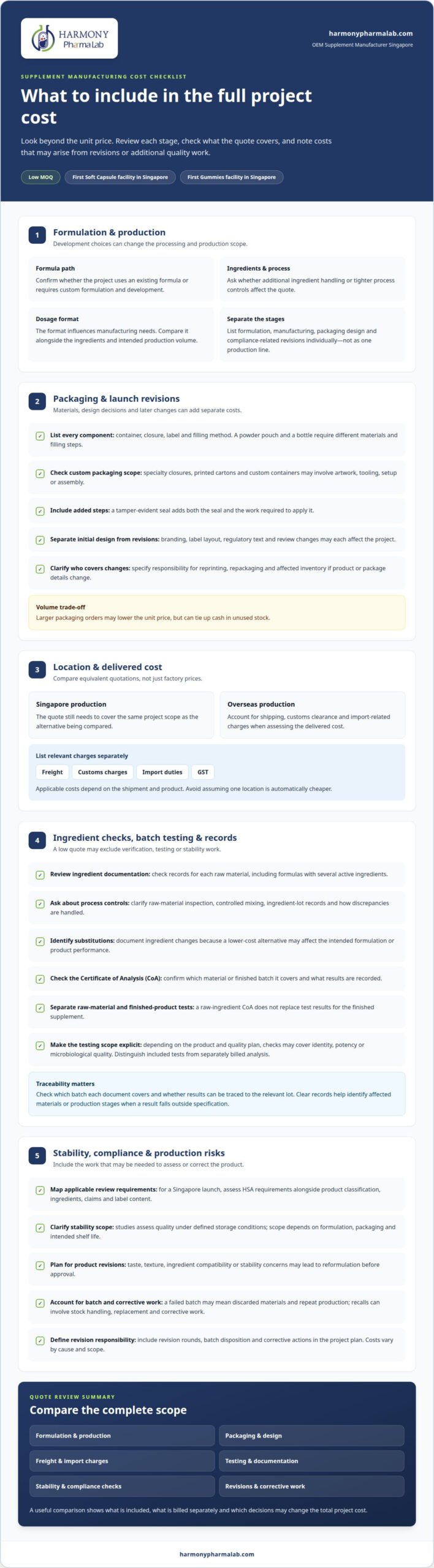
A launch budget covers more than the production run. Formulation, manufacturing, packaging design and compliance-related revisions can each add a separate cost.
Formulation and Production Stages
Formulation determines a supplement’s ingredients, dosage form and processing requirements. An existing formula and a custom formulation follow different development paths. Additional handling or tighter process controls for certain ingredients may affect costs. Packaging also requires a suitable container, closure, label and filling method. A powder pouch and a bottle, for example, use different materials and filling steps. Include each stage in your cost breakdown rather than treating production as a single line item.
Location and Import Expenses
When comparing a Singapore manufacturer with an overseas one, assess the full delivered cost, not just the factory quote. Overseas production may involve shipping, customs clearance and import-related charges. Singapore production can reduce the distance goods travel, but the quote still needs to cover the same scope. For products entering Singapore, list applicable import duties, GST, freight and customs charges separately. Costs depend on the shipment and product, so compare equivalent quotations rather than assuming one location is automatically cheaper.
Reformulation and Production Risks
Reformulation changes a product after development, while a failed batch may mean discarded materials and repeat production. Concerns about taste, texture, ingredient compatibility or stability can lead to revisions before approval. Recalls can involve stock handling, replacement and corrective work; compliance issues may require label or formula changes. Costs vary by cause and scope, so include revision rounds, batch disposition and corrective actions in the project plan.
Packaging and Compliance Revisions
Packaging choices affect both unit cost and launch readiness. A standard bottle and straightforward label generally involve fewer design and setup decisions than a custom container, specialty closure or printed carton. Every extra component can add artwork, tooling, setup or assembly requirements. For example, a tamper-evident seal adds the cost of the seal and the step required to apply it. Larger packaging orders may lower the unit price, but they also tie up cash in unused stock.
Design costs may include branding, label layout, regulatory text and revisions after review. Changing serving instructions or ingredient details may require updated artwork and replacement labels. If compliance requires a product or package change, the formulation or production plan may need revision too. Separate initial design costs from later revisions, and specify who covers reprinting, repackaging and affected inventory. This makes hidden costs in supplement manufacturing easier to distinguish from the base production charge.
How low prices can reflect ingredient and testing shortcuts
A low quote may exclude ingredient verification, batch testing or stability work. For a Singapore launch, map applicable HSA requirements to the product’s classification, ingredients, claims and label content before production.
Ingredient and Testing Shortcuts
Reducing the scope of ingredient and testing checks can lower costs, but it may also leave brands with less evidence about raw-material identity, potency or finished-product consistency. Before production, review the ingredient records and tests included in the quote. A formula with several active ingredients, for example, needs clear documentation for each material, not just a general statement that quality checks are performed.
Raw-material inspection and controlled mixing can identify problems before a full batch proceeds. Ask how production records ingredient lots and handles discrepancies. A lower-priced quote that excludes these steps may shift investigation and correction work to the brand. Document ingredient substitutions too, since a lower-cost alternative may affect the intended formulation or product performance.
Batch Testing and Certificates
A Certificate of Analysis (CoA) records test results for a material or finished batch. Batch testing checks whether sampled product meets defined specifications, so both documents can support quality control. Compare the testing scope in the quote with the product’s ingredients and dosage form. A CoA for a raw ingredient, for instance, does not replace test results for the finished supplement.
Check which batch each document covers, what attributes were tested and whether results can be traced to the relevant lot. Depending on the product and quality plan, testing may assess identity, potency or microbiological quality. The quote should distinguish included tests from separately billed analysis. Clear records support traceability when a result falls outside specification and help identify affected materials or production stages.
Compliance and Stability Checks
Compliance and stability checks assess whether product information and quality controls support the intended launch. In Singapore, HSA requirements depend on product classification and claims, so assess these alongside ingredients and label content. Regulatory review can flag changes before packaging is printed or a production batch is completed, helping avoid unnecessary revisions.
Stability studies assess how product quality changes under defined storage conditions. Their scope depends on the formulation, packaging and intended shelf life. Microbiological testing and production quality checks may also form part of the control plan. If these processes are excluded from a quote, the launch budget may omit work needed to evaluate product consistency over time.
Certification and documentation can add separate costs, while compliance issues may trigger label or formula changes. Build a scope that names each test, study, record, and review. This gives brands a clearer basis for comparing quotes and tracking quality-control responsibility. For a structured overview of Singapore supplement production planning, explore the available information.
Cost calculators and manufacturer quotes
A calculator can provide an initial budget estimate using inputs such as ingredients, volume and packaging. To identify extra fees, ask which materials, tests, revisions and production steps the quote includes and which are billed separately.
Uncovering Extra Fees
A complete quote separates the base production scope from additional charges. Two estimates may appear comparable while covering different work. Ask whether formula adjustments, sample rounds, packaging setup, testing or storage are listed separately. For example, clarify whether a label revision changes the design fee or adds printing costs.
Ask what happens if ingredient availability changes or a batch needs rework. Request the assumptions behind the quoted volume, packaging specification and delivery scope. A calculator can organize these inputs, but it cannot replace a manufacturer’s detailed quote. Startups can use an estimate to identify cost drivers before setting a launch budget.
Estimation Mistakes and Cost Planning
A common estimation mistake is comparing unit costs without matching the included scope. One quote may include packaging setup while another lists it separately. Compare the same formula, material specifications, batch volume and testing plan. This reveals the differences and prevents a low headline figure from distorting the launch budget.
Review actual spending against the estimate at each development stage. Track changes to ingredients, artwork, testing and production volume in one cost log. If a packaging revision affects the material order, record both impacts, not just the design expense. This helps teams spot avoidable spending early.
Manufacturer quotes and calculators serve different purposes. A calculator helps with initial scenario planning; a quote reflects a defined project scope. Model how volume or packaging choices affect the estimate, then compare the scenarios with expected demand. Higher volumes may lower unit costs, but buying more material can increase storage needs and the cash tied up in stock.
- Separate one-time development work from recurring production charges.
- Record which tests and documents are included in the stated scope.
- Compare quotes using identical volume, formula, and packaging assumptions.
- Track each revision against its effect on materials and schedule.
If actual costs exceed the plan, review production efficiency. Bottlenecks in mixing, filling or packaging can waste time and materials. Identifying the stage causing rework gives the team a practical basis for improvement. Regular budget reviews can show whether changes reduce waste or simply shift costs elsewhere.
Reduce uncertainty by making assumptions clear before production begins. Document who approves formula or artwork changes, how additional work is costed and what happens to unused packaging. These controls help brands manage risk while keeping a clear record of decisions.
Ingredient costs and bulk-purchasing savings
Ingredients can account for 30-50% of supplement cost of goods sold, making sourcing decisions central to unit economics. For a Singapore launch, the landed material cost also reflects transport, storage, and the quantity purchased. A lower ingredient price can support profit, but only if the material meets the formula’s specifications and remains usable through production.
Bulk purchasing may reduce per-unit ingredient costs by 25-40% at orders of 5,000 or more supplement units. The saving comes from spreading purchasing and handling costs across a larger quantity. It does not automatically make the full launch less expensive. A brand that buys beyond expected demand may tie up cash in unused stock or face deterioration before the next production run.
Premium ingredients, including organic, non-GMO, or clinically dosed actives, are estimated to add 15-30% to ingredient costs. Their effect depends on the formula’s ingredient mix and how much of each material it requires. Rare or high-quality ingredients can also involve international sourcing and added transport expenses. A capsule formula using several specialty actives, for example, can have different sourcing needs from a simpler formula.
Traceability links each ingredient to its source and production lot. Keep supplier records, material specifications and lot documents together so teams can connect incoming ingredients to finished batches. Compare suppliers on price and quality rather than treating the lowest quote as the best value. Assess a lower-cost substitute against the required material properties and intended formula before using it.
Ingredient selection can also affect process efficiency. Differences in material characteristics may change mixing requirements, handling or production consistency. Any ingredient savings may be offset by extra processing or avoidable waste. Assess the full material and production implications before approving a substitution, especially if it affects multiple ingredients.
Production volume is another key cost factor. Small batches often have higher per-unit costs, while larger volumes can spread production and purchasing costs across more units. Longer timelines may allow more deliberate bulk ordering and production scheduling. However, a larger order supports competitive unit costs only when demand, storage capacity and usable shelf life align with the quantity.
- Calculate ingredient cost per finished unit, not only per kilogram of raw material.
- Compare suppliers using matching specifications and traceability records.
- Model the effect of a larger order against projected demand and stock holding.
- Assess premium ingredients for their contribution to the formula and overall unit economics.
For capsules, ingredient quantities and material compatibility influence the production plan. Compare these requirements with expected order volume before committing to bulk purchases. A measured approach can protect profitability while keeping ingredient quality, traceability and production efficiency aligned.
Manufacturing costs by supplement type
Dosage format affects the equipment, ingredients and processes required for production. Compare formats by their full manufacturing requirements, not unit cost alone. For a supplement brand, the right choice balances product experience, production complexity and expected demand.
Capsules and tablets are often considered cost-effective formats because their production processes can be relatively simple. Typical minimum order quantities for capsule or tablet supplements are 5,000-10,000 units. Smaller runs of 1,000-2,000 units may be possible, but per-unit costs increase. For a private label supplement, an existing formula can also differ from a custom formulation in development needs.
Softgels require specialised equipment, particularly for products using oil-based ingredients. Their production needs and material choices differ from those of a hard capsule or tablet. A brand comparing these forms should consider the ingredient properties, equipment requirements, and packaging format together. That comparison helps explain why two products with similar ingredient lists can have different manufacturing economics.
Gummies involve additional formulation work for flavour, colour, and texture. Their process must account for these characteristics alongside the active ingredients. Typical minimum order quantities for gummy or liquid supplements are 10,000-20,000 units. A smaller quantity may be available in some production contexts, but the higher unit cost can affect a launch budget and expected profit.
Powders and liquids also require format-specific processing and packaging. Powder can be packed in sachets, jars or tubs, while liquid formulations require a suitable container and filling process. Material, filling method and package size all influence the production plan. These choices also shape how consumers store and use the product.
Compare formats using the same assumptions: formula, active ingredients, order quantity, packaging and testing scope. This makes differences in equipment and production steps easier to assess. A smaller order may reduce stock exposure, while a larger run can spread setup costs across more units. The right balance depends on demand forecasts and the cash tied up in inventory.
- Capsules and tablets suit projects prioritising simpler production processes.
- Softgels require specialised equipment and can fit oil-based formulas.
- Gummies need flavour, colour, and texture formulation alongside ingredient development.
- Powders and liquids need packaging and filling plans suited to their physical form.
Your production price depends on dosage format, formulation, order volume, packaging, and testing scope; the exact figure is provided in a quote for your case. To align a format with your product brief, discuss your supplement manufacturing requirements.
Harmony Pharma Lab: Soft Capsule
Harmony Pharma Lab provides OEM and ODM manufacturing for supplement brands, with a core focus on Soft Capsule and Gummies. Its six formats are Soft Capsule, Gummies, Hard Capsules, Powder, Liquid and Tablet. Formulation development and format selection support a more informed discussion of production requirements and launch plans.
For a soft capsule project, Harmony Pharma Lab provides blending, emulsification, and bottle or sachet filling for B2B nutraceutical clients. This is a practical next step when you have a product concept and need to scope its production requirements, including ingredients, packaging, and testing needs. A detailed project scope helps connect manufacturing decisions with the cost factors discussed above.
Contact Harmony Pharma Lab to discuss your supplement manufacturing requirements, or visit harmonypharmalab.com.
Turn your launch budget into a production plan
A launch budget should guide decisions, not just record expenses. Treat it as a working plan that connects product priorities with production choices, so changes to a formula or launch scope have clear commercial context. This also helps teams distinguish deliberate investment from hidden costs in supplement manufacturing that can arise when decisions are made in isolation.
Before moving forward, align your team on the product’s priorities: its intended format, the role of each ingredient and the quality evidence needed to support the launch. A shared brief gives manufacturing discussions a clearer foundation and helps keep decisions consistent as the project develops. It also provides a practical reference for weighing trade-offs without losing sight of the product’s purpose.
Harmony Pharma Lab works with supplement brands on production planning across its available formats. If you are ready to discuss how your concept can move toward production, contact Harmony Pharma Lab. A considered plan is a strong starting point for a more controlled launch.
Frequently Asked Questions
How much does it cost to launch a private label supplement?
There is no single launch cost because the total depends on the product and launch scope. Key factors include dosage format, formula, order volume, packaging, testing, and inventory plans. The project price depends on the case and is provided after a quote request. For budgeting, distinguish one-time development work from recurring production and ongoing expenses, such as storage and distribution, so the launch plan reflects more than manufacturing alone.
What are supplement contract manufacturers’ setup, formulation, and R&D fees?
Costs depend on whether the project uses an existing formula or develops a custom one. Setup may involve preparing production processes and materials for a specific product. Formulation and development may involve ingredient compatibility, sample development and revisions before approval. Ask for these activities to be itemized in the project scope, so you can see which charges apply once and which may change if the formula or specifications change.
What hidden packaging, labeling, and design costs should supplement brands budget for?
Budget for more than the container and printed label. Artwork adaptation, print setup, carton components, seals and changes after approval can each add work. Changing an ingredient statement after label approval, for example, may require updated files and replacement materials. Keep a record of the final packaging specifications, approved artwork and revision responsibilities. This helps prevent outdated packaging from remaining in the production plan or being ordered for a changed product.
What are the testing, quality assurance, and certification costs for supplements in Singapore?
These costs depend on the product’s ingredients, dosage format and testing scope. In Singapore, consider product classification and claims when planning applicable HSA-related review and documentation. A quality plan may include raw-material checks, finished-batch testing and stability work. Budget for each planned test or review separately from general production charges. If results require follow-up analysis or corrective work, the project scope should clarify how those activities affect costs.
What storage, warehousing, and inventory fees apply to supplement products?
Storage and warehousing charges depend on how much stock you hold, how long it remains in storage and the handling required. Inbound receiving, inventory tracking, order preparation and dispatch may be charged separately from storage space. Brands holding several formats or packaging configurations may also need more detailed stock control. Align production quantities with sales plans, and account for slow-moving inventory, replenishment timing and handling before deciding how much finished product to store.