

The widest material menu does not automatically make a vegetarian capsule manufacturer the right production partner. HPMC and pullulan have different properties, and a shell that suits one formula may not suit another.
That difference matters when you assess moisture sensitivity, ingredient compatibility, fill requirements and consistent dosing. Broad capability claims can make manufacturers difficult to compare, particularly when product suitability and repeatable batch production are central to your decision.
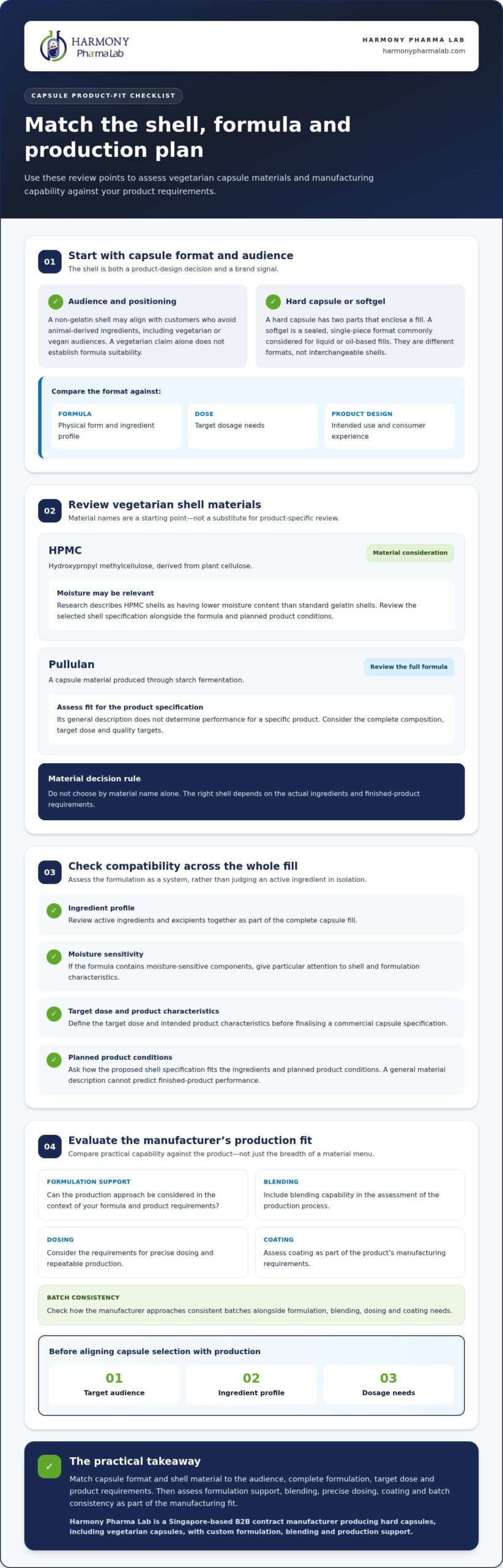
This guide explains how to compare vegetarian and gelatin capsules, understand common vegetarian shell materials and assess manufacturing capabilities against your product requirements. It also covers how formulation, blending, production, coating and batch consistency fit into a practical development process.
Based in Singapore, Harmony Pharma Lab is a B2B contract manufacturer producing hard capsules, including vegetarian capsules. The company supports custom formulation, blending and production, with a focus on precise dosing, coating and batch consistency for commercial supplement brands. Use the criteria below to identify a production approach that aligns with your formulation and brand priorities.
Key Takeaways
- Compare vegetarian hard capsules with gelatin capsules and softgels to determine which format fits your product and brand positioning.
- Assess HPMC and pullulan against your formulation’s moisture sensitivity and ingredient compatibility, rather than choosing by material name alone.
- Use a consistent checklist to evaluate a vegetarian capsule manufacturer, including formulation support, blending, dosing, coating and batch consistency.
- Document your target audience, ingredient profile and dosage needs before aligning capsule selection with production requirements.
- Harmony Pharma Lab’s Singapore-based B2B manufacturing support connects vegetarian hard capsules with custom formulation, blending and production.
Why supplement brands choose a vegetarian capsule manufacturer
Capsule format is both a product-design decision and a brand signal. A vegetarian shell can help a supplement brand serve customers who avoid animal-derived ingredients, while a gelatin shell may suit different formulation or positioning priorities. Neither option is universally better. The right choice depends on the intended audience, formula and finished-product requirements.
Vegetarian hard capsules are two-piece capsules made with a non-gelatin shell material to enclose a supplement formulation. This describes the format, not a particular manufacturer’s materials or capabilities. Hard capsules differ from softgels, which use a sealed, single-piece shell. For background on capsule types and materials, see Capsule (pharmacy).
Vegetarian hard capsules versus gelatin capsules
The main distinction is the shell’s source. Gelatin is animal-derived, while common vegetarian hard-capsule materials include HPMC, made from plant cellulose, and pullulan, produced through starch fermentation. Their properties differ, so consider the shell alongside the formulation rather than treating it as a label decision alone.
Brand positioning can also guide the choice. If a product is intended for vegetarian or vegan customers, a non-gelatin capsule may align more closely with their expectations. A brand serving a broader audience may weigh that positioning against ingredient compatibility, dosage needs and other product requirements. A vegetarian claim alone does not establish that a shell suits every formula. Suitability depends on the actual ingredients and product design.
For broader considerations when specifying a hard-capsule product, consult this hard capsule buying guide.
Vegetarian hard capsules versus vegetarian softgels
Hard capsules and softgels are different formats, not interchangeable versions of the same shell. A hard capsule has two parts that enclose a fill. A softgel is a sealed, single-piece format commonly considered for liquid or oil-based fills. These structural differences affect formulation and product design, although the best format depends on the specific ingredients and intended use.
When comparing formats, start with the formula’s physical form, target dose and desired consumer experience. Then assess whether the shell and format suit the ingredients and product requirements. A vegetarian label does not answer those questions by itself. For more on softgel design, see this soft capsule manufacturing guide.
A suitable vegetarian capsule manufacturer should be assessed in the context of the product, not simply by whether it offers a non-gelatin shell. Consider audience positioning, capsule structure and formulation needs before making production decisions.
How vegetarian capsule materials affect formulation and product fit
Shell material is one part of capsule performance, not a guarantee of finished-product suitability. A material’s composition and moisture characteristics can inform development, but the full formula, including active ingredients and excipients, must be considered as a system. Assess shell-material suitability alongside the finished formulation, since ingredients, dose and product requirements all affect whether the selected capsule is a practical fit.
HPMC and pullulan: material considerations for brands
HPMC, or hydroxypropyl methylcellulose, is derived from plant cellulose. Pullulan is a polymer produced through starch fermentation. Both are used in vegetarian capsule shells, but their different origins do not establish that either will perform better for a particular product. General material background is available in Vegetarian Capsule Manufacturing Services. Product-specific performance still depends on the formulation and selected capsule specification.
Use the table as a starting point for technical review, not as a substitute for assessing the intended formula with the proposed shell.
| Material | General characteristic | Potential consideration | Technical review question |
|---|---|---|---|
| HPMC | Plant-cellulose-derived capsule material; research describes HPMC shells as having lower moisture content than standard gelatin shells. | Moisture sensitivity may be relevant to the formula and its handling requirements. | How does the selected shell specification fit the ingredients and planned product conditions? |
| Pullulan | Capsule material produced through starch fermentation. | Its specific properties and fit should be considered in relation to the complete formula. | Does the proposed material suit the product’s composition, dose and quality targets? |
Assessing capsule and formulation compatibility
Review the complete capsule fill instead of assessing an active ingredient in isolation. Active ingredients, excipients and the intended dose all contribute to the product specification. For example, a formula with moisture-sensitive components calls for particular attention to shell and formulation characteristics. A general material description alone cannot predict finished-product performance.
Before finalising a commercial capsule specification, define the target dose, ingredient profile and intended product characteristics. Then consider whether the fill and shell can be handled together in a consistent manufacturing approach. Addressing these points early can bring technical questions to light before material selection is built into production planning.
- Ingredient profile: Record active ingredients and excipients, including known sensitivities relevant to the product.
- Dose requirements: Document the target fill and assess it against the chosen capsule format.
- Product priorities: Set the intended characteristics and quality expectations for the finished capsule.
A vegetarian capsule manufacturer should connect shell selection with formulation review and production requirements, rather than treating the shell as a standalone choice. Harmony Pharma Lab supports custom formulation, blending and production for hard capsules, including vegetarian capsules. Brands developing a commercial capsule can explore Harmony Pharma Lab’s manufacturing support as they align formulation decisions with production needs.
Compare vegetarian capsule manufacturers on capability, quality, and fit
A useful comparison goes beyond whether a supplier lists vegetarian capsules. Start with the product brief and identify the work required to develop and manufacture the product. Then distinguish specific capabilities from broad claims such as “high quality” or “complete solutions.” A clear comparison connects formulation, blending, dosing, coating and production to the intended capsule and finished-product requirements.
Market context can inform your decision, but it does not replace an operational assessment. Vitaquest’s overview of Vegetarian Capsule Manufacturing Company discusses vegetarian capsule production and related brand considerations. Use this background to frame your comparison, then focus on the manufacturing scope and deliverables that apply to your product.
Formulation and production capabilities
Assess how formulation support, blending and hard-capsule production fit together for your product. A capability is more useful when its role in development or production is clear. Precise dosing and coating may also matter, depending on the capsule specification and product objectives. Harmony Pharma Lab is a Singapore-based B2B contract dietary supplement manufacturer that produces hard capsules, including vegetarian capsules, and supports custom formulation, blending and production, with a focus on precise dosing, coating and batch consistency.
- Formulation: Consider how formulation work aligns with the active ingredients, excipients and intended capsule format.
- Blending: Compare the blending support with the requirements of the planned fill and production process.
- Dosing: Include dose precision in the assessment when the product specification requires it.
- Coating: Evaluate coating as a product requirement, not as a capability every capsule needs.
- Production: Look for a clear connection between development decisions and the intended commercial production approach.
Quality systems and batch consistency
For a commercial supplement brand, consistency across batches is a practical quality objective. Variability can affect whether successive production runs align with the established product specification. Assess how the manufacturing partner approaches repeatable production and batch consistency. Treat these objectives separately from specific certifications, testing programmes or regulatory claims, which belong in a comparison only when documented for the relevant project.
Keep the comparison focused on evidence and coordination. Record the stated capabilities, the work they cover and the deliverables associated with your product. A broad quality statement does not prove a particular process. Technical coordination matters too: formulation choices, blending requirements, dosing and coating should remain aligned as the product moves toward production.
A vegetarian capsule manufacturer is a stronger fit when its capabilities map directly to the product brief and required production outcomes. Compare the process, quality objectives and deliverables together. Labels alone cannot establish manufacturing fit.
Match a vegetarian capsule manufacturer to your product requirements
A project brief turns a format preference into a production plan. Before choosing a vegetarian capsule manufacturer, clarify what the finished product must deliver, which requirements are fixed and where technical refinement is welcome. This preparation connects the intended audience and formula to decisions about capsule format, formulation, blending and production.
Prepare a concise capsule product brief
Capture the commercial purpose and technical essentials in one working document. Separate known requirements from assumptions so development can focus on the decisions that still need resolution.
- Define the target market and audience. Record the intended customer and the reason for choosing a vegetarian capsule, such as aligning the format with the product’s positioning.
- Document the ingredient profile. List active ingredients and excipients, along with known characteristics that may affect formulation or shell selection.
- Set dosage needs. Specify the intended dose and dosage format. Note product characteristics that could influence capsule size or fill requirements, while leaving technical specifications open for review.
- Explain the format rationale. State why a hard vegetarian capsule is being considered and identify the product priorities it is expected to support.
- Separate fixed requirements from flexible choices. Mark essential audience, ingredient and dosage requirements clearly. Identify areas, such as formulation details or production preferences, that may be refined through technical development.
This brief gives development a useful starting point without treating early assumptions as final specifications. For example, a brand may have a fixed target dose while the precise formulation and production approach remain open to alignment.
Align formulation decisions with commercial production
Use the brief to connect product intent with the work needed to make it. Ingredient profile and dose inform formulation; the formula informs blending requirements; and the agreed product specification guides dosing, any required coating and production planning. Consider batch consistency as a product requirement, rather than waiting until production decisions are already made.
Bringing linked decisions into the same development discussion can reduce avoidable specification changes. If a change in ingredient profile affects the blend or target dose, review those implications before finalising the capsule specification. This helps keep development and production requirements coherent and gives the manufacturing team a clearer basis for planning.
For additional context on hard-capsule production decisions, the custom capsule manufacturing overview complements this project-planning approach. Harmony Pharma Lab supports commercial brands with custom formulation, blending and hard-capsule production, including vegetarian capsules. Discuss your capsule project with Harmony Pharma Lab to connect product requirements with a production approach.
How Harmony Pharma Lab supports vegetarian capsule manufacturing
For supplement brands, choosing a vegetarian capsule manufacturer is part of a wider production decision. Harmony Pharma Lab is a Singapore-based B2B contract dietary supplement manufacturer that produces hard capsules, including vegetarian capsules. Its work connects product formulation with blending and production for commercial brands.
The project brief is the starting point. Ingredients, dosage requirements and intended product positioning help define what formulation and production need to address. Harmony supports custom formulation, blending and production, with a focus on precise dosing, coating and batch consistency.
Custom hard capsule production for supplement brands
Harmony manufactures hard capsules, including vegetarian capsules, for B2B customers. Support across custom formulation, blending and production brings key development and manufacturing activities together, helping brands connect product requirements with the capsule and its fill.
For a commercial project, this means translating the product brief into practical production considerations instead of treating capsule format as an isolated choice. Ingredients inform formulation, formulation informs blending, and dosage and coating requirements can shape the production approach. Harmony’s stated capabilities include precise dosing, coating and batch consistency, all relevant when developing a defined product specification.
- Formulation: Connect the planned ingredient profile and product positioning with custom formulation support.
- Blending: Include the fill and blending requirements in the overall capsule plan.
- Production: Align dosage, coating and batch consistency requirements with the intended hard-capsule product.
Discuss your vegetarian capsule project
Start a project discussion with the details that shape the product: its ingredients, intended dosage and market positioning. Share which requirements are fixed and where formulation decisions may be refined. This provides a practical basis for considering how custom formulation, blending and hard-capsule production relate to the finished supplement.
As a Singapore-based manufacturing partner serving commercial brands, Harmony Pharma Lab supports vegetarian hard-capsule projects as part of its broader formulation and production work. The focus is on aligning the product brief with manufacturing requirements, including relevant dosing, coating and batch consistency considerations.
To discuss a vegetarian capsule project, share your product requirements with Harmony Pharma Lab.
Turn your capsule decision into a production brief
Turn the material and format decision into a concise, decision-ready brief. Capture the non-negotiables, such as audience, ingredient profile, dosage and product positioning, then separate them from details that can be refined during development. This keeps the discussion focused on choices that shape the capsule specification and helps align product intent with manufacturing requirements before they become fixed.
A well-prepared brief also gives your team a common reference as formulation decisions progress. It clarifies what the finished product needs to achieve, what needs technical review and which requirements should guide production planning. Choosing a vegetarian capsule manufacturer then becomes less about a label and more about the fit between your supplement concept and the process needed to produce it. Share the brief with relevant product and commercial stakeholders so priorities are aligned from the outset.
Harmony Pharma Lab supports commercial brands developing vegetarian hard-capsule projects. Discuss your vegetarian capsule project and take the next step toward a clearly defined production approach.
Frequently Asked Questions
Is a vegetarian capsule the same as a vegan capsule?
Not necessarily. The terms “vegetarian” and “vegan” can be applied differently across products and markets. For a brand claim, review the capsule shell’s stated composition and any manufacturing inputs relevant to the claim criteria. A consumer-facing label is not a complete material specification. Keep product documentation that identifies the shell and supports the wording used in packaging and sales materials, so the claim accurately reflects the finished product.
What materials are used to make vegetarian capsules?
Vegetarian capsule shells may use materials such as HPMC or pullulan, depending on the product. These materials differ in origin and may have different technical properties, which can affect formulation review and product specifications. Use the actual shell specification, rather than a generic category description, when making product or label decisions. Do not assume a particular material without documentation for the capsule under consideration.
Can vegetarian capsules contain the same ingredients as gelatin capsules?
Capsule format alone does not determine whether an ingredient is compatible. Suitability depends on the active ingredients, excipients, target dose, shell characteristics and finished-product requirements considered together. A formula developed for one shell may need review before being transferred to another. Assess the complete formulation before selecting a capsule, rather than assuming all ingredients will perform equally across capsule types. Product-specific technical review can identify questions to resolve before finalising the specification.
Are vegetarian capsules suitable for dietary supplements?
Yes, vegetarian hard capsules are used as a dosage format for dietary supplements, but suitability depends on the intended formulation and product requirements. Assess the shell, ingredients and dose alongside the brand’s positioning before settling on the format. Capsule choice alone does not establish a supplement’s efficacy or regulatory compliance; those depend on separate, product-specific considerations. Keep the rationale for the format distinct from evidence supporting product claims or compliance decisions.
How do I compare vegetarian capsule manufacturers?
Compare capabilities that map to your product brief, including formulation and blending support, capsule production, dosing, coating, batch consistency and technical communication. A vegetarian label alone does not show how a manufacturer will support your project. Record the requirements that affect your formula and commercial plan, then distinguish documented operating details from broad promotional statements. This helps you compare the work involved and the deliverables relevant to your product.
Can a vegetarian capsule manufacturer support custom formulations?
Some contract manufacturers support custom formulation alongside blending and capsule production. Harmony Pharma Lab provides custom formulation, blending and production for dietary supplements, including vegetarian hard capsules. The project’s ingredients, intended dose and product characteristics shape the development discussion. A custom approach does not establish a particular ingredient outcome, shell material, production volume or timeline; those details depend on project requirements and belong in the applicable product specification.
What information should I prepare before discussing vegetarian capsule production?
Prepare the intended market and audience, ingredient profile, dosage requirements, preferred capsule format and key product characteristics. Note which requirements are fixed, such as a defined target dose, and which can be refined during development. A concise brief gives the discussion structure for formulation, blending, dosing, coating and production needs without treating an early preference as a final specification. Include the reason for choosing a vegetarian format to clarify its role in the product.