

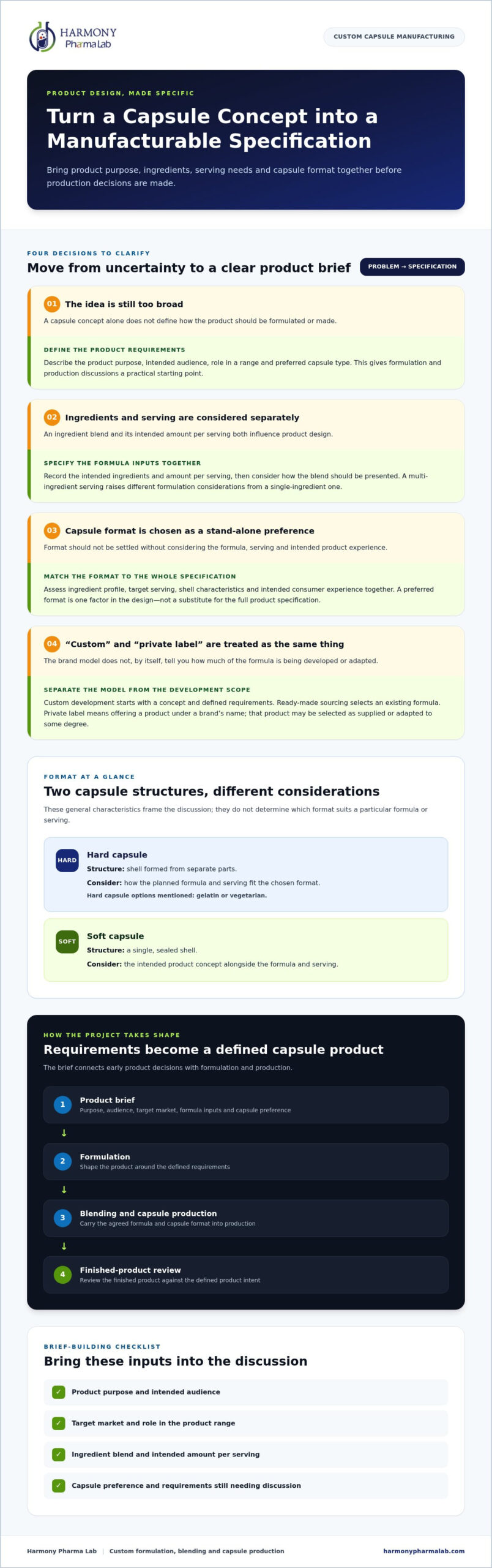
A capsule concept is not yet a manufacturable product. Custom capsule manufacturing connects a brand’s ingredient and serving goals with a defined formula, suitable capsule format and production plan. It starts with the product requirements, rather than simply selecting a standard or private-label option.
That distinction matters because the ingredient blend, amount per serving and preferred capsule type all influence product design. A useful brief brings these requirements together early, helping the brand identify decisions that are settled and those that still need discussion. For supplement brands in Singapore, clear specifications are central to moving a concept toward production.
This guide explains the main stages, from product brief and formulation through blending and capsule production. It also outlines the specifications that shape capsule design, including serving requirements and the choice between hard gelatin, vegetarian or soft capsules. You’ll learn how to prepare a manufacturing-ready brief and what information helps align product intent with production requirements. Harmony Pharma Lab supports B2B supplement brands and wholesale distributors through custom formulation, blending and capsule production, connecting early product decisions with a defined commercial product.
Key Takeaways
- Distinguish a product developed around your specifications from a ready-made formula selected for your brand.
- Use ingredient characteristics, serving needs and product positioning to guide capsule format decisions.
- Understand how custom capsule manufacturing moves from defined requirements through blending and encapsulation to finished-product review.
- Organise your brief around product purpose, intended audience, target market, formula inputs and capsule preference.
- See how Harmony Pharma Lab supports supplement brands and wholesale distributors with custom formulation, blending and soft or hard capsule production.
What Custom Capsule Manufacturing Means for Supplement Brands
Custom capsule manufacturing produces a supplement according to a brand’s defined product specifications. Those specifications may cover the formula, serving amount, capsule format and other requirements that shape how the product is developed and made.
Custom capsule manufacturing turns a brand’s product requirements into a defined capsule product, while ready-made supplement sourcing selects from formulas that already exist. A custom project begins with a product concept and defines requirements to guide formulation and production. Ready-made sourcing starts with an existing product, even if the brand applies its own presentation or positioning.
Capsules differ in structure and materials. A general overview of hard- and soft-shelled types is available in Capsule (pharmacy). For a supplement brand, format is one part of the product decision, alongside the formula and intended serving.
Custom capsule manufacturing versus ready-made and private-label products
Ready-made sourcing involves selecting an established formula rather than defining its requirements from the outset. Custom development starts with a brand’s concept and shapes product choices around it. The scope of adaptation can vary, so “custom” describes a project tailored to specified needs, not one fixed package of services or outcomes.
Private label describes a business model in which a product is offered under a brand’s name. It doesn’t automatically mean the formula is fixed or that extensive customization is involved. A private-label product may be selected as supplied or adapted to some degree. To distinguish the model from the development scope, identify which product decisions are already set and which are being defined for the project.
Which supplement brands use custom capsule production?
Custom capsule production can suit brand owners developing a new supplement or expanding an existing range, as well as wholesale distributors developing products for their business needs. A clear concept gives formulation and production discussions a practical starting point. It might describe the intended audience, the product’s role in a range or a preferred capsule type.
Brand size alone doesn’t determine suitability. The more useful question is whether the product requirements can be clearly described and translated into a workable specification. A focused concept brings those requirements into view. The next step is to consider how ingredients, serving needs and capsule format shape the product.
Harmony Pharma Lab is a Singapore-based B2B contract manufacturer supporting supplement brands and wholesale distributors with custom formulation, blending and capsule production. Its capsule formats include soft capsules and hard gelatin or vegetarian capsules. This coordinated approach links the product concept to a defined formulation and capsule format, keeping the project centred on the brand’s requirements.
How Formula, Ingredients, and Capsule Format Shape a Custom Product
Capsule format is a design decision, not a detail to settle after the formula. Ingredient characteristics and the target serving affect what needs to fit into each capsule, while product positioning influences the experience the brand intends to offer. Consider these factors together to create a product specification that can guide formulation and production. A broader supplement dosage form selection guide can help brands compare capsule options with other formats.
For example, a serving that combines several ingredients raises different formulation considerations from one built around a single ingredient. Useful questions include how much of each ingredient is intended, how the blend should be presented and whether the preferred format aligns with the product concept. The specification should capture these aims without assuming that one capsule type will suit every formula.
Hard capsules and soft capsules serve different product concepts
Hard capsules and soft capsules are distinct formats, each with structural characteristics that may suit different product concepts. Hard capsules have a shell with separate parts, while soft capsules use a single, sealed shell. These broad distinctions help frame early discussions, but they don’t determine which format suits a particular ingredient blend or serving. The hard capsule manufacturing buying guide and soft capsule manufacturing guide cover each format in more detail.
| Format | General characteristic | Product specification consideration |
|---|---|---|
| Hard capsule | Shell formed from separate parts | Consider how the planned formula and serving fit the chosen format. |
| Soft capsule | Single, sealed shell | Assess the intended product concept alongside the formula and serving. |
Match capsule specifications to the intended product
Capsule format should follow the product specification, not stand alone as a preference. Evaluate the ingredient profile, target serving, shell characteristics and intended consumer experience together. If a brand’s concept prioritises a particular serving amount or format, consider that preference alongside the proposed blend rather than treating each as a separate decision.
Product positioning helps clarify priorities. A brand may be developing a capsule for a defined audience or adding a product to an existing range. In either case, the intended use and presentation can inform format discussions. Record essential requirements separately from preferences, so the development conversation can focus on how each choice aligns with the formula.
Standards references can also inform how brands think about supplement quality expectations. The USP Dietary Supplement Standards page explains USP’s role in dietary supplement standards and related programmes. For project planning, bring the relevant ingredient, serving and format requirements together before formulation discussions. Harmony Pharma Lab’s custom formulation and capsule production connects these decisions through a coordinated development and manufacturing process.
What Happens During Custom Capsule Manufacturing?
Custom capsule manufacturing moves from an agreed product concept to a defined production specification, then through blend preparation and encapsulation. Each stage depends on earlier decisions: the formula and serving requirements shape the blend, while the selected capsule format guides how that blend is filled. The general progression is:
- Approve the product requirements. Document the intended formula, serving, capsule format and other essential product characteristics. Agreed requirements give formulation and production discussions a shared reference point.
- Translate the brief into production specifications. Turn the product requirements into practical instructions for making the batch. These may define the ingredients and their intended proportions, serving expectations, capsule type and relevant identification details. Resolve gaps or changes at this stage to keep later decisions aligned.
- Prepare the ingredients and blend. Organise the ingredients according to the agreed formula and combine them into a capsule blend. The formula and production instructions guide this stage.
- Encapsulate the prepared material. Place the blend into the selected capsule format. The approved requirements guide filling and keep production aligned with the intended product and serving.
- Identify and review the batch. Batch identification links the production run to its defined specifications. A finished-product review considers the product against the agreed requirements. The review should be defined for the project, including any specific tests or certifications that are required.
From product specification to prepared capsule blend
The specification connects formulation decisions to the ingredients prepared for production. It gives the blending stage a reference for what belongs in the product and how the components relate to the intended serving. At a high level, blending aims to distribute the formula components through the batch. When preparing a brief, make sure the ingredient list, intended proportions and serving expectations are clear enough to guide this work.
Encapsulation and batch consistency
During encapsulation, prepared material is placed into the selected capsule format according to the production requirements. Consistent specifications give each capsule batch a defined reference for dosing, identification and review. Carrying agreed requirements through each stage supports consistent expectations across production runs. Harmony Pharma Lab provides custom formulation, blending and capsule production, with an emphasis on precise dosing and batch consistency.
Keep the product specification clear and define the project’s review requirements. This helps connect the general manufacturing stages to the specific product being developed.
How to Prepare a Clear Brief for a Custom Capsule Project
A useful project brief turns an initial product idea into inputs that can guide formulation discussions. It doesn’t need to resolve every technical question. It should make the product’s purpose clear, record what the brand knows and distinguish firm requirements from preferences that still need discussion. For custom capsule manufacturing, this clarity keeps product decisions connected, rather than treating ingredients, serving and format as unrelated choices.
Define the product and its intended market
Start with a plain-language description of the product and the role it is intended to play in the brand’s range. Identify the intended audience and describe the intended use without making medical claims. For example, a brief might state that the product is intended for adults as part of a daily wellness range, if that accurately reflects the concept. Keep this description focused on positioning, not promises about health outcomes.
Record where the finished supplement is expected to be sold. A product intended for Singapore may have different market considerations from one also planned for sale overseas. List each target market separately and flag its applicable regulatory or labelling requirements for review. Don’t assume one market’s rules apply globally. This makes market research a distinct task rather than treating the brief as a regulatory assessment.
Organize formula and capsule requirements
Group the technical inputs so the development conversation can distinguish known information from open decisions. A concise brief can include:
- Formula inputs: ingredients under consideration, established formula information and any ingredient exclusions or preferences.
- Serving expectations: the intended amount per serving and any serving-related requirements already defined.
- Capsule preference: hard or soft capsule preference, plus any relevant shell preference. Mark each as preferred or essential.
- Product positioning: the intended audience, place in the range and desired consumer experience, expressed in practical terms.
- Project scope: packaging or launch considerations only if they are part of the project being discussed.
Separate facts from assumptions. If an ingredient amount is still under consideration, label it provisional rather than presenting it as final. If capsule type is a preference, say so. This makes unresolved choices visible and helps prevent an early idea from being mistaken for an approved specification. It also gives the formulation discussion room to consider how the inputs work together.
Keep the brief concise and revise it as decisions develop. A clear document doesn’t predetermine a formula, capsule design, timeline or production outcome. It creates a shared starting point for evaluating the project’s requirements. For brands preparing a capsule concept, discuss your formulation and capsule project with Harmony Pharma Lab, whose B2B work includes custom formulation, blending and capsule production.
How Harmony Pharma Lab Supports Custom Capsule Manufacturing
Harmony Pharma Lab is a Singapore-based B2B contract manufacturer working with supplement brands and wholesale distributors. It supports the development of defined supplement products through formulation, blending and capsule production. For brands, this connects product requirements with manufacturing in a coordinated project discussion.
Custom capsule capabilities for supplement brands
Harmony Pharma Lab provides custom formulation, blending and production of soft capsules and hard capsules. Hard capsule options include gelatin and vegetarian capsules. These formats give brands different starting points for product planning, while formulation and serving requirements help shape the project specification. The right decisions depend on the product concept and its stated requirements, not on a general claim that one format is preferable.
The company’s B2B focus serves businesses developing or expanding a supplement range. A wholesale distributor may bring a product concept for its market, while a brand owner may be defining a new formulation or refining an existing idea. In both cases, a useful discussion starts by making the intended formula, serving and capsule preference clear enough to consider together.
Harmony Pharma Lab places emphasis on precise dosing and batch consistency. Defined requirements provide a reference for formulation and production discussions, while consistency remains an important consideration across batches. The project brief, formulation and production requirements all inform how these objectives are approached.
Move from a defined concept to a production discussion
Before an initial discussion, assemble the information already available. A concise brief can state the product’s purpose, intended audience and target market, then distinguish confirmed inputs from open decisions. Include known ingredient information and serving expectations, and state whether a hard or soft capsule is preferred or essential. If packaging or launch considerations are part of the project, record them separately so they don’t obscure the core product requirements.
Not every technical choice needs to be settled before a project discussion. Identifying what is known, what remains undecided and what needs further consideration creates a practical basis for exploring the product concept. For example, document a preferred capsule type as a preference while leaving the final formulation and related production requirements open for discussion.
For supplement brands and wholesale distributors considering custom capsule manufacturing, Harmony Pharma Lab brings custom formulation, blending and capsule production into one B2B project context. Share your product brief and known specifications to discuss a custom capsule project with Harmony Pharma Lab.
Move Your Capsule Concept Forward
A product concept is easier to advance when its priorities are explicit. Before the next development conversation, decide what matters most to your brand: a specific ingredient profile, a defined serving, a preferred capsule format or a balance among them. That priority gives the project a practical focus when technical decisions need to be considered together.
Keep a short record of decisions as they develop. Note what is settled, what remains open and why each preference matters to the intended audience. This creates continuity between the original idea and later discussions, while leaving room for formulation and production considerations to inform the final specification. Clear priorities help turn discussion into considered next steps without assuming the product is already fully resolved.
Harmony Pharma Lab works with supplement brands and wholesale distributors on capsule projects. Discuss your custom capsule manufacturing project with Harmony Pharma Lab and take the next step with a clear brief and considered product direction.
Frequently Asked Questions
What is custom capsule manufacturing?
Custom capsule manufacturing produces supplement capsules to a brand’s defined product requirements. These can include the intended formula, serving, capsule format and target market. For example, a brand may have a product concept and ingredient list but still need to clarify its preferred capsule type or serving expectations. Recording those details helps turn an idea into a specification that can guide manufacturing discussions.
What is the difference between custom capsule manufacturing and private label?
Custom manufacturing focuses on making a product to defined brand requirements, while private label refers to offering a product under a brand’s name. The terms can overlap: a private-label project may involve adaptation, while another may use an existing formula with little change. To understand the distinction in a specific project, identify which formula and product decisions are established and which are being developed around the brand’s concept.
Can an existing supplement formula be used for custom capsule manufacturing?
An existing formula can provide a starting point, but it doesn’t automatically establish production readiness. Gather the ingredient list, serving information and any available formulation documents, then distinguish confirmed details from assumptions. For instance, a formula may specify ingredients but leave the preferred capsule format undecided. Reviewing those gaps clarifies what needs discussion before production planning, without presuming the formula can be used unchanged.
How is the minimum order quantity for custom capsules determined?
Minimum order quantities vary by project, so there isn’t one figure that applies to every capsule product. The formula, selected capsule format, production setup and packaging scope can all affect quantity planning. When comparing project options, consider the expected run alongside the product specification and launch plans. Treat quantity as project-specific rather than assuming a threshold from another product or manufacturing arrangement will apply.
How long does custom capsule manufacturing take?
The timeline depends on the project’s readiness and the decisions or work still required. An established formula with settled specifications may involve a different sequence from a concept that needs further formulation development. Ingredient planning, capsule-format decisions, production scheduling and market-specific documentation can also affect timing. A project brief helps identify the relevant dependencies and outstanding inputs.
Are capsules suitable for every supplement ingredient?
No. Capsule suitability depends on the full product specification, including the ingredient profile, amount per serving and selected format. A proposed blend may need further consideration if the serving requirements or product experience don’t align with the initial capsule preference. Treat the ingredient list and capsule choice as connected decisions, rather than assuming every ingredient or formula can be accommodated in any capsule type.
What information should a brand prepare before discussing custom capsule production?
Prepare a short description of the product concept, its intended audience and target markets, plus any known ingredient and serving information. Include available formula documents and state whether a capsule preference is fixed or flexible. Separate confirmed requirements from open questions. For example, identify an overseas sales plan as a target market so its regulatory and documentation considerations can be addressed separately.