

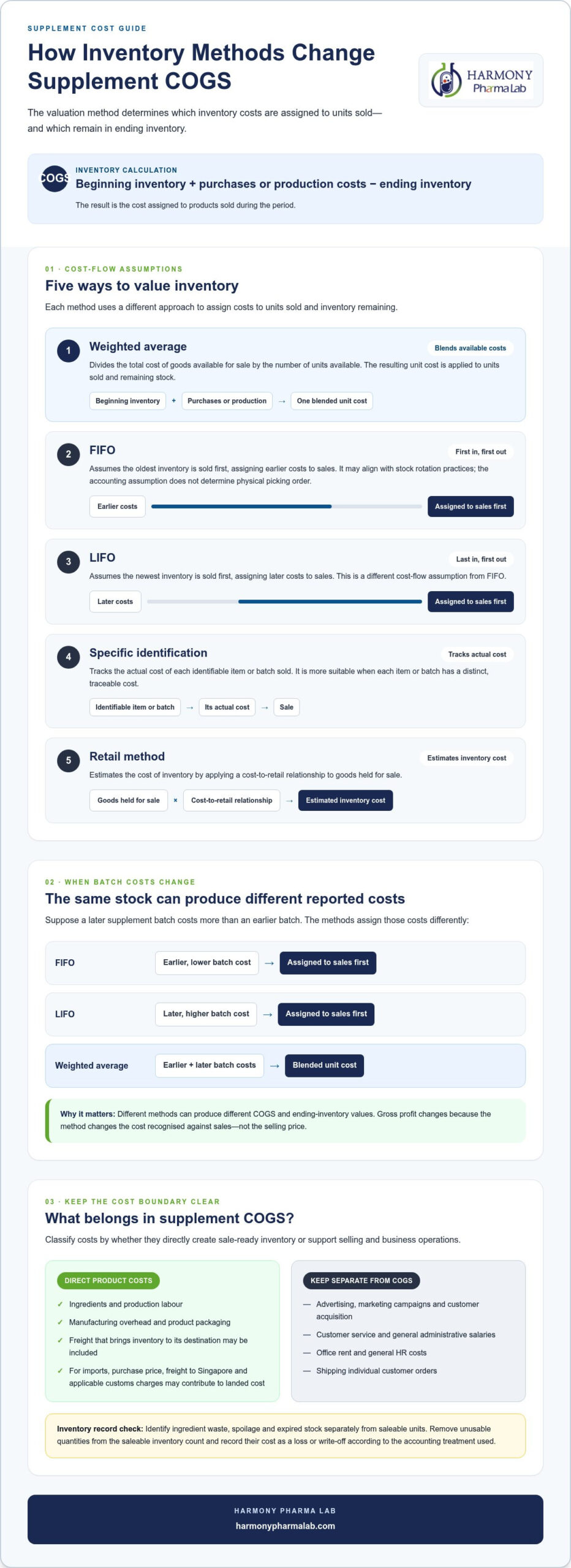
Your supplement margin depends on which inventory costs you count and when they enter COGS. To understand how to calculate supplement cost of goods sold, add beginning inventory to purchases or production costs, then subtract ending inventory. The result is the cost assigned to products sold during the period.
This calculation clarifies the gap between sales revenue and the direct costs of making supplements. Ingredients, direct production labour and manufacturing overhead can contribute to COGS, while sales and marketing expenses are generally treated separately. Keeping these categories distinct makes product margins more useful for business decisions.
This article explains what supplement COGS includes and how the inventory formula works. It also compares average cost, FIFO and LIFO, showing how each method can assign different costs to products sold and affect reported gross margin. Consistent methods and accurate inventory records make it easier to interpret product performance as costs and stock change.
Key Takeaways
- Distinguish costs directly tied to producing supplements from selling and administrative expenses to keep COGS meaningful.
- Use beginning inventory plus purchases, less ending inventory, to calculate the cost assigned to products sold during a period.
- Understand how average cost blends the costs of available stock, while FIFO and LIFO assign costs using different inventory assumptions.
- Apply one inventory valuation method consistently, since the method can change reported COGS and gross margin as costs shift.
- Compare gross profit with sales revenue to assess product margin and support clearer pricing and production decisions.
What Is Cost of Goods Sold (COGS)?
For supplements, COGS is the direct cost of producing or acquiring sale-ready inventory that is assigned to units sold during a period.
Direct Production and Packaging Costs
Direct production and packaging costs are traceable to making a supplement ready for sale. Recording them consistently shows how much each product costs before sales and operating expenses affect profit. Ingredient inputs, production labour, manufacturing overhead and product packaging can contribute to COGS. Freight that brings inventory to its destination may also be included, while delivery to customers is generally excluded.
For example, separate a batch’s ingredient and production costs from office payroll, then allocate the production costs across the units made. Include product packaging when it is part of preparing those units for sale, but leave general administrative supplies out. This distinction identifies the direct cost assigned to each supplement instead of blending production costs with general business activity.
For imported supplements in Singapore, landed cost combines the purchase price, freight to Singapore and applicable customs charges, along with other costs directly attributable to bringing stock to a sale-ready condition. Document each component so you can allocate the total landed cost to inventory consistently. Do not include shipping individual orders to customers.
Track Singapore GST separately from product and freight costs. Include import GST in inventory cost only when it is not recoverable under the business’s applicable GST treatment. Otherwise, record it separately from COGS. This prevents recoverable tax from being treated as a product input and keeps cost records clear.
Costs Excluded from COGS
Costs excluded from COGS support selling or running the business rather than directly creating sale-ready inventory. Separating them matters because they reduce operating profit but are not part of the product cost used to calculate gross profit. Advertising, marketing campaigns, customer acquisition, customer service and general administrative salaries are examples of operating expenses.
For instance, an advertisement that attracts a supplement buyer does not change the ingredient or production cost of the unit sold. Record the campaign as a selling expense and compare it with revenue separately from COGS. The same applies to office rent and general HR costs: they support operations but are not direct production expenses.
Supplement COGS covers direct product costs, operating expenses cover selling and administrative activity, and gross profit is sales revenue minus COGS. To calculate supplement cost of goods sold accurately, classify costs by their relationship to production and keep customer acquisition and other operating costs separate.
Average cost method
Average cost assigns a blended unit cost to inventory acquired or produced at different costs. For supplement brands, it smooths cost changes across available stock, so inventory valuation depends less on which batch is sold first.
The weighted-average calculation divides the total cost of goods available for sale by the number of units available. “Goods available” combines beginning inventory and current purchases or production; the resulting unit cost is applied to units sold and remaining stock. For example, if two supplement batches have different ingredient costs, this method blends those costs rather than tracing each sale to one batch.
Businesses can value inventory using several methods, each based on a different assumption:
- Weighted average: Combines costs across available units into a single average unit cost.
- FIFO: Assumes the oldest inventory is sold first, assigning earlier costs to sales.
- LIFO: Assumes the newest inventory is sold first, assigning later costs to sales.
- Specific identification: Tracks the actual cost of each identifiable item or batch sold.
- Retail method: Estimates inventory cost by applying a cost-to-retail relationship to goods held for sale.
These methods can produce different COGS and ending-inventory values when supplement input costs change. For instance, if a later batch costs more than an earlier one, FIFO generally assigns the earlier cost to units sold first. LIFO assigns the later cost first, while weighted average blends both. Gross profit changes because the method changes the cost recognised against sales, not the selling price.
Choose a method that fits your stock and cost records, then apply it consistently across reporting periods. Average cost suits interchangeable inventory when tracing costs batch by batch is impractical. Specific identification is more suitable when each item or batch has a distinct, traceable cost. FIFO may align with stock rotation practices, while LIFO reflects a different cost-flow assumption. These accounting assumptions do not determine the physical order in which stock is picked.
Identify ingredient waste, spoilage and expired stock in inventory records, separately from saleable units. Remove unusable quantities from the saleable inventory count, then record their cost as a loss or write-off according to the accounting treatment used. This prevents expired supplement stock from inflating the units available for the average-cost calculation.
Review batch records, purchase costs and stock adjustments together before calculating the average. A consistent unit count matters: including expired products or excluding usable stock can distort both the blended cost and ending inventory. Documenting adjustments makes reported COGS easier to explain and compare across periods.
Beginning inventory, purchases, and ending inventory formula
The core calculation is COGS = beginning inventory + purchases − ending inventory. It assigns the cost of inventory sold during a defined accounting period rather than treating every purchase as an immediate product cost. For a supplement business, use consistently measured inventory values and purchases attributable to goods available during that period.
Beginning inventory is the value of stock held at the start of the period. An established business uses the previous period’s ending inventory as its beginning figure. A new business with no opening stock can enter zero. Purchases include inventory acquired during the period, while ending inventory is the value of unsold stock at period-end.
- Set the period. Use the same start and end dates for the inventory records, purchases, and sales being analysed.
- Record beginning inventory. Carry forward the prior period’s closing value, or use zero for a new business with no opening stock.
- Add eligible purchases. Include the costs of inventory acquired for sale during the period.
- Subtract ending inventory. Value the stock still held and saleable at the period’s close.
For example, suppose a supplement business starts with stock, buys additional inventory and still has unsold units at period-end. Add the opening value to purchases, then deduct the closing value. The remainder is COGS for that period. If ending inventory is understated, calculated COGS rises; if it is overstated, calculated COGS falls.
Keep the calculation aligned with your inventory records. A purchase belongs in the period when the business recognises the inventory under its accounting approach, not simply when payment occurs. Record returns, damaged goods and stock adjustments consistently, as each can change the purchase total or closing inventory value. The inventory valuation method also affects these figures.
For bundles, subscriptions and multipacks, identify the supplement units included in orders during the period, then assign their inventory costs using the chosen valuation method. For a bundle containing different products, allocate the cost of each included unit to the sale; a multipack uses the combined cost of its component units. For subscriptions, count products fulfilled during the period, not future scheduled deliveries.
Keep the unit of account consistent across sales and inventory records. If your system records a multipack as one saleable item, its COGS should reflect the combined cost of its contents. If it records each supplement unit separately, aggregate the component costs for the relevant order. This consistency makes the formula useful for comparing sales, stock and product profitability across reporting periods.
Defining supplement product margin
Product margin compares supplement sales revenue with the COGS assigned to units sold. This helps brands assess whether producing and selling a product supports their commercial objectives.
Product Margin and Gross Profit
Gross profit is sales revenue minus COGS, while gross margin expresses that profit as a share of revenue. Calculate gross margin as (sales revenue − COGS) ÷ sales revenue × 100. The COGS ratio is COGS ÷ net sales × 100. These related measures show the portion of revenue absorbed by product costs and the portion remaining after those costs.
For a supplement line, compare net sales for a period with the COGS assigned to units sold during that same period. If a product’s COGS rises while its selling price stays unchanged, gross profit falls. If sales revenue changes while COGS stays steady, the margin changes through the revenue side instead.
Why COGS Matters
COGS links inventory valuation directly to reported gross profit. A change in the cost assigned to sold stock can alter margins even when the product’s sales price and sales volume stay stable. Accurate costing therefore matters when assessing a supplement’s performance, reviewing prices or comparing product lines.
Use the calculation to separate product economics from operating expenses such as advertising and customer acquisition. For example, a campaign can increase selling costs without changing the direct cost assigned to supplements sold. Reviewing gross profit alongside marketing expenses clarifies how product costs and selling activity each affect overall profitability.
Typical COGS Percentages and Gross Margins
Typical COGS percentages and gross margins vary with a supplement’s ingredients, manufacturing requirements, packaging, sales channel and selling price. A formula with higher-cost inputs can have a different COGS ratio from a simpler product, even when both brands use the same calculation. Evaluate the figures against each product’s own cost structure.
Compare like with like: use the same product, channel and accounting period when reviewing margin changes. A direct-to-consumer sale and a wholesale sale can generate different revenue per unit, while production costs may remain similar. That difference changes gross margin, so comparisons across channels need channel-specific sales revenue and consistently valued COGS.
Use the COGS ratio to see how much of net sales is represented by product costs, and gross margin to assess what remains after COGS. Neither measure includes all operating expenses. A supplement can show positive gross profit while advertising, administration and other operating costs reduce overall profit.
For a practical review, calculate both measures for each supplement line, then compare them across reporting periods. Investigate whether a margin change came from sales revenue, inventory costs or the valuation method. This helps distinguish a change in selling performance from a change in the costs assigned to products sold.
FIFO and LIFO assumptions
FIFO and LIFO are inventory cost-flow assumptions for assigning costs to products sold and stock remaining. FIFO assumes the oldest inventory is sold first; LIFO assumes the most recently produced or purchased inventory is sold first. When supplement batches have different costs, the selected method affects reported COGS and ending inventory.
These assumptions concern accounting, not necessarily warehouse picking. A business may physically dispatch a newer batch first while applying FIFO to its cost records. Keep the chosen method consistent across reporting periods so changes in reported margin reflect business activity rather than a switch in cost assignment.
- FIFO: Assign earlier batch costs to sales first, leaving newer costs in ending inventory.
- LIFO: Assign newer batch costs to sales first, leaving earlier costs in ending inventory.
- Weighted average: Blend the costs of available inventory into an average unit cost.
Consider a supplement brand that buys the same product in two batches at different unit costs. Under FIFO, the earlier batch’s cost is assigned to sales first. Under LIFO, the later batch’s cost is assigned first. The remaining units receive the costs associated with whichever batch remains under each method.
When batch costs rise over time, FIFO generally produces lower COGS and higher gross profit than LIFO because it assigns the older, lower costs to sales first. LIFO generally assigns newer, higher costs to sales, producing higher COGS and lower gross profit. If costs fall, these effects generally reverse. The actual result depends on the cost sequence and units sold.
Ending inventory also differs under each assumption. With rising costs, FIFO leaves newer, higher costs in stock; LIFO leaves older, lower costs. Because ending inventory is subtracted in the COGS formula, its valuation affects the current period’s reported cost. The method therefore influences both the income statement and the inventory value carried forward.
For a practical comparison, map each supplement batch’s purchase or production date, quantity and recorded cost. Apply FIFO and LIFO to the same units sold, then compare COGS, ending inventory and gross profit. This isolates the effect of the assumption from changes in sales volume or selling price.
Choose the method that fits your accounting framework and inventory records, then apply it consistently. For supplements with traceable batch records, keep cost-flow assumptions distinct from expiry management and physical stock rotation. A clear method helps explain why reported margins move when input costs change, even if product prices remain steady.
For brands assessing how production decisions shape batch costs, explore supplement production options as part of planning future inventory.
Harmony Pharma Lab: Soft Capsule
Harmony Pharma Lab supports supplement brands with B2B production, including Soft Capsule manufacturing. For brands assessing COGS, aligning the chosen format with production planning helps make direct product costs easier to identify and track across inventory batches.
Harmony Pharma Lab manufactures Soft Capsule, Gummies, Hard Capsules, Powder, Liquid and Tablet products for supplement brands. These formats give brands different production options when developing or expanding a supplement portfolio. Clear records of production inputs and inventory costs help connect manufacturing decisions with the COGS and margin calculations discussed above.
Contact Harmony Pharma Lab to discuss supplement manufacturing for your brand.
Build the Next Product Decision on Clear Costing
Use your costing approach when planning a new supplement or refining an existing product. Understanding how to calculate supplement cost of goods sold connects production choices with the inventory records you will use to assess product performance. Before setting a product plan, consider how the selected dosage format and production requirements will appear in your cost tracking.
Harmony Pharma Lab offers Soft Capsule, Gummies and Hard Capsule manufacturing for supplement brands. Matching a format to your product concept is a practical starting point for aligning manufacturing plans with inventory tracking and product economics.
Bring your next product concept into focus with a discussion about its format and production requirements. Discuss your supplement production plans with Harmony Pharma Lab, and take the next step toward a clearly costed product plan.
Frequently Asked Questions
Are Salaries Included in COGS?
Production salaries can be included when employees work directly on manufacturing supplements. For example, labour involved in blending ingredients or operating production equipment may be allocated to the products made. Salaries for sales, finance, human resources and general administration are operating expenses instead. Use job duties and production records to distinguish direct manufacturing labour from roles supporting the wider business.
How Does Inventory Affect COGS?
Inventory determines which product costs are recognised as COGS during a reporting period and which remain on the balance sheet as unsold stock. A stock count can reveal items sold, returned, damaged or still available. For example, if a batch remains unsold at period-end, its cost is generally carried in ending inventory rather than assigned to that period’s sales. Accurate counts help prevent distorted margins.
What Are the Different Accounting Methods for COGS?
Common inventory cost methods include FIFO, LIFO, weighted average, specific identification and the retail method. FIFO assigns older inventory costs to sales first, while LIFO assigns newer costs first. Weighted average blends costs across available stock, and specific identification tracks individual items or batches. The retail method estimates inventory cost using the relationship between cost and retail value. Apply the selected approach consistently.
What Costs Are Included in Cost of Goods Sold for Supplements?
Supplement COGS can include ingredients, direct production labour, manufacturing overhead and costs directly associated with bringing inventory into sale-ready condition. For example, ingredient inputs and production-related factory utilities may be connected to manufacturing. Classify each cost according to its relationship to creating inventory, not simply whether it appears on a supplier invoice. Advertising, customer service and general office costs are normally operating expenses.
How Do You Calculate Supplement COGS per Bottle or Unit?
Calculate total COGS for the period, then divide it by the number of saleable units represented by that cost. For a bottle calculation, use a consistent unit definition, such as one finished bottle, and include the costs allocated to its production. If a batch contains different products, separate their costs before dividing. The result is an accounting unit cost, not a retail price.
Should Supplement COGS Include Packaging, Labels, and Shipping?
Packaging and labels used to make a supplement ready for sale can be included as direct product costs. Freight that brings inventory to its destination may also form part of inventory cost, while delivery to customers is generally treated separately. Distinguish freight for incoming stock from postage for an individual customer order. This avoids mixing production costs with fulfilment expenses.
How Should Manufacturing Labour and Contract Manufacturing Fees Be Allocated to Supplement COGS?
Allocate direct manufacturing labour and production-related contract fees to the products or batches they support. A practical basis might be documented production hours, batch quantities or another consistent measure that reflects resource use. Separate costs directly tied to manufacturing from general administration or sales support. For contract production, keep batch records and invoices aligned so the allocated cost follows inventory into COGS when units are sold.