

The format that looks most appealing to customers may not be the right fit for the ingredients or serving size. Effective supplement dosage form selection starts with feasibility: the ingredients, target serving, and intended use must work in the chosen format before you optimize taste, convenience, and brand positioning.
It’s understandable to focus first on how customers will take a supplement. But choosing a format too late can create avoidable development challenges if the ingredients or serving don’t suit the concept. A structured comparison helps you balance the product experience with practical formulation and production requirements.
This guide provides a repeatable framework for assessing soft capsules, hard capsules, tablets, gummies, powders, and liquids. You’ll compare how ingredient characteristics and serving size influence format fit, then weigh preparation, sensory experience, and brand priorities. Finally, you’ll identify manufacturing questions to address early, so your brief connects ingredient requirements, customer expectations, and production feasibility before the format is set.
Key Takeaways
- Start supplement dosage form selection with the product brief, so ingredient and serving requirements guide the initial choice.
- Compare capsules, tablets, gummies, powders, and liquids by preparation, serving experience, and formulation considerations rather than treating formats as interchangeable.
- Screen ingredient properties, target serving, frequency, taste, and stability before weighing consumer convenience and brand positioning.
- Use a scorecard weighted to your product’s priorities to document trade-offs instead of relying on general format popularity.
- Turn the preferred format into a manufacturing-ready brief that records requirements and unresolved technical questions.
Supplement Dosage Form Selection Starts With the Product Brief
A dosage form is the physical format used to deliver a measured serving of a supplement. Capsules, gummies, tablets, powders, and liquids are dosage forms; a bottle, pouch, or blister pack is packaging. The distinction matters because the dosage form affects how the product is formulated and used, while its container holds and presents the finished product. The Dietary supplement overview also describes common formats, including capsules, tablets, powders, and liquids.
Format decisions have practical effects beyond appearance. They influence how ingredients are combined, how a serving is taken, and which packaging options may suit the product. They also contribute to positioning: a ready-to-take format creates a different use experience from a powder that needs to be prepared. Since these considerations are connected, don’t select a format on consumer appeal alone.
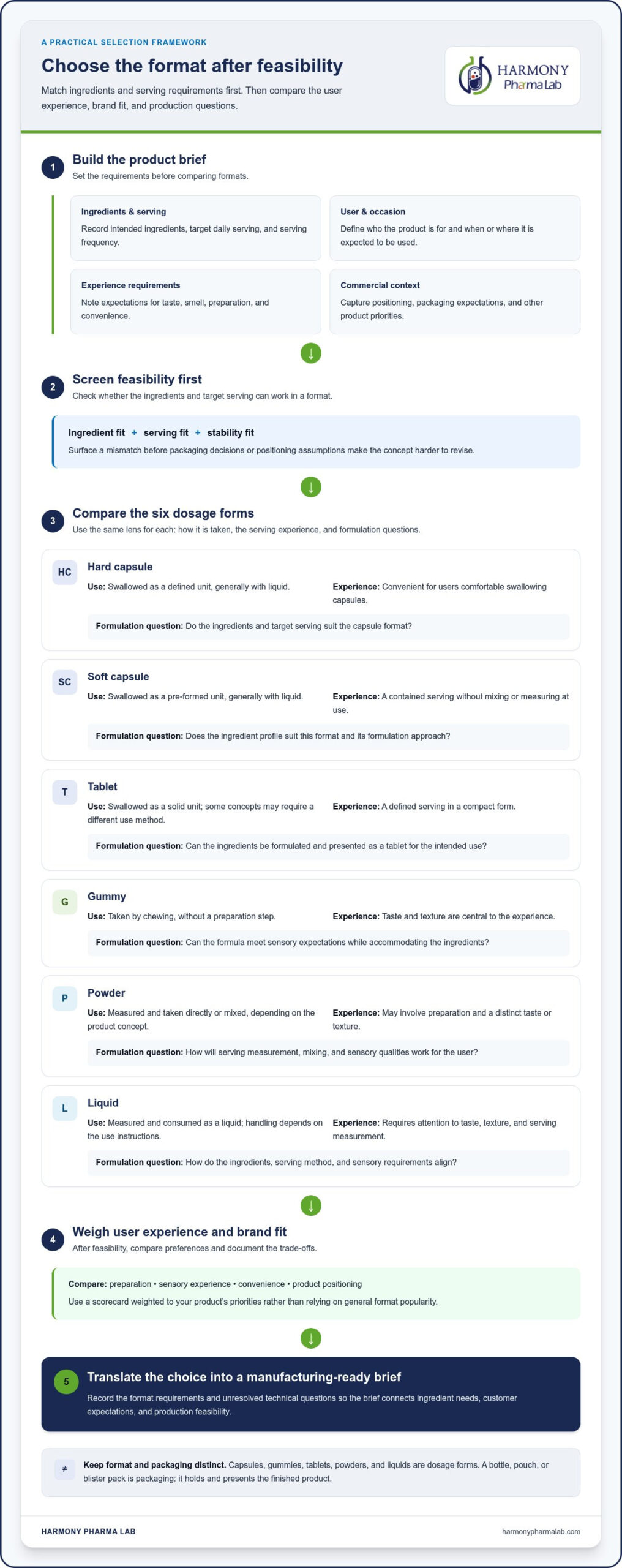
Start by testing whether the ingredients and target serving can work in a format. Once you understand feasibility, compare user experience and brand fit. This order can surface a mismatch early, before packaging decisions or positioning assumptions make the concept harder to revise.
Separate dosage form from packaging and product concept
A product concept describes what the supplement is intended to deliver and who it is for; the dosage form is how the measured serving is presented for use. A bottle is not a dosage form, just as a pouch does not determine whether its contents are powder or another format. Keeping these decisions separate lets your team compare alternatives without treating a container or visual direction as a technical choice.
For example, a brand developing a daily nutrient concept could assess a tablet, capsule, or powder for the same intended user and occasion. Each option brings different formulation and serving considerations. That comparison belongs in product development, not just in a final label-design exercise. Packaging can be evaluated once the preferred format and product requirements are clearer.
Set the decision criteria before comparing formats
Write down the requirements that will determine whether an option is viable. This makes comparisons more consistent and separates essential constraints from preferences that could be adjusted. Include commercial context alongside formulation and user needs, because the format must support a coherent product concept from development through production.
- Ingredients and serving: Record the intended ingredients, target daily serving, and serving frequency.
- User and occasion: Define who the product is for and when or where it is expected to be used.
- Experience requirements: Note expectations for taste, smell, preparation, and convenience.
- Commercial constraints: Capture positioning, packaging expectations, and other priorities without assuming one format suits every brand.
Use this brief as the basis for the next stage of supplement dosage form selection: screen ingredient, serving, and stability fit before weighing preference or market appeal. A clear starting point also makes trade-offs easier to document and gives formulation and production discussions a practical direction.
How Capsules, Tablets, Gummies, Powders, and Liquids Differ
Each format creates different formulation and use considerations. Compare them using the same criteria: how the serving is taken, whether preparation is needed, what sensory experience it creates, and which formulation questions need review. These are screening prompts, not universal performance claims. Suitability depends on the ingredients, serving target, and finished formulation.
| Format | Use and preparation | Serving experience | Formulation questions |
|---|---|---|---|
| Hard capsule | Swallowed as a defined unit, generally with liquid. | Convenient for users comfortable swallowing capsules. | Do the ingredients and target serving suit the capsule format? |
| Soft capsule | Swallowed as a pre-formed unit, generally with liquid. | A contained serving without mixing or measuring at use. | Does the ingredient profile suit this format and its formulation approach? |
| Tablet | Swallowed as a solid unit; some concepts may require a different use method. | A defined serving in a compact form. | Can the ingredients be formulated and presented as a tablet for the intended use? |
| Gummy | Taken by chewing, without a preparation step. | Taste and texture are central to the experience. | Can the formula meet sensory expectations while accommodating the ingredients? |
| Powder | Measured and taken directly or mixed, depending on the product concept. | May involve preparation and a distinct taste or texture. | How will serving measurement, mixing, and sensory qualities work for the user? |
| Liquid | Measured and consumed as a liquid; handling depends on the use instructions. | Requires attention to taste, texture, and serving measurement. | How do the ingredients, serving method, and sensory requirements align? |
Compare capsules and tablets without assuming an absorption winner
Hard capsules typically use a shell that contains the formulation, while soft capsules enclose a prepared fill in a soft shell. Tablets are compressed solid units. These structural differences can guide early discussion, but they don’t establish which format will dissolve or be absorbed more effectively. Ingredient properties and the specific formulation matter. For additional format-specific context, review this hard capsule buying guide.
Compare gummies, powders, and liquids by use experience
Gummies are chewed, powders may need measuring or mixing, and liquids require a suitable serving method. Each choice changes how taste, smell, texture, and preparation shape the user experience. Those preferences should inform evaluation, but they don’t prove technical suitability. A gummy concept still needs a workable formula, just as a powder or liquid must suit its intended serving. Explore the gummy supplement manufacturing guide for a closer look at that format.
Use this comparison as an initial screen for supplement dosage form selection, then assess each viable option against the product brief rather than general assumptions. For brands developing a concept across formats, custom supplement formulation and production can connect ingredient and user requirements with manufacturing considerations.
Screen Ingredient, Serving, and Stability Fit Before Choosing
Once you’ve defined the product requirements, screen technical feasibility before comparing format appeal. Assess the ingredients, establish the intended serving, consider how often and how the product will be used, then flag formulation and stability questions for review. This sequence helps distinguish a format that sounds attractive from one that can support the actual product brief.
Format feasibility depends on the ingredient, serving, and intended use. Treat this as a screening principle, not a final formula assessment. A promising initial fit still needs technical development and supporting evidence before product specifications are set.
Check ingredient and serving requirements
Start with the quantity of each ingredient intended per serving, then consider the total formula rather than assessing ingredients in isolation. Several components may need to fit within one daily serving, and their physical properties or handling needs may affect how they can be combined. For example, a strongly flavoured or aromatic ingredient may raise sensory questions in a format where taste is part of the experience.
Next, compare the target serving with the proposed use pattern. A once-daily serving presents a different design brief from one taken in portions throughout the day. Don’t rely on generic claims about how much a capsule, tablet, gummy, powder, or liquid can accommodate. Capacity and suitability depend on the specific ingredients and formulation design.
- Ingredient profile: Record the amount, physical properties, and any known compatibility or handling considerations for each ingredient.
- Serving design: Specify the target quantity per serving and the intended daily frequency.
- Usability: Identify whether taste, smell, texture, measuring, or preparation could affect consistent use.
These checks can narrow the options without prematurely ruling out a format. If a serving appears difficult to reconcile with the proposed use experience, record the tension as a formulation question. Then assess whether development can resolve it rather than assuming a universal format limit.
Assess stability and formulation implications
List sensitivities that may influence development, including possible exposure to moisture, light, air, heat, or interactions among formula components. Treat each as a question tied to the specific ingredient and proposed formulation. A concern should prompt evaluation, not an unsupported conclusion that a particular dosage form will protect the ingredient or deliver a defined shelf life.
Preliminary screening identifies what needs investigation; it does not establish product stability. Stability assessment requires appropriate testing and evidence for the formula and conditions being evaluated. Packaging may also become relevant, but it should not be treated as proof of protection without supporting data.
For supplement dosage form selection, keep a short record of the evidence available, open questions, and options that remain feasible. That record gives formulation discussions a practical starting point and helps your team distinguish confirmed requirements from assumptions that still need technical review.
Apply a Practical Framework to Compare Consumer and Brand Fit
With feasibility screened, compare the remaining options against the intended user and commercial concept. A consistent process keeps technical requirements distinct from preferences, so a popular format does not automatically outrank one that better fits the formula and routine. The best-fit format balances technical requirements with the experience the product is designed to provide.
- Define requirements. Summarise the ingredient profile, serving target, intended user, use occasion, and essential experience requirements in the product brief.
- Screen feasibility. Remove options that conflict with known ingredient, serving, or use requirements. Keep unresolved technical questions visible rather than treating them as settled.
- Compare experience. Assess convenience, preparation, sensory expectations, and serving instructions for each format that remains viable.
- Assess positioning. Consider whether the format supports the product’s intended audience, routine, and market identity without making technical assumptions based on appeal alone.
- Document trade-offs. Record the rationale for the shortlist, the evidence behind each assessment, and the questions that still require review.
Build a format shortlist from non-negotiable requirements
Separate required conditions from preferences before scoring. A requirement could be a serving method essential to the product concept; a preference might be a particular sensory experience that can be adjusted. Exclude formats that fail a genuine non-negotiable, then compare viable options against convenience, preparation, sensory, and packaging goals. Record assumptions and evidence gaps as open items, not technical facts.
A practical scorecard can use a simple rating, such as strong fit, needs review, or poor fit. Set each criterion’s priority from the brief: ingredient and serving feasibility may be essential, while a preferred taste profile may be important but adjustable. This keeps general market popularity from overriding product-specific needs.
- Criterion: Ingredient and serving feasibility. Priority: Required. Assessment: Supported, unresolved, or incompatible.
- Criterion: Preparation and convenience. Priority: High or moderate. Assessment: Compare with the intended routine.
- Criterion: Sensory and packaging fit. Priority: Set by the brief. Assessment: Note preferences and evidence gaps.
Connect format choice to product positioning
Evaluate how the format fits the target audience’s routine and the experience the brand intends to communicate. Consider the practical consequences for packaging and consumer instructions, such as whether the serving is taken directly, measured, or prepared. For capsule concepts, use this custom capsule manufacturing guide as a format-specific reference while weighing the brief’s requirements.
Use the completed scorecard to explain why one option leads and what trade-offs remain. Harmony Pharma Lab’s custom formulation and production can bring the product brief’s ingredient, serving, and user requirements into manufacturing discussions.
Translate Dosage Form Selection Into a Manufacturing-Ready Brief
A format decision becomes useful to product development when the reasoning behind it is captured in a clear brief. This document gives formulation and production discussions a shared reference: what the product is intended to do, who it is for, which format is preferred, and what still needs technical review. It also helps prevent early assumptions from being mistaken for confirmed specifications.
For supplement dosage form selection, the goal is not to present every detail as settled. Separate established requirements from hypotheses so the development team can see what is defined and where further assessment is needed.
Prepare a clear product-development brief
Describe the product concept, intended ingredients, target serving, audience, and use occasion in practical terms. Include format preferences and sensory goals, then record known handling or stability considerations. Mark each item as a requirement, preference, or open question. This distinction gives technical review a clear starting point and keeps early assumptions visible.
- Product and use: State the intended product concept, target user, and expected use occasion.
- Formula and serving: List intended ingredients and the proposed serving concept, including frequency where defined.
- Format and experience: Note the preferred dosage form, sensory goals, preparation expectations, and relevant packaging considerations.
- Constraints and questions: Record known ingredient or handling considerations, alongside unresolved formulation and stability questions.
For example, a brief might identify a preferred capsule format while noting that the target serving and ingredient combination still require formulation assessment. That is more useful than presenting the format as final. The brief should make the decision path clear without implying that an untested concept has already been validated.
Connect the brief with a multi-format manufacturing partner
Harmony Pharma Lab is a Singapore-based B2B contract manufacturer providing custom supplement formulation and production across soft capsules, hard capsules, gummies, tablets, powders, and liquids. This range gives brands a manufacturing perspective as they translate product requirements into a format and development plan. Scalable OEM manufacturing supports brand development, while a clear brief connects ingredient, serving, user, and production considerations.
Keep open questions specific enough to guide technical discussion. Rather than noting only “stability to assess,” record the relevant ingredient or formulation concern and the evidence still needed. Likewise, distinguish a desired sensory profile from a confirmed formulation outcome. This makes the handoff more structured and helps teams focus on the decisions that remain.
A manufacturing-ready brief is a working document, not a promise that every product detail is settled. It should capture the current direction, explain why the format is being considered, and identify what requires review before specifications are confirmed. Harmony Pharma Lab’s manufacturing capabilities span these supplement formats and support product development discussions.
Move Your Product Concept Into Development
The next step is to turn your format decision into a working development brief. Capture the requirements that are already established, identify the questions that need technical assessment, and use both to guide the next product-development discussion. This gives your team a clear basis for refining supplement dosage form selection as the concept progresses.
Harmony Pharma Lab supports supplement brands through custom formulation and scalable OEM manufacturing across soft capsules, hard capsules, gummies, tablets, powders, and liquids. A defined brief connects ingredient and user requirements with manufacturing discussions, while keeping unresolved details visible for review.
Explore Harmony Pharma Lab’s custom supplement manufacturing capabilities and take your product concept forward with a clearer development direction.
Frequently Asked Questions
How do you choose a supplement dosage form for a new product?
Choose a format by matching the formula and serving plan to a technically feasible option, then comparing how well it fits the intended routine. For example, a product designed for use away from home may need a different preparation experience from one intended to be mixed at home. Keep a shortlist and record the product-specific evidence behind each option. This makes supplement dosage form selection more grounded than relying on general format rankings.
Is one supplement dosage form absorbed better than others?
No single dosage form can be assumed to provide better absorption across ingredients. A meaningful comparison needs evidence for the specific active ingredient and finished formulation, because the format alone doesn’t establish performance. Findings for one ingredient or formula shouldn’t automatically be applied to another product. Review relevant formulation-specific data before making absorption claims or choosing a format on that basis.
Can a supplement brand offer the same formula in multiple dosage forms?
Related products may be developed in multiple formats, but each version needs its own technical assessment. Changing a capsule concept to a powder, for instance, can affect ingredient compatibility, serving presentation, flavour expectations, and directions for use. The products may share a core concept without having identical compositions or instructions. Treat each version as a separate formulation project, with its own evidence and development decisions.
What happens if the daily serving does not fit the preferred format?
If the planned daily serving isn’t practical in the preferred format, revisit the product brief rather than forcing a fit. Depending on the requirements, the team could assess another format, a different serving presentation, or an alternative formulation approach. A revised use pattern may also affect convenience and instructions. Evaluate any adjustment for ingredient compatibility and intended use before adopting it.
How much does taste influence supplement dosage form selection?
Taste can be a major consideration when consumers chew, mix, or drink a supplement, but its influence depends on the ingredients and intended experience. A pronounced flavour may make sensory assessment especially relevant for a gummy, powder, or liquid concept. Evaluate taste alongside serving size and preparation using the actual formula direction, rather than assuming a format will mask an ingredient’s flavour. Sensory goals should inform development, not replace feasibility review.
When should a brand decide on the dosage form?
Consider the dosage form during early product planning, after defining the ingredient concept and target use but before packaging and launch decisions are fixed. Early consideration gives the team room to identify constraints and compare options. The selection can remain provisional as formulation work clarifies feasibility. Documenting the reason for the preferred format also helps keep later development decisions aligned with the intended audience and use case.