
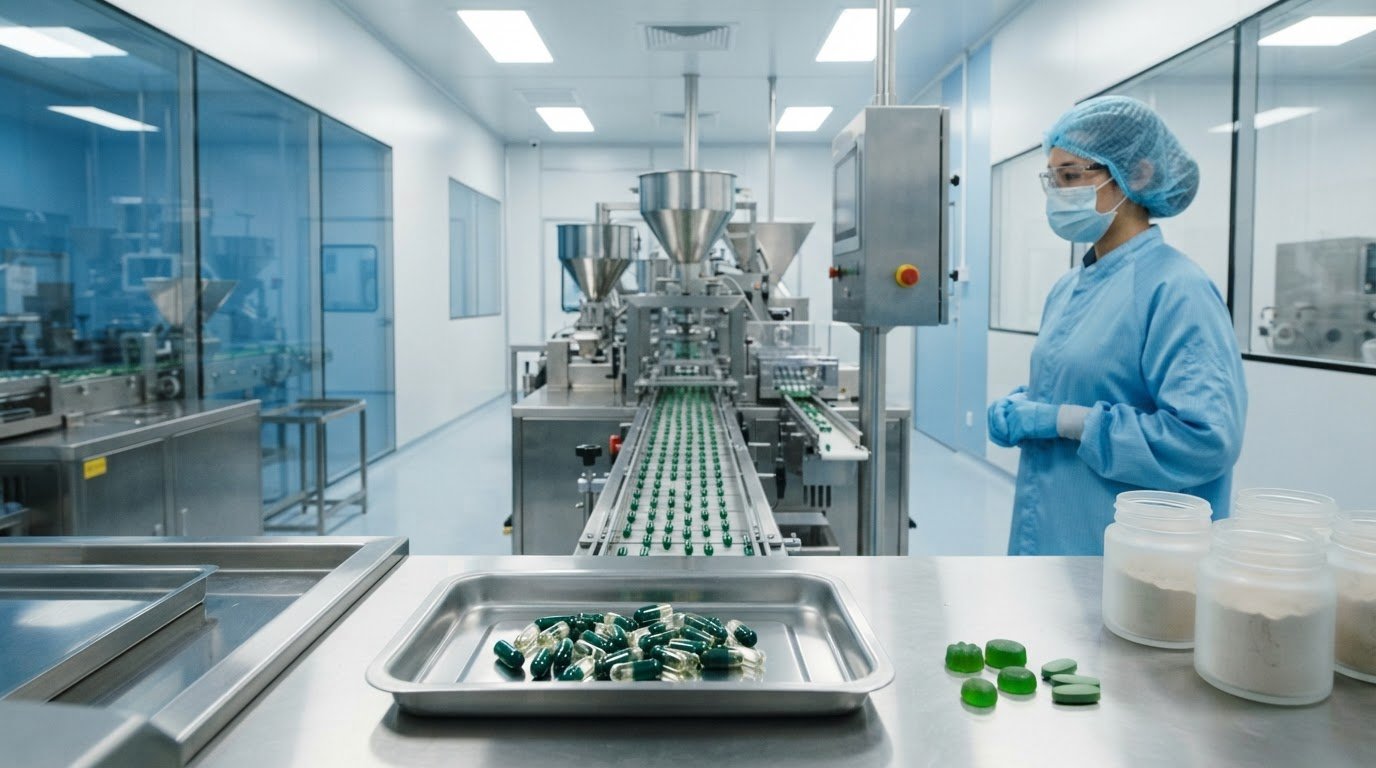
Minimum order quantities for private-label supplement lines can vary by product and production requirements. Understanding the minimum order quantity for supplement manufacturing means looking beyond the finished-unit count: ingredient purchasing thresholds, packaging choices, and production setup can all shape a viable run size. This range is a useful planning benchmark, not a single requirement for every product.
It’s natural to focus on how many units you need for a launch, especially when balancing inventory against expected demand. But ingredient minimums can matter just as much as the finished-product quantity.
This article explains how ingredient sourcing, product format, formula complexity, and economies of scale affect order sizes and per-unit costs. You’ll also learn why a smaller run may cost more per unit and which production considerations to weigh when planning a supplement launch in Singapore.
Key Takeaways
- Private-label supplement order sizes can vary with the production format and formulation.
- Ingredient purchasing thresholds can shape a launch quantity; PharmaNZ says minimum order quantities typically apply to most ingredients at 25kg.
- Smaller production runs often carry higher per-unit costs because setup, cleaning, and raw-material purchasing affect production economics.
- Before settling on a batch size, consider ingredient inventory, supplier minimums, packaging choices, and the equipment needed to run the product.
- Compare formats such as capsules, tablets, powders, and gummies against your formula and launch plan to identify a production quantity that fits both.
Economies of scale in raw material sourcing
Supplement manufacturers set minimum order quantities partly to source raw materials efficiently. Larger purchases can spread sourcing and handling costs across more finished units. For example, buying an ingredient in a quantity suited to a planned run may cost less per unit than placing repeated small orders. The benefit depends on how the purchased quantity matches the formula and batch size.
Every formula creates different material requirements. A capsule blend with several active ingredients needs enough of each to make the planned batch, while a simpler formula may use fewer inputs. If a supplier’s minimum for one ingredient exceeds what the batch requires, material may be left over. That stock ties up cash and needs storage and inventory planning.
The most economical production volume is not automatically the largest possible run. It is the volume that uses purchased ingredients efficiently without creating excessive finished-goods or raw-material inventory. For a launch product, compare the ingredients required for your target batch with supplier purchase minimums. A mismatch may make a larger run more economical, but only if projected demand can absorb the additional stock.
Ingredient availability also affects scheduling. If a required material is already in inventory, the production plan may not need a new purchase. If the supplier sets a minimum order, include that threshold in the batch calculation. Packaging creates a similar consideration: standard bottles may suit a smaller run, while custom packaging can require a separate purchase commitment.
- Match ingredients to the formula: calculate how much of each material the planned batch consumes.
- Separate available stock from new purchases: existing inventory can change the quantity that must be sourced.
- Include packaging and equipment: stock packaging and the selected production line affect workable run sizes.
Small businesses can discuss lower MOQs or pilot and sample production runs. A pilot can assess a formula or process at limited scale, but it may not eliminate ingredient or packaging minimums. For example, even a small test batch may require purchasing more of a low-volume ingredient than the batch uses.
Raw-material economics also connect to batch quality control. Manufacturing MOQs help support quality-control testing for each batch, so a run must be large enough to justify the production and testing process. A very small run may use ingredients efficiently but still carry greater setup costs per finished unit. The practical target balances sourcing efficiency, testing needs, equipment capability, and expected sales.
Before choosing a volume, map the product’s ingredient list against available inventory and supplier minimums, then compare packaging options and equipment requirements. If one ingredient sets the purchase threshold, adjusting the batch quantity or formula proportions may improve material use. This makes MOQ a production-planning decision, not just a unit count chosen in isolation.
Relationship between order size and per-unit costs
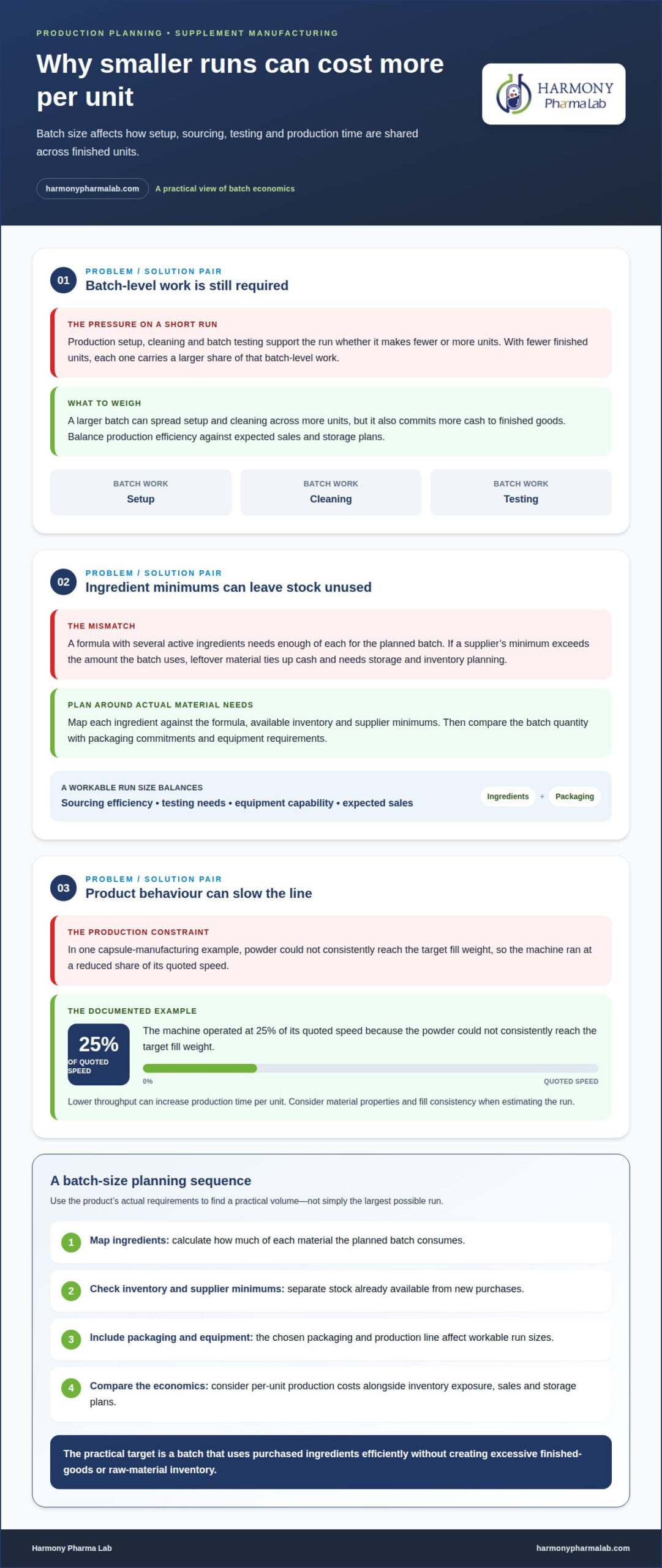
A production run combines costs that vary with quantity and costs incurred for the batch itself. Ingredients and packaging typically scale with unit count, while setup, cleaning, and batch testing support the production run. Manufacturers spread those batch-level costs across finished units. When a line produces fewer units, each unit carries a larger share of setup and cleaning costs.
Consider two capsule runs using the same formula and equipment at different quantities. Both require production preparation and cleaning, but the larger run distributes that work across more capsules. This is why a lower MOQ often comes with a higher per-unit cost. Not every cost falls at the same rate: ingredient prices, packaging choices, production speed, and formula requirements also affect the calculation.
Development adds another cost layer before routine production begins. A complex formula may require more formulation work and testing than a straightforward blend. Changes to ingredients or dosage format may also need additional evaluation. Separate development costs from production costs, then consider both when estimating the investment for launch. A production quote should reflect the specific formula, batch quantity, packaging, and manufacturing steps required.
Production setup and cleaning remain relevant even when a run is short. Equipment must be prepared for the product, and cleaning follows production to support the next run. If a powder blend feeds unevenly, the line may need to run more slowly to achieve its target fill weight. In one capsule-manufacturing example, the machine operated at 25% of its quoted speed because the powder couldn’t consistently reach the target fill weight. Lower throughput can increase production time per unit.
- Batch size: compare how setup and cleaning work are distributed across the planned quantity.
- Formula: account for ingredient sourcing and any additional development or testing steps.
- Line performance: consider whether the product’s material properties affect production speed or fill consistency.
- Packaging: include the selected container and format in the cost calculation.
When choosing between a short initial run and a larger launch batch, weigh unit economics against inventory exposure. A larger run may spread fixed production work more efficiently, but it also commits more cash to finished goods. The suitable volume balances production efficiency with realistic sales and storage plans.
Pricing depends on the project and is provided after a quote request. Cost factors include formula complexity, ingredient sourcing, packaging, batch size, setup, cleaning, and production speed. Comparing these inputs makes the per-unit figure more useful than considering order quantity alone.
What is the typical Minimum Order Quantity (MOQ) for starting a private label supplement line?
Supplement manufacturing MOQs generally range from 300,000 to 1 million units per product. For tablets and capsules, the practical quantity also depends on ingredients, equipment, packaging, and the production batch.
Common MOQ Ranges
A typical MOQ is the minimum finished-product quantity a manufacturer will produce in one run. The general range of 300,000 to 1 million units per product gives private-label brands a planning benchmark, but not a universal figure for every tablet or capsule. The gap between these volumes can affect inventory commitments and per-unit economics. Compare the proposed quantity with expected demand and the materials required for that specific formula.
Tablets and capsules do not have one fixed MOQ for every product. A capsule blend with several ingredients may have different sourcing needs from a tablet with another formula, and equipment requirements can also affect the workable batch size. Assess each format separately rather than assuming a quantity from one quote applies to another. Ask for the MOQ per product, not just a combined production total.
In Singapore, include product classification, ingredient suitability, claims, and label content in the launch review. These factors shape the regulatory and labelling assessment for a specific supplement, so plan for compliance during product development, not just at the packaging stage.
Low-MOQ offers also call for careful review of production and quality controls. Assess whether the proposed quantity supports batch testing, consistent production, and adequate ingredient and packaging planning. Check whether the MOQ applies to each formula, flavour, or packaging configuration, as separate versions may need separate production runs. A low unit threshold alone does not show that the complete production plan suits the product.
Requesting and Comparing Quotes
A useful quote request describes the formula, dosage format, intended packaging, and planned quantity. These details give manufacturers the same project scope to assess, making their MOQs and cost structures easier to compare. For example, compare capsule proposals using the same ingredient brief and package type; otherwise, differences in scope can distort the comparison.
- Share the formula brief and specify whether the product is a tablet or capsule.
- Request the MOQ per product and identify whether packaging configurations affect it.
- Compare setup, testing, ingredients, packaging, and finished-unit quantities together.
Review each quote against those details to distinguish a suitable production volume from a low headline MOQ. For a Singapore launch, include the intended label and product claims in the brief so manufacturers can assess the product scope alongside its production requirements.
How supplement format and formula complexity affect MOQs
Supplement format and formula complexity both influence how efficiently a manufacturer can produce a batch. Powders, tablets, hard capsules, soft capsules, liquids, and gummies use different processes and materials. A quantity that suits one format may not suit another. Compare each product separately, even when several share a brand or ingredients.
For example, a powder blend requires mixing and filling, while tablets require processing the blend into tablet form. Capsules involve filling shells, and soft capsules use a different format from hard capsules. These differences affect the equipment and processes required. The format therefore informs the batch plan, rather than simply changing the finished supplement’s appearance.
Formula complexity adds another layer. A product with several ingredients requires a formulation that combines them in the intended proportions, while a simpler formula may have fewer components to manage. Compare a single-ingredient powder with a multi-ingredient capsule blend: the latter involves coordinating more materials and may have different manufacturing requirements. Ingredient quantities and availability can also affect feasible production volume.
Material behaviour matters as well. A powder’s flow and consistency can affect how reliably equipment fills capsules or containers. In a documented capsule-production example, a machine ran at 25% of its quoted speed because the powder could not consistently reach its target fill weight. This illustrates why equipment suitability and product properties belong in MOQ planning, alongside the format name.
Packaging can further distinguish otherwise similar products. Tablets in standard bottles create a different production configuration from powders filled into sachets. If a brand develops several flavours or formula versions, each may need its own production plan. Treating every version as one combined order can hide the actual batch requirements for each finished product.
- Identify the format: distinguish tablets, capsules, powders, liquids, and gummies before estimating a run.
- Map the formula: list each ingredient and note how the combination affects processing.
- Match product and equipment: consider how material properties influence filling or production consistency.
- Separate variations: plan distinct formulas, flavours, or packaging configurations individually.
For a Singapore launch, use the product brief to connect the intended format, formula, and packaging configuration. This helps ensure the production plan reflects the actual product, not just a generic category. A tablet and a capsule may share ingredients but require different production routes; a complex blend may also need a different plan from a straightforward formula. These differences explain why MOQs vary by format and formulation, and why manufacturers assess them together.
Ingredient minimum order quantities
An ingredient MOQ is the smallest quantity a supplier will sell for a specific raw material. According to PharmaNZ, minimum order quantities typically apply to most ingredients at 25kg. That purchasing threshold can exceed the amount a formula consumes in one production run. A brand may therefore need to plan around an ingredient purchase, not just finished-unit demand.
Consider a formula with several ingredients in different proportions. The main ingredient may be used in a substantial quantity, while a secondary ingredient is included at a lower level. If a supplier’s minimum purchase exceeds the formula’s needs, the remaining material becomes inventory for a future run. That may improve material efficiency across repeat runs, but requires inventory planning and suitable storage.
Map each formula component against its supplier minimum before choosing a batch quantity. Start with the amount required per finished unit, then calculate the total needed for the proposed run. Compare that figure with available inventory and the supplier’s purchase threshold. This shows which ingredient sets the practical batch size and which can be sourced in quantities closer to immediate production needs.
- Ingredient demand: calculate each raw material’s required quantity for the planned batch.
- Supplier threshold: identify the minimum purchase quantity for each ingredient.
- Existing inventory: subtract usable stock before estimating new purchasing needs.
- Remaining material: plan how unused ingredients fit into later production cycles.
A 25kg supplier minimum can affect two formulas differently. For example, a product using a higher proportion of an ingredient may consume most of that purchase in one run. A formula using less may leave more material for subsequent batches. The key takeaway is to assess ingredient quantities individually, rather than applying one general allowance across the entire blend.
Ingredient sourcing also interacts with packaging and equipment. A product may have enough raw material for a planned run, while its packaging order or production setup points to a different workable quantity. Consider the formula, ingredient inventory, supplier minimums, packaging choice, and production equipment together. This reveals whether the proposed run uses purchased materials efficiently or creates avoidable surplus.
For a new supplement concept, prepare an ingredient schedule that lists each component, the planned batch requirement, and the amount needing purchase. Use that schedule to compare production scenarios and identify the ingredient driving the MOQ. Discuss your supplement production requirements to align ingredient planning with a workable manufacturing run.
Harmony Pharma Lab: Soft Capsule
Harmony Pharma Lab manufactures supplements for brands, including Soft Capsules. This is a natural next step when your ingredient plan, target batch, and dosage format are defined and you need to turn them into a production brief. The company also offers Gummies, Hard Capsules, and Tablets, giving brands options to align product design with manufacturing plans.
For a soft capsule concept, prepare the formula requirements and intended order volume so production discussions can focus on the product’s specific needs. This connects ingredient decisions with a suitable manufacturing format and batch plan.
Contact Harmony Pharma Lab to discuss your supplement production requirements, or visit harmonypharmalab.com.
Turn your production plan into a launch brief
Use your manufacturing decisions to build a launch brief that connects product intent with commercial priorities. Define the customer, product positioning, preferred format, and launch sequence before finalising internal forecasts. A focused brief helps your team align product development, procurement, and inventory planning around the same objective. It also gives production discussions a clearer starting point than an early unit target alone.
Understanding a supplement manufacturer’s minimum order quantity is most useful when it informs wider launch decisions. Treat the proposed batch as one part of the plan, alongside product differentiation, available working capital, and the pace at which you expect to introduce the product. This perspective can help your team make deliberate trade-offs as the concept moves toward production.
When your product brief is ready, contact Harmony Pharma Lab to discuss your manufacturing plans. A considered next step can bring your product concept closer to a launch plan your business is prepared to support.
Frequently Asked Questions
What is the minimum order quantity (MOQ) for supplement manufacturing?
MOQ is the smallest production quantity accepted for one supplement product in a manufacturing run. A practical understanding of supplement manufacturing minimum order quantity starts with the general benchmark of 300,000 to 1 million units per product, then considers the specific formula and production requirements. Distinguish the finished-product MOQ from ingredient and packaging purchase quantities, since those commitments can affect the stock a brand must plan for.
What factors determine a supplement manufacturer’s MOQ?
A manufacturer’s MOQ reflects the product’s materials, production process, and packaging configuration. Separate flavours or label versions may need distinct production plans rather than counting as one interchangeable batch. Consider ingredient availability, standard or custom packaging, and formulation work when defining the production scope. Understanding supplement manufacturing minimum order quantity means evaluating these factors together, instead of treating the unit threshold as the only measure.
What are typical supplement manufacturing MOQs in Singapore and Southeast Asia?
A broad planning benchmark for supplement manufacturing is 300,000 to 1 million units per product. For a Singapore or Southeast Asia project, use this as a starting reference rather than assuming every product follows one regional threshold. Request the MOQ for the exact formula, dosage format, and packaging plan. This provides a more relevant basis for comparing production proposals than relying on a general regional estimate.
How do MOQs differ for capsules, tablets, powders, gummies, and liquids?
There is no single fixed MOQ for capsules, tablets, powders, gummies, or liquids; each format uses different processes and materials. Request a separate quantity for each format and product version. For instance, a brand considering both a gummy and a liquid should treat them as separate manufacturing plans, even if they share a concept or ingredients. This helps clarify the production scope for each format.
How do stock formulas compare with custom formulations for MOQ and cost?
A stock formula can reduce formulation work before production, while a custom formulation involves developing a product around selected ingredients and specifications. Neither choice alone determines the MOQ, because ingredients, packaging, and production requirements also affect the run. According to PharmaNZ, development of a complex supplement product can take up to 3 months. Assess development scope separately from production quantity when comparing the options.