

A tablet that works on paper becomes a commercial product only when its formula can be produced consistently at scale. Choosing a tablet supplement manufacturer means looking beyond compression equipment to formulation fit, production controls, documentation and the capacity to support your growth plan.
These decisions can be difficult to compare. Capabilities may sound similar, but differences in dosing precision, coating options and batch consistency can affect product quality and market readiness. For brands developing products in Singapore or for global markets, clear documentation also matters.
This practical checklist will help you assess tablet-specific capabilities, define the records and questions to address before committing, and compare each partner against your product requirements. It covers custom formulation, blending, compressed tablet production, coating, quality controls and commercial fit. Harmony Pharma Lab is a Singapore-established B2B contract manufacturer that supports custom tablet development alongside capsule, gummy, powder and liquid formats, helping brands match dosage-format decisions to their product goals.
Key Takeaways
- Set your intended users, target markets, product purpose and launch plan before comparing manufacturing proposals.
- Assess how your formulation goals and ingredient properties align with the tablet supplement manufacturer’s blending, compression, dosing and coating capabilities.
- Compare quality documentation by category, including facility certifications, product testing, batch records and market-specific documents.
- Use a consistent checklist to evaluate communication, order planning, scalability and commercial assumptions. Minimum order quantities and timelines depend on project scope.
- Harmony Pharma Lab’s custom formulation and tablet production capabilities support commercial brands developing custom tablets.
Tablet Supplement Manufacturer Checklist: Define Product and Market Fit
A suitable manufacturing partner must match your product brief, target market and launch plan, not simply offer tablet production. Before comparing capabilities, define who the product is for, what purpose it is intended to serve, how customers will take it and where you plan to sell it. These decisions shape the formula, tablet format, documentation needs and commercial scale to discuss.
A tablet supplement manufacturer develops a formula and produces it commercially. Equipment alone does not establish whether a manufacturer is the right fit. Dietary supplements and pharmaceutical drugs are distinct categories, even where some production operations sound similar. The overview of pharmaceutical manufacturing processes describes operations such as granulation and tablet pressing. It provides process context, but supplement and pharmaceutical requirements are not interchangeable.
Turn the product concept into a manufacturer-ready brief
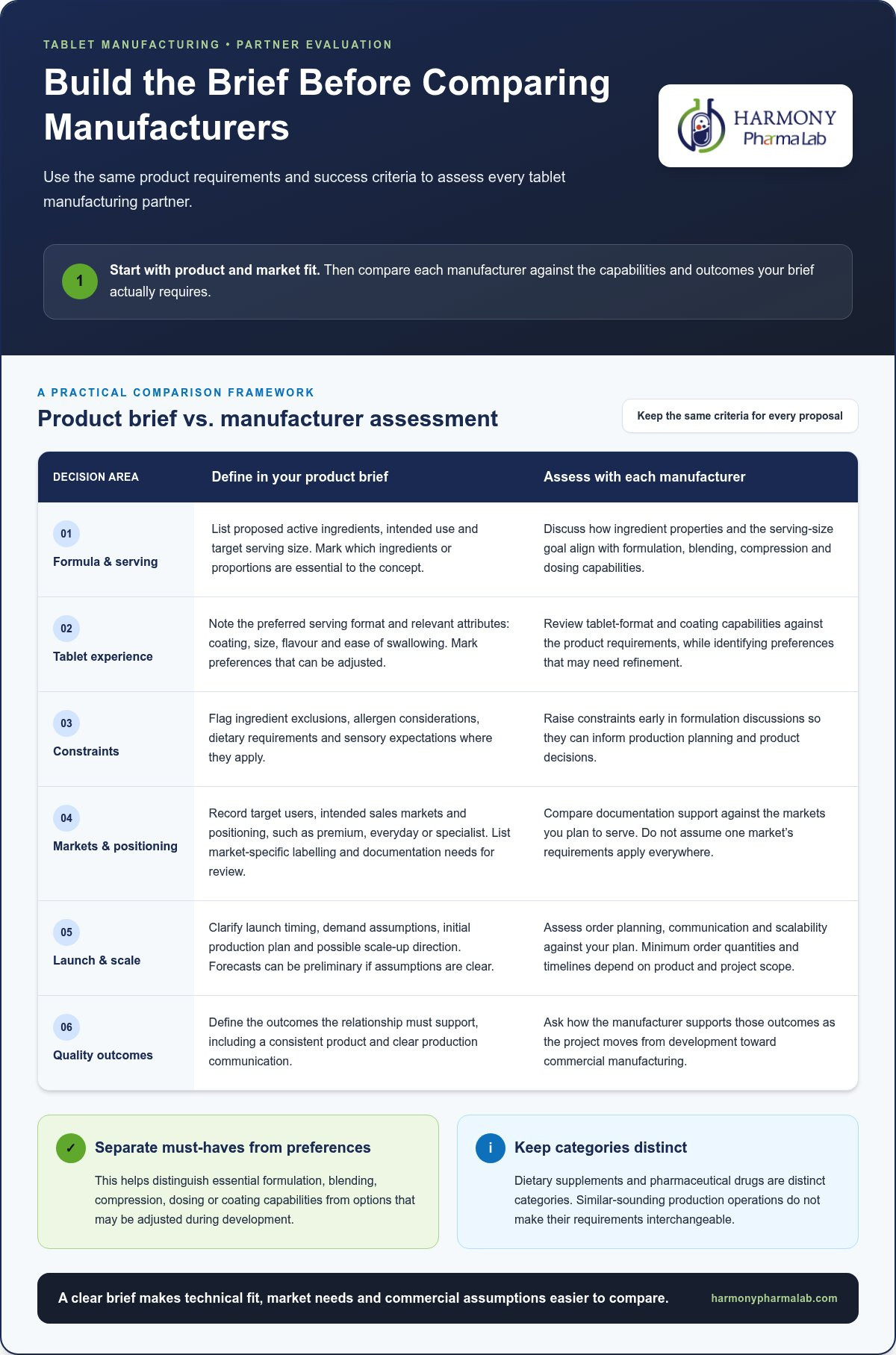
Translate your concept into information that can guide formulation and production discussions. Specify what the tablet must deliver, and separate essential product conditions from attributes that could be refined during development.
- Formula intent: List proposed active ingredients, intended use and target serving size. Identify ingredients or proportions that are essential to the product concept.
- Tablet experience: Note the preferred serving format and relevant attributes, such as coating, size, flavour or ease of swallowing. Mark preferences as flexible if development may require adjustments.
- Constraints: Flag ingredient exclusions, allergen considerations, dietary requirements and sensory expectations where they apply. These can affect formulation choices, so include them early rather than introducing them after development decisions.
- Markets and positioning: Record intended sales markets, target users and brand positioning, such as premium, everyday or specialist use. List market-specific labelling and documentation requirements for review, without assuming that one market’s requirements apply everywhere.
This brief gives everyone a shared reference point. It also helps distinguish a true formulation constraint from a preference that can be balanced against tablet size, serving convenience or other product priorities.
Set success criteria before comparing suppliers
Define what a successful launch and workable manufacturing relationship look like before assessing proposals. Consider expected demand, the initial production plan and the possibility of scaling as the brand develops. Forecasts do not need to be final, but the assumptions should be clear enough to support practical planning.
- Identify must-haves: Separate required formulation, blending, compression, dosing or coating capabilities from optional services and format preferences.
- Set commercial objectives: Clarify launch timing, demand assumptions, order-planning expectations and the direction for scale-up. Minimum order quantities and timelines depend on the product and project scope, so do not treat them as universal benchmarks.
- Define quality outcomes: Specify the outcomes the partnership must support, including a consistent product and clear production communication as the project moves from development toward commercial manufacturing.
A concise brief keeps attractive but non-essential features from distracting from core needs. It gives your team a consistent basis for comparing formulation fit, operational alignment and commercial readiness in the sections that follow.
Evaluate Formulation and Tablet Production Capabilities Before Comparing Quotes
A tablet’s production feasibility depends on how its formula, ingredient properties and serving-size goal work together. A formula with several active ingredients, for example, can present different tablet-design considerations from one with a smaller serving size. These factors affect whether the intended format and user experience align with the manufacturing process. Compare technical fit before weighing proposals on commercial terms.
Use your product brief as the reference point. Assess a tablet supplement manufacturer against the specific work required to move your concept into commercial production, rather than broad descriptions of general manufacturing capacity. Harmony Pharma Lab supports custom formulation, blending, compressed tablet production, precise dosing and coating for commercial brands.
Match the formula to the tablet format
Review ingredient characteristics alongside the target serving size. The amount and combination of ingredients can influence the tablet format needed to deliver the intended serving. Product priorities, such as ease of use, may also affect design decisions. Keep essential formula requirements distinct from adjustable preferences so development can address practical production considerations without losing sight of the product brief.
Coating may also be part of the production discussion, depending on the product’s requirements. Define its purpose in the brief without assuming a particular coating type or outcome. If you’re comparing dosage forms as part of product planning, the soft capsule manufacturing guide offers a related perspective. The right format depends on the formula and product objectives.
Use a capability map to connect requirements with production steps:
- Formulation: Align the proposed formula with intended use, ingredient characteristics and serving-size goals.
- Blending: Define how the formula brief translates into a blend prepared for tablet production.
- Compression and dosing: Compare the production scope with the tablet and serving requirements.
- Coating: Include it where it supports a defined product requirement, rather than treating it as a default feature.
General terms such as “tablet production” can cover different scopes. Compare the stated capabilities with your needs instead of assuming a broad label includes every stage or service.
Assess production controls and scale-up fit
Once the process fits the formula, define how its key steps should be carried out and communicated. Written process expectations create a shared reference for formulation, blending, compressed production, dosing and coating. They also make it easier to assess how the proposed workflow supports the product brief as production moves toward commercial scale.
A clearly defined production process supports the goal of consistent tablet batches. A capability label alone does not establish batch consistency. It depends on a process that is understood and followed against agreed product requirements. Record the intended process scope and the product characteristics that matter, then use them to review proposals and future production plans.
Harmony Pharma Lab brings custom formulation, blending, compressed tablet production, precise dosing and coating together for B2B brands developing custom tablets. Brands comparing formats can also explore custom tablet manufacturing capabilities to see how this production scope can align with a product brief.
Compare Quality Systems, Batch Controls, and Market Documentation
Quality claims are most useful when they point to defined processes and evidence. When assessing a tablet supplement manufacturer, separate facility-level credentials from product-specific records and market documentation. These categories answer different questions: a facility certification relates to a facility or system, while product and batch documents relate to the supplement being developed or produced. Neither broad quality language nor a single document tells the whole story.
Use the same evidence categories for each proposal. Record what is relevant to your project, who is responsible for providing or reviewing it, and which items need further discussion. This keeps the evaluation objective without treating a particular certification or document as universally required.
Review quality and batch-consistency evidence
Written product specifications define the characteristics a batch is intended to meet. Batch records help show how production activities are documented against those specifications. Together, these records offer a practical basis for discussing process consistency beyond a general statement about quality.
Keep evidence categories distinct. Ingredient identity information concerns the materials used; in-process controls relate to checks or controls during production; finished-product documentation concerns the completed product. Establish which documentation applies to the project and how it connects to the agreed product specification. This framework helps define the evidence to review for each project.
Align documentation with target markets
Map documentation requirements to each intended sales market. Include target countries and expected export documentation in the initial project brief, then separate general project records from country-specific regulatory obligations. Requirements can differ by market and product, so do not assume that one market’s documentation package automatically covers another.
The comparison below helps assign each item to a purpose and responsible party. Tailor the entries to the product and markets under consideration.
Evidence requested | Purpose | Project relevance | Responsible party
Facility certifications or credentials | Understand the scope of a facility-level claim. | Relevant where a buyer, market or commercial plan requires specific facility evidence. | Manufacturer provides applicable evidence; brand defines its project needs.
Product testing information | Understand what product-related checks or records are relevant. | Depends on formula, product brief and intended markets. | Agree responsibilities between manufacturer and brand for the project.
Batch records and specifications | Connect production documentation with defined product characteristics. | Useful for reviewing how batch information relates to agreed specifications. | Manufacturer maintains relevant production documentation; brand identifies required review points.
Market documentation | Organise documents needed for intended sales destinations. | Varies with target market and commercial route. | Brand identifies destination-market obligations; parties align on supporting documents.
Use this matrix to identify gaps in scope and distinguish them from assumptions about which standards apply. Harmony Pharma Lab supports tablet production with batch consistency as part of its B2B manufacturing capabilities. Align project documentation with the product brief and intended markets.
Use a Tablet Supplement Manufacturer Checklist to Assess Commercial Fit
A proposal is comparable only when each partner is working from the same product brief and commercial assumptions. Use a consistent checklist to assess the complete scope, from formulation and production through documentation, communication and order planning. This helps distinguish a lower headline quote from a proposal that covers the requirements your product needs.
Minimum order quantities and timelines depend on the product and project scope, so treat them as project-specific terms rather than universal benchmarks. Record the assumptions behind each proposal, including the requested quantity, production scope and documentation expectations. That gives your team a clearer basis for comparison than figures detached from the product brief.
Compare proposals on an equivalent basis
Use the same formula brief and tablet format for each proposal. Then compare the scope line by line, noting where services or assumptions differ. A consistent evaluation can cover:
- Product and format: Confirm that each proposal refers to the same formula brief, tablet format and agreed product attributes.
- Service scope: Separate formulation, blending, compressed production, dosing and coating into distinct items. Mark what is included and what is an optional development step.
- Documentation: Compare the documentation categories relevant to the project and intended sales markets, using the same expectations for each proposal.
- Order assumptions: Record requested quantities and any project-specific minimum order quantities or timelines, along with the conditions attached to them.
- Communication: Note the proposed communication cadence, key decision milestones and the information needed to keep development and production discussions moving.
Separate confirmed deliverables from assumptions and future options. For example, a possible later formula adjustment should not be treated as part of the initial production scope unless it is explicitly included. This distinction makes commercial comparisons more useful and reduces the risk of planning around an unconfirmed expectation.
Check readiness for launch and future production
A partner may fit the launch brief but require a different plan as demand changes. Compare how the proposed scope supports initial production and anticipated scale-up, including what would need review if order quantities or market plans change. This is not a request for a fixed growth promise. It helps identify assumptions and decisions that could affect future production.
Clarify who owns formulation decisions, product specifications and approvals at each milestone. Your team may define brand requirements and approve product decisions, while manufacturing discussions translate those requirements into a workable production plan. Record who provides input, who reviews changes and which decisions need approval before they affect the project.
For a final comparison, use one shared brief, one set of market-documentation expectations and clearly stated order assumptions. Harmony Pharma Lab works with commercial brands on custom tablet formulation and production, with scope tailored to the project. Discuss your tablet manufacturing brief to align product requirements with a production plan.
Move from Shortlist to Custom Tablet Manufacturing with Harmony Pharma Lab
Once your shortlist is grounded in product fit, production capabilities and commercial assumptions, discuss how those requirements translate into a custom manufacturing project. Harmony Pharma Lab is a Singapore-established B2B contract manufacturer of dietary supplements, supporting commercial brands developing custom tablets. Established in Singapore in 2025, the company works with brands on tablet formulation and production, with project scope shaped around the product brief.
Harmony Pharma Lab manufactures dietary supplements, not pharmaceutical drugs or consumer-ready retail products. This keeps the discussion focused on B2B supplement development and production. For brands planning a broader portfolio, the company also manufactures capsules, gummies, powders and liquids. These formats can inform portfolio planning, while each formula and product objective still needs its own assessment.
How Harmony Pharma Lab supports tablet supplement brands
Custom formulation and blending connect a brand’s product objectives with the work required to prepare a tablet formula for production. Clear priorities guide that discussion, whether the brief centres on intended use, serving goals, ingredient requirements or other essential product attributes.
Tablet capabilities include compressed production, precise dosing, coating and batch consistency. These are practical elements to include in a project conversation because they relate directly to translating the product brief into a manufacturing scope. A well-defined brief establishes which capabilities matter for the product and keeps optional preferences separate from essential requirements.
As you move from comparing partners to planning a project, use the selected product and market requirements as your reference point. A focused discussion can align formulation goals with the intended production scope and commercial plan, rather than treating each capability as an isolated feature.
Prepare a focused first project brief
Bring a concise summary of the product concept to the initial B2B discussion. It does not need to resolve every formulation detail. It should give the team a clear view of the product’s purpose, priorities and intended commercial direction.
- Formula direction: Include proposed ingredients, intended use, serving goals and any non-negotiable formula requirements.
- Market plans: Identify intended sales markets and the documentation expectations already identified for each destination.
- Product requirements: Note tablet preferences, coating considerations, ingredient or allergen constraints and sensory priorities. Distinguish essentials from options.
- Commercial scope: Outline anticipated initial demand and possible scale-up needs, along with the production capabilities central to the project.
This preparation gives both sides a practical basis for discussing project scope and priorities. To share your goals and begin a B2B manufacturing conversation, connect with Harmony Pharma Lab with your tablet brief.
Turn Your Manufacturing Criteria into a Clear Next Step
Your shortlist becomes more useful when it leads to a shared plan for decisions, approvals and future development. Rather than treating partner selection as a one-time procurement step, consider how the working relationship can adapt as your product priorities and commercial plans evolve. Clear expectations give both teams a practical basis for moving from concept to production while keeping responsibilities visible.
The right tablet supplement manufacturer is a partner whose proposed scope aligns with your objectives and whose discussions help turn open questions into defined project decisions. You don’t need every detail settled before starting a conversation. A concise brief and a clear view of your priorities are enough to establish a constructive starting point.
Take the next step by sharing your product direction with Harmony Pharma Lab and shaping the conversation around your project goals. Discuss your custom tablet manufacturing brief and move forward with clarity. A considered start can create a stronger foundation for your brand’s next stage of growth.
Frequently Asked Questions
What is the difference between a tablet supplement manufacturer and a pharmaceutical manufacturer?
A tablet supplement manufacturer produces dietary supplements, while a pharmaceutical manufacturer produces medicines developed and regulated under requirements for pharmaceutical products. The categories can involve similar production operations, but they are not interchangeable. Define the product category and intended markets at the start of a project, then align formulation, claims, production scope and documentation with those needs. Harmony Pharma Lab manufactures dietary supplements, not pharmaceutical drugs.
How does custom tablet manufacturing differ from private-label manufacturing?
Custom tablet manufacturing develops a product around a brand’s specified formula or product brief. Private-label manufacturing typically involves placing a brand’s identity on an existing or standardised product, with the extent of customisation varying by project. For example, a brand seeking a distinctive ingredient profile may need a custom development discussion, while a brand adopting a ready-made formulation may have different priorities. Compare who controls the formula and what development work is included.
What determines the minimum order quantity for supplement tablets?
Minimum order quantity depends on the formula, ingredients, tablet specifications, production setup and project scope. Ingredient sourcing or a specialised product requirement may affect planning differently from a straightforward production brief. Compare the stated quantity with the exact product and services it covers, and note any assumptions about future orders. This helps you judge whether the proposed commitment suits your launch plan without relying on generic industry figures.
How long does custom tablet supplement manufacturing take?
There is no single timeline that applies to every custom tablet project. The schedule can depend on formulation development, ingredient availability, review and approval stages, documentation needs and production planning. A project that requires formula refinement may follow a different path from one with an agreed formulation and specifications. For useful planning, map the key milestones, identify decisions your team must make and distinguish development time from production scheduling.
Can a tablet supplement manufacturer help develop a custom formula?
Yes. A contract manufacturer with formulation capabilities can work from a brand’s product objectives to develop a formula for tablet production. Harmony Pharma Lab provides custom formulation for commercial supplement brands. A useful starting brief includes the intended product purpose, proposed ingredients, serving goals and essential constraints. Formulation development translates those priorities into a production plan, but it does not replace the brand’s responsibility to assess its product claims and target-market needs.
How do tablets and gummies compare as supplement formats for a brand?
Tablets and gummies suit different product and brand priorities, so the better option depends on the formula, intended serving and desired user experience. A tablet brief may prioritise a compact serving format or coating, while a gummy concept may place greater emphasis on flavour and sensory qualities. Ingredient characteristics and serving goals can affect feasibility in either format. Compare both against the product’s purpose, formulation constraints and audience expectations before settling on a format.