

A strong gross margin can still conceal weak profitability. For Singapore brands evaluating profit margins for private label supplements in 2026, a practical gross-margin target is 40-60%, but that figure is not the same as net profit: operating expenses, marketing and sales fees still reduce what the business keeps.
It’s reasonable to focus on manufacturing costs because they affect the gap between a product’s selling price and its gross profit. But understanding profitability means accounting for the full cost structure, including expenses after production, rather than treating a margin benchmark as a promise of commercial success.
This article explains how private-label, OEM, and custom-formula models affect costs, what gross-margin benchmarks can tell you, and why the business model matters to supplement profitability in Singapore. It also distinguishes gross margin from contribution and net margin, helping you assess each figure in context.
Key Takeaways
- Separate gross margin from contribution and net margin to see how much revenue remains after each layer of costs.
- Compare private-label, OEM and custom-formula models by how control, production responsibilities and cost structures affect your economics.
- Treat industry margin figures as reference points, not guarantees; product mix and operating expenses shape actual profitability.
- Assess each supplement format on its own cost drivers instead of assuming vitamins, protein powders and probiotics share the same margins.
- Use a product’s expected selling price and full cost structure to set a viable margin target before committing to a launch.
1. What gross margin should a supplements brand target?
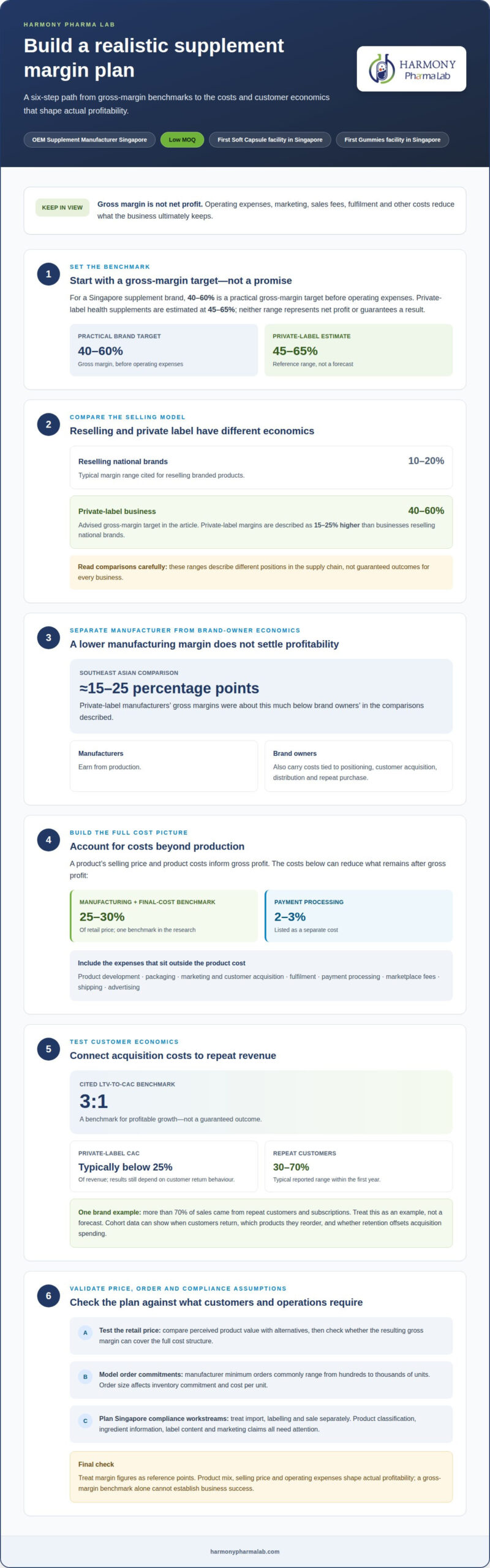
For a Singapore supplement brand, a 40-60% gross margin is a practical target before operating expenses. Private-label health supplements are estimated at 45-65%, but neither range represents net profit. The margin depends on selling price minus product costs, while marketing, fulfilment, payment processing, and other expenses reduce the remaining earnings.
Private-label businesses can earn margins 15-25% higher than businesses reselling national brands. Reselling branded products typically yields 10-20% margins, while private-label businesses are advised to target 40-60% gross margins. These comparisons describe different positions in the supply chain, not guaranteed results for every Singapore business.
Manufacturers and brand owners also have different economics. In Southeast Asian comparisons, private-label manufacturers’ gross margins were about 15 to 25 percentage points below brand owners’. Manufacturers earn from production, while brand owners also bear costs tied to positioning, customer acquisition, distribution, and repeat purchase. A lower manufacturing margin does not automatically mean lower business profitability.
Thai Union illustrates how a mixed own-brand and private-label model can involve different revenue streams and cost structures. Its asset turnover was about 0.84x in 2025, but asset turnover measures sales generated from assets, not gross margin. Compare each business activity separately rather than treating one company-wide figure as a direct supplement benchmark.
One supplement founder’s example reported margins above 45% within eight months of launch. That result is an illustration, not a minimum or forecast for other brands. It also cannot establish profitability by itself: revenue, repeat purchase, advertising expense, and operating costs determine how much gross profit remains after the launch period.
Private-label pricing gives brands more control over product positioning than reselling national brands, but competition still shapes the price customers will accept. Set a retail price by comparing the product’s perceived value with alternatives, then test whether the resulting gross margin covers the full cost structure. A manufacturing and final-cost target of 25-30% of retail price is one benchmark in the research.
Branding, marketing, and market-entry costs require separate planning. Include product development, packaging, customer acquisition, fulfilment, and payment processing in the model; payment-processing costs are listed at 2-3%. Manufacturers commonly set minimum orders ranging from hundreds to thousands of units, so order size affects inventory commitment and the cost per unit. Startup costs depend on these choices, not a universal figure.
In Singapore, treat import, labelling, and sale as separate compliance workstreams. Product classification, ingredient information, label content, and marketing claims all affect what needs attention before a product reaches customers. For marketplace fees, shipping, and advertising, include the actual channel charges, delivery arrangements, and campaign spending in your calculations, since each affects contribution margin after gross profit.
2. Private-label, OEM and custom-formula business models
Private label, white label, OEM, and custom formulation describe different levels of product ownership and development. A private-label product is made exclusively for one retailer, while a white-label product is generic and sold to multiple retailers. OEM arrangements focus on producing goods to a buyer’s specifications; custom formulations offer more control over ingredients and product design. The more control a brand seeks, the more closely it must manage development, compliance, and inventory decisions.
White label can help a brand enter retail with an existing product concept, leaving it to focus on packaging, positioning, and customer acquisition. The trade-off is differentiation: when other sellers offer a similar formula, competition can shift toward price and promotion. Private label gives a retailer more influence over specifications, ingredients, and features. That can be useful when customer feedback points to a clear product need, but it also makes the brand responsible for aligning formulation and claims with relevant compliance requirements.
Treat a move to custom formulations as a staged business decision. First, use sales data and customer feedback to identify what an existing product does not address. Then assess whether changing the ingredients or formulation would meaningfully differentiate the product for its intended audience. Finally, model development and inventory commitments against expected retail demand. Customization can strengthen margin potential only when customers recognise its value and the resulting price covers the added costs.
Customer acquisition cost (CAC) and customer lifetime value (LTV) connect product economics to marketing. A 3:1 LTV-to-CAC ratio is cited as a benchmark for profitable growth. Private-label businesses typically keep CAC below 25% of revenue, but the ratio still depends on whether customers return. Calculate acquisition costs by channel, then compare them with the revenue a customer generates over the relationship, accounting for discounts and fulfilment expenses.
Repeat customers can support more predictable revenue, although repeat sales do not automatically mean higher profit. Private-label businesses typically report repeat-customer rates of 30-70% within the first year. One supplement brand example generated more than 70% of sales from repeat customers and subscriptions. Use cohort data to see when customers purchase again, which products they reorder, and whether retention offsets acquisition spending.
Keep gross margin and customer economics separate. A 40% gross margin may appear workable, yet high acquisition costs or weak repeat purchase can narrow contribution after marketing and fulfilment. Compare model scenarios using the same retail price, channel assumptions and customer-retention period. A structured supplement production plan can help connect formulation choices with inventory and commercial targets.
3. Supplement gross-margin benchmarks and limitations
Private-label supplement margin estimates vary because sources may measure different businesses and cost boundaries. One estimate places average private-label product margins at 35%, compared with 26% for national brands. Another gives private-label health supplements a 45-65% profit-margin range. These figures are reference points, not a single Singapore category standard, and “profit margin” may not mean gross margin in every comparison.
Typical private-label gross profit margins are often presented as 40-60%. That range can help set an initial target, but it does not establish what a specific product should earn. Ingredients, format, packaging, production scale, retail positioning, and demand influence unit economics. Compare products within relevant categories and keep the calculation consistent: revenue less the costs assigned to goods sold.
There is no reliable public gross-margin benchmark for the supplements category. A figure drawn from a different channel or product mix may not reflect a Singapore brand’s operating model. Direct-to-consumer sellers, retail suppliers, and manufacturers have different revenue and cost structures. Use external percentages to frame questions, then calculate margins using your own sales and production records.
Keep gross margin separate from net margin. A private-label business should account for operating expenses, marketing, and fees when setting its gross-margin target, while net-margin expectations can vary. Another recommendation calls for net margins of at least 40% after all costs. Those net targets conflict, so don’t treat them as interchangeable or assume all sources define costs identically.
Use a consistent calculation before comparing results. Divide gross profit by net sales to calculate gross margin; subtract cost of goods sold from sales to find gross profit. Track operating costs separately to understand net profit. A product can have a healthy gross margin yet deliver a weak net result if customer acquisition, fulfilment, or overhead consumes the remaining revenue.
High gross margin alone is not proof of a sound business. A supplement brand with gross margin above 65% but EBITDA below 7% should investigate expenses between gross profit and EBITDA. A gross margin of 70% or more alongside EBITDA below 5% is identified as a warning sign. These comparisons direct attention toward cost control, not toward raising the gross-margin target without analysis.
For a useful comparison, match the channel, product category, accounting period, and cost definitions. Track gross margin alongside contribution and net margin, then review changes as demand and positioning shift. If a product’s percentage differs from a market estimate, examine its cost structure and sales mix before changing its retail price or production plan.
4. Private label supplement business profitability
Profitability depends on what remains after product costs, selling expenses, and operating overhead. Gross margin describes product economics, while contribution margin accounts for additional costs tied to selling. Net profit reflects the wider business. A brand can have a strong product margin and still retain limited earnings after customer acquisition, fulfilment, platform charges, and administration.
Contribution margin offers a useful bridge between gross profit and net profit. Across business categories, the 2024 top-quartile benchmark was 35%, while the median for seven- and eight-figure brands was approximately 25%. The bottom-quartile benchmark was 17%. These cross-category figures are reference points, not supplement-only targets, so use them to frame analysis rather than predict a Singapore brand’s result.
Contribution margin below 20% is identified as a warning threshold. Calculate it after variable expenses such as payment processing, discounts, shipping, and advertising. Then compare results by product and sales channel. If one platform produces lower contribution than direct sales, investigate channel charges and acquisition spending before changing the product’s retail price.
Direct-to-consumer collagen supplements are estimated to achieve 55-75% profit margins, while online supplement sales are described as producing 30-60% margins. These estimates do not establish a guaranteed gross or net result. The terms may use different cost definitions, and collagen-specific economics may not transfer to other supplement categories or business models.
Evaluating profit margins for private label supplements 2026 means testing product economics against the planned sales model. Build a sample calculation for each product, including expected selling price, production costs, packaging, discounts, platform charges, shipping, and advertising. Model conservative demand alongside the central forecast. This shows how slower sales or higher acquisition spending can affect cash available for replenishment.
Testing and compliance work also belong in the operating plan, not as an afterthought. Allocate for product testing, label review, and claim substantiation according to the product and market requirements. Keep these costs visible, then assess how launch timing and inventory levels affect cash flow. Profit margins for private label supplements 2026 are more useful as a planning measure when the model includes these operating demands.
Review profitability by period and channel instead of relying on one blended figure. Compare product contribution, advertising efficiency, repeat revenue, and operating expenses each month. If gross margin is high but earnings remain weak, trace the costs between gross profit and net income. This can show whether pricing, packaging, platform mix, or customer acquisition needs adjustment.
5. Supplement Profit Margins by Product Type
Vitamins, protein powders, and probiotics do not share one dependable margin figure. There is no reliable public gross-margin benchmark for the supplements category, and broad estimates can hide differences between products. Compare each item using the same accounting period and cost definitions, then assess its ingredients, packaging, production requirements, sales channel, and customer demand.
For vitamins, unit economics depend on the format, ingredient profile, serving size, and retail positioning. A basic tablet and a more complex blend may have different ingredient and production costs, even within the same category. To compare them, calculate net sales less cost of goods sold for each product, then track discounts and channel expenses separately.
Protein powders bring format and fulfilment considerations into the calculation. A larger container can affect packaging, storage, shipping, and the price customers are willing to pay. Demand matters too: a product with stronger sales may move inventory faster, but discounting or costly customer acquisition can reduce its contribution. Compare containers and sales channels separately rather than assuming every powder has the same margin.
Probiotics call for a product-specific cost review. Ingredient composition, packaging choices, production specifications, and quality-related work can all affect unit economics. Avoid assigning a margin based only on the category name. Instead, include cost of goods sold, expected retail price, promotions, fulfilment, and repeat purchasing in one calculation.
Collagen provides a useful example of why estimates need context. Private-label collagen supplements sold through a direct-to-consumer model are estimated to achieve 55-75% profit margins. That estimate does not establish a gross-margin target for vitamins, protein powders, or probiotics. It also should not be compared directly with another figure unless both calculations include the same costs.
Use the same comparison for each product type. First, record the selling price and product costs. Next, add channel-specific expenses such as discounts, shipping, payment processing, and advertising. Then compare contribution by product and channel. This helps show whether a vitamin tablet, protein powder, or probiotic generates sustainable revenue after variable selling costs.
For Singapore brands considering powder products, formulation and packaging choices should align with the intended retail position and demand. Model those specifications against production and sales assumptions before setting pricing. Discuss powder production for your supplement range as part of assessing how the product format fits your margin plan.
Harmony Pharma Lab: Soft Capsule
Harmony Pharma Lab supports supplement brands with contract manufacturing, including Soft Capsule production for businesses assessing product format and unit economics. Its low-MOQ approach can suit brands planning production around a defined launch and inventory strategy. The company also manufactures Gummies, Hard Capsule, and Tablet formats, giving B2B brands options to align dosage form with product positioning.
For a Singapore supplement business, production planning connects formulation, format, and expected demand. Harmony Pharma Lab can support brands moving from margin analysis to production planning for these formats, including Soft Capsule and Gummies. It operates as a B2B manufacturing partner, not a direct-to-consumer retailer.
To discuss your supplement manufacturing requirements, contact Harmony Pharma Lab.
Turn Margin Analysis into a Product Plan
Assessing profit margins for private label supplements in 2026 is most useful when it leads to a clear product and production plan. Set the intended customer, channel, and format first, then align formulation and packaging decisions with the commercial position you want to establish. This creates a practical basis for discussing production requirements rather than relying on a broad benchmark alone.
Harmony Pharma Lab manufactures Soft Capsule, Gummies, and Hard Capsule formats for supplement brands. If one fits your product direction, bring your concept and target market to the next discussion. A focused conversation can connect your format choice with the production considerations involved in a commercial launch.
Contact Harmony Pharma Lab to discuss your supplement plans. A well-defined product plan is a constructive next step toward building a sustainable supplement business.
Frequently Asked Questions
What are the biggest cost challenges for supplement brands?
The main cost pressures include product inputs, production, inventory, customer acquisition, fulfilment, and ongoing operations. Their impact varies by format and sales channel. A powder brand, for example, needs to account for packaging and delivery alongside production; an online seller also needs to track platform charges and advertising. Monitor costs by product and channel so a high-selling item does not hide weak contribution after variable expenses.
What gross margin should a supplements brand target?
A 40-60% gross margin is a practical planning target for a private-label business, but the right goal depends on its costs and sales model. Set a target by working backward from the selling price: calculate product costs first, then assess whether the remaining gross profit can support marketing, fulfilment, and overhead. Review the result for each product rather than relying on a single brand-wide average.
What are typical gross and net profit margins for private label supplements in 2026?
Private-label supplement gross-margin estimates commonly fall around 40-60%, with a separate estimate placing private-label health supplement margins at 45-65%. Net-margin guidance is less consistent: one estimate identifies 15-25% as sustainable, while another recommends at least 40% after all costs. Treat these as differing reference points, not a unified benchmark. Compare only figures that use the same accounting definitions and include the same expenses.
How do private label supplement margins compare with white label, custom formulation, and resale models?
White-label products are generic and can be sold by multiple retailers, while private-label products are made exclusively for one retailer. Custom formulation gives a brand more influence over ingredients and specifications, alongside greater development responsibilities. Reselling national brands typically yields 10-20% margins; private-label margins are often described as 15-25% higher than resale. The actual difference depends on pricing, production terms, channel costs, and demand.
What are the main risks that can reduce supplement profit margins, including returns, expiry, and customer acquisition costs?
Returns reduce retained sales, while expired inventory can leave a brand with stock it cannot sell. Customer acquisition costs can also consume the contribution from an initial order, particularly when customers do not purchase again. Forecast demand by product, review stock movement, and track returns and acquisition spending by channel. This helps identify whether pricing, promotions, inventory planning, or customer retention needs attention.
What are typical minimum order quantities and startup costs for private label supplement brands?
Manufacturers commonly require minimum orders ranging from hundreds to thousands of units.