
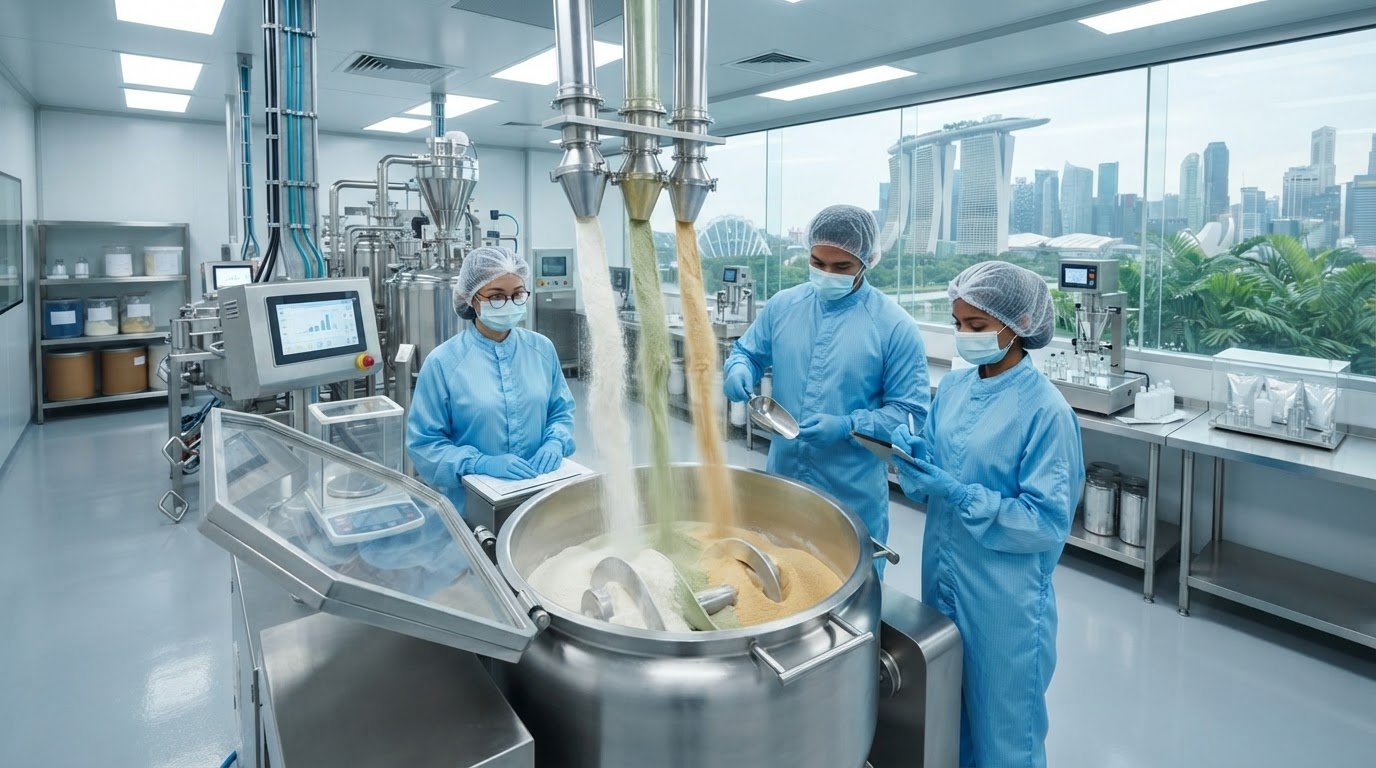
A powder formula can be carefully designed and still behave differently when production scales up. Bulk supplement powder blending depends not only on the ingredient list, but also on how ingredients move and combine during processing. Understanding the steps involved helps you prepare for production and spot details that need attention early.
To plan a blend, it helps to know what information a manufacturer needs and which ingredient properties may affect production. This guide covers the main blending stages, practical factors that influence consistency, and what to include in a manufacturing brief.
From ingredient proportions and powder properties to blending and filling, each stage connects formulation decisions with the finished product. Harmony Pharma Lab is an OEM Supplement Manufacturer Singapore, providing tailored powder blending and bottle or sachet filling for supplement brands. Its low MOQ options support brands at different stages of development. The sections ahead will help you prepare a clear, production-ready brief.
Key Takeaways
- Bulk supplement powder blending combines measured ingredients into a production blend. Formulation and packaging are separate parts of product development.
- Production moves from defining the formula and reviewing ingredients to planning the blend and preparing it for the intended finished format.
- Particle size, density and flow behaviour can affect blend consistency, so document known ingredient properties early.
- Prepare your formula, intended use, preferred format and available ingredient details to make manufacturing discussions more productive.
- Harmony Pharma Lab supports brands with tailored powder blends and bottle or sachet filling as part of its OEM supplement manufacturing in Singapore.
Bulk supplement powder blending: what the process does for a formula
Bulk supplement powder blending is the production step in which measured powdered ingredients are combined into a defined blend for filling or further processing. It turns the ingredient quantities specified for a product into bulk material that can move to the next manufacturing stage.
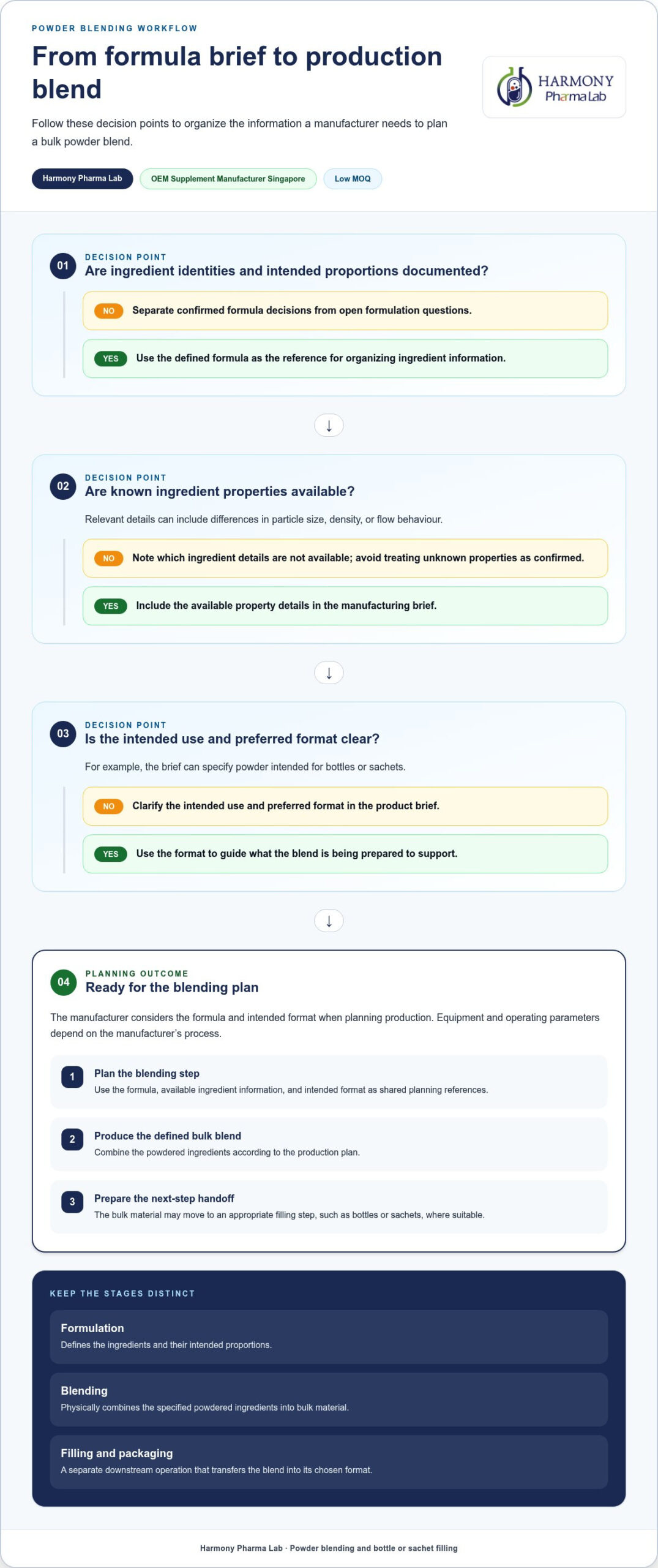
Blending has a distinct role in product development. Formulation defines the ingredients and their intended proportions. Ingredient sourcing obtains the specified materials, while blending physically combines them. Packaging comes later, when the blend is transferred into its chosen format. Keeping these activities distinct helps you identify what is settled and what still needs development.
What bulk blending contributes to a supplement formula
During blending, individual powdered ingredients are brought together as one production blend. A formula might combine a principal ingredient with smaller quantities of flavouring or other powdered components. The aim is to create a bulk material that represents the defined formula, rather than a collection of separate ingredients.
Blending does not, by itself, establish whether a formula is clinically effective. That question depends on considerations outside the physical mixing operation, including the evidence and decisions supporting the formula. Blending alone also does not establish a product’s stability or suitability for a particular use. These are separate development workstreams.
The blend is prepared for its intended next step. For example, a powder product may move from bulk blending to bottle or sachet filling. The target format matters because it shapes the handoff: the blend needs to be prepared as material for the next operation, not treated as a finished consumer product. Discuss the formula and packaging requirements as related but separate parts of the plan.
How a blend fits into a supplement product’s lifecycle
Product development starts before manufacturing. A brand establishes the product concept and defines its formula, including the intended ingredients and proportions. Sourcing makes the specified inputs available. Bulk blending is the production stage that combines those inputs according to the formula; it does not replace the decisions that created it.
After blending, the bulk material can move to an appropriate filling step, such as filling bottles or sachets. The intended format should be clear during production planning, even though filling is a different operation. This distinction helps align the formula brief, manufacturing work and final presentation.
Industrial approaches to combining solids vary according to how materials move and interact. An overview of industrial solid mixing mechanisms provides useful technical context. For brands, the practical point is that blending is one stage in a wider product lifecycle. Formula development and stability assessment inform product readiness, while blending and filling turn defined requirements into material prepared for the next manufacturing step.
How bulk supplement powder blending moves from formula to finished blend
Bulk supplement powder blending connects a product brief to a production blend and its next manufacturing step. The workflow depends on the ingredients, intended product format and production process. A clear brief gives the brand and manufacturer a shared reference without assuming that every formula follows an identical workflow.
From product brief to blend plan
Before production planning, the formula should identify each ingredient and its intended proportion. The product brief should also describe the intended use and preferred format, such as powder for bottles or sachets. The ingredient list explains what is being combined; the format indicates what the blend is being prepared to support.
- Define the formula. Document ingredient identities and intended proportions. Separate confirmed decisions from open formulation questions.
- Organise the input information. Gather available ingredient details, including known differences in particle size, density or flow behaviour that may affect handling.
- Plan the blending step. The manufacturer considers the formula and intended format when planning production. Equipment and operating parameters depend on the manufacturer’s process.
- Produce the blend. Combine the powdered ingredients according to the production plan to create the defined bulk material.
- Prepare the handoff. Align the completed blend with its next step, such as bottle or sachet filling, where appropriate.
This sequence is a practical way to understand the workflow, not a universal review checklist or a statement of regulatory requirements. Applicable product-market requirements and manufacturing details are separate considerations. Keep them distinct when planning a project rather than assuming one set of requirements applies to every market or product.
Blending and the downstream handoff
Blending combines the powdered ingredients specified in the formula. It does not itself fill retail containers or determine the final package. After blending, the bulk material may proceed to a suitable filling operation, including bottles or sachets, depending on the product brief and manufacturing plan. Keeping these stages distinct clarifies where blending ends and packaging begins.
For example, a brand developing a drink-mix powder for sachets should communicate both the defined formula and the intended sachet format. That context helps shape production planning and the handoff. The specific process details are determined by the manufacturer, since the same equipment or settings may not suit every powder formula.
Make the first manufacturing discussion more productive by organising the formula, intended use, preferred format and known ingredient details. Harmony Pharma Lab works with brands on tailored bulk powder blends and bottle or sachet filling as an OEM supplement manufacturing partner in Singapore.
What affects consistency in bulk supplement powder blends?
A consistent blend depends on more than the ingredient list. Each powder has physical properties that influence how it moves, combines and behaves during production. In bulk supplement powder blending, understanding these differences helps brands and manufacturers plan for the formula instead of assuming every powder will mix in the same way.
Particle size, density, and flow behavior
Particle size describes how large or small individual powder particles are. Bulk density refers to how much a quantity of powder weighs in a given volume, including the spaces between particles. Flow behaviour describes how readily powder moves when poured or transferred. These properties influence how ingredients enter, move through and leave a blending process.
Ingredients with noticeably different particle sizes or densities may move differently during mixing and handling. For example, a fine, light powder combined with larger, heavier particles may distribute differently from ingredients with more similar physical properties. A powder that flows freely may also behave differently from one that tends to cling or move unevenly. These differences do not mean a blend will necessarily be inconsistent, but they can affect process planning.
Ingredient properties and handling conditions together can affect the risk of variation in a powder blend. Share known ingredient details and flag materials that behave differently during storage or transfer. The manufacturer can consider those inputs within its production process.
Blend uniformity and segregation in context
Brands care about uniformity because the intended formula should remain appropriately distributed throughout the bulk blend. Segregation is the separation of ingredients after they have been combined. It may be a consideration during movement, transfer or filling, particularly when components differ in particle size, density or flow behaviour. It is a risk to assess, not an inevitable outcome of blending.
Understand uniformity expectations in context. A manufacturer may define a performance specification and explain how it evaluates a blend against that specification. Any figure applies to its stated process, method and product context, so it should not automatically be treated as a universal industry standard. Discuss what uniformity means for your product and how it relates to the production plan.
Equipment selection and process controls are also manufacturer-specific. A blender type, operating approach or transfer method that suits one formula may not suit another. Discuss how the manufacturer plans to handle the materials in your formula and how the blend will move into its next stage. This keeps attention on process fit rather than assumptions about a single ideal method.
How supplement brands can prepare for bulk powder blending
A clear production brief turns a product concept into a practical manufacturing discussion. You do not need to resolve every formulation question before starting. Separating confirmed decisions from open questions makes it easier to see what is ready for planning and what may need further development.
Organize the formula and product brief
Begin with the formula in a consistent format. List each ingredient by identity and intended proportion, using the same units and naming throughout. If a detail is provisional, label it clearly instead of presenting it as final. This gives the manufacturing discussion a reliable reference and helps prevent assumptions from becoming part of the production plan.
Next, describe the product concept and intended use in plain language. Include relevant sensory goals, such as a preferred flavour profile or desired characteristics of the finished powder. These preferences provide useful context, but should not be presented as validated specifications unless they have been established. Note known ingredient characteristics that may affect handling, and identify information that is still being developed.
A practical brief can bring together:
- The current ingredient list and intended proportions
- The product concept, intended use and relevant sensory goals
- Known information about the ingredients and any unresolved questions
- The preferred finished format and packaging direction
This is a preparation aid, not a universal required-document list. Its purpose is to make the project understandable and show which decisions are settled or still in progress. For example, if the flavour direction is chosen but the ingredient proportions are under review, state both clearly so the discussion can focus on the right workstream.
Define scale and the intended product format
Describe how you expect the product to move into production. State whether you are planning a bulk blend for further processing or a finished powder intended for bottle or sachet filling. If you have a target production scope, launch plan or expected demand, include it as planning context. This helps frame the manufacturing conversation.
Packaging direction matters because it clarifies the next step after blending. A powder for bottles and a powder for sachets share a blending stage, but lead to different filling formats. Note your preferred option and identify any alternatives still under consideration. The manufacturer can then discuss the project against its production process and the details in your brief.
Harmony Pharma Lab offers low MOQ options for brands developing powder supplements. As an OEM Supplement Manufacturer Singapore, it supports tailored bulk powder blends alongside bottle or sachet filling. Discuss your powder blend brief with Harmony Pharma Lab to frame the formula, intended scope and preferred format for production planning.
Working with Harmony Pharma Lab on OEM supplement powder blending
Turning a powder concept into a production project requires alignment between the formula, intended product format and manufacturing scope. Harmony Pharma Lab is a B2B OEM supplement manufacturing partner in Singapore, supporting brands with tailored bulk powder blends for functional health and wellness applications. Its powder services include blending and bottle or sachet filling, so brands can plan the blend and its next production step together.
Where Harmony Pharma Lab’s powder services fit
Bulk supplement powder blending is most useful when it is planned around a defined product brief. The ingredient list, intended proportions and product goals give the manufacturing discussion a practical starting point. From there, brands can consider how the blend will be used and whether the finished powder is intended for bottles or sachets.
Harmony Pharma Lab provides scalable OEM solutions for supplement brands, with powder manufacturing that includes blending and filling. This connects the bulk material to a downstream format without treating blending and packaging as the same operation. The project scope can be discussed in relation to the brand’s development stage and production goals.
This joined-up view can help brands refining a concept as well as those preparing a defined product for production. A clear brief keeps the discussion focused on the formula and intended output, while the manufacturing plan can be shaped around the project.
Moving from preparation to a manufacturing conversation
Before beginning a project discussion, organise the key details that describe what you want to make and where the product stands. A concise brief can include:
- The current formula, with ingredient identities and intended proportions
- The product concept, intended use and any relevant flavour or sensory goals
- The intended format, such as a bulk blend for further processing, bottles or sachets
- The production scope you are planning, along with details that remain undecided
Separating confirmed information from open questions makes the conversation clearer. For example, identify the preferred format while noting that some formula details are still being developed. This gives the manufacturing discussion context without presenting an unresolved decision as final. Harmony Pharma Lab’s low MOQ options can also suit brands planning production at different stages.
As an OEM Supplement Manufacturer Singapore, Harmony Pharma Lab works with brands to align tailored powder blending and filling with their project brief. Share your formula status, intended format and production scope to begin a focused discussion about next steps. Discuss your powder manufacturing project.
Move your powder concept toward production
Turn your product priorities into a focused manufacturing brief. Identify which decisions are settled, where you still need input and how you want the product to progress from concept to production. This gives the discussion a clear purpose and connects development choices with your commercial goals.
With bulk supplement powder blending, progress comes from aligning the product brief with a practical production approach. Start with the information already available and refine open points as the project takes shape. A structured conversation can clarify the path from an initial concept to a production-ready plan.
Harmony Pharma Lab works with supplement brands as a B2B OEM manufacturing partner. Discuss your powder manufacturing project and take the next step with a clearer direction for your product.
Frequently Asked Questions
How long does bulk supplement powder blending take?
There is no single duration for bulk supplement powder blending. Timing depends on the formula and production plan. A project with a settled ingredient brief may need different preparation from one with inputs or proportions still being finalised. The intended filling format can also shape the overall schedule. Share the project scope and the status of the formula when discussing timing so the estimate reflects the work involved.
Can ingredients with different particle sizes be blended together?
Yes. Ingredients with different particle sizes can be combined, although their physical differences may affect how they move during blending and handling. A fine powder and a coarser powder, for example, may flow or settle differently. Include known differences in your ingredient information and flag materials that have been difficult to handle. The manufacturer can consider these properties when planning a process for the blend.
What information should a brand prepare before requesting powder blending?
Prepare a current formula, intended product use, preferred format and summary of the production scope you have in mind. Label formula versions clearly, especially if ingredient proportions have changed during development. Include available ingredient details and list unresolved questions separately. For example, distinguish a confirmed flavour direction from a formula that is still being finalised. This helps focus the manufacturing discussion on settled decisions and those that need attention.
Does bulk powder blending include filling bottles or sachets?
Blending and filling are separate production steps, so blending alone does not include packaged formats. A bulk blend may be prepared for later filling, depending on the project scope. Harmony Pharma Lab’s powder manufacturing services include blending and bottle or sachet filling, allowing brands to plan these stages together. Specify the intended package format early to clarify the handoff after blending.
Can a supplement brand start with a low minimum order quantity?
Harmony Pharma Lab offers low MOQ options for supplement brands, including those developing powder products. Describe the production scope you are considering and the intended format when planning your project. This gives the manufacturing discussion useful context for aligning the brief with production.
Is bulk powder blending the same as supplement formulation?
No. Formulation defines the ingredients and their intended proportions; blending is the production operation that combines those specified ingredients. Deciding to revise the amount of a flavour component is a formula decision, while combining the approved ingredients into a production blend is blending. Keeping the activities distinct helps you identify whether you are still developing the product composition or are ready to plan its manufacture.