
To choose a supplement manufacturer, focus on whether its capabilities match your product format, whether its quality controls and certifications cover the work, and whether its production model and ingredient sourcing support your plans. Before signing, clarify who owns the formula, how quality is managed from ingredients through finished batches, and what documentation supports compliance with Singapore requirements. The Health Sciences Authority says businesses involved in importing, selling or manufacturing health supplements must understand the applicable regulations and permissible health claims.
Production capacity and commercial terms matter, but they are only part of the picture. Development expertise, communication, sourcing transparency, and the ability to support future production can also affect how smoothly a product moves from concept to market.
This guide explains how to compare manufacturing services, certifications, production models, and ingredient sourcing, with practical questions to raise before signing. It also covers how to assess regulatory knowledge for Singapore and decide whether a partner suits your current requirements and longer-term plans.
Key Takeaways
- Compare a manufacturer’s formulation, production and testing capabilities against your product format and planned growth.
- Look beyond certification names: assess their scope, facility coverage and relevance to the work being performed.
- Understand how white-label, private-label and custom manufacturing differ, especially in formula ownership and product development.
- Assess ingredient sourcing transparency and how supply-chain choices may affect production planning and oversight.
- Before signing, clarify quality controls, Singapore regulatory knowledge, documentation and the responsibilities assigned to each party.
1. Manufacturer services, from formulation through production and testing
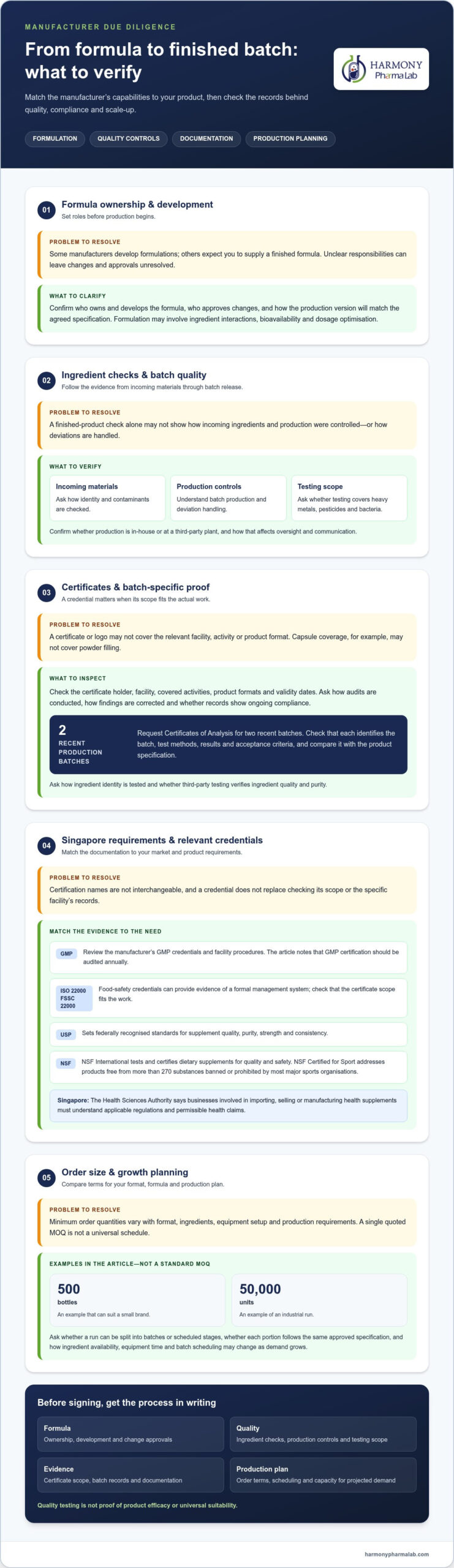
To choose a supplement manufacturer, map its services against your product’s development stage. Some manufacturers support formulation; others expect brands to supply a finished formula. Formulation work can involve ingredient interactions, bioavailability, and dosage optimisation, not simply blending ingredients. For example, a powder formula may need adjustment for ingredient compatibility and the intended serving size. Establish who develops the formula, who approves changes, and how the final production version will match the agreed specification.
Trace production from ingredient receipt to batch release. Ask how incoming materials are assessed, how batches are produced, and what testing is performed. Testing may cover heavy metals, pesticides, and bacteria. A defined process helps you understand what evidence supports product quality and how deviations are handled. It also clarifies whether production takes place in-house or through a third-party plant, which affects oversight and communication.
Minimum order quantities shape inventory commitments and the flexibility of a launch. They vary with the format, ingredients, equipment setup, and production requirements, so compare the terms for your specific formula. Ask whether a production run can be divided into separate batches or scheduled stages, and whether each portion follows the same approved specification. A 500-bottle order can suit a small brand compared with an industrial run of 50,000 units, but those figures are examples, not a universal MOQ schedule.
Plan capacity around the launch and projected demand. Discuss how production requirements may change as the brand grows, including ingredient availability, equipment time, and batch scheduling. If forecasts increase, clarify how larger volumes affect production planning and quality controls. Efficient output matters, but deadlines should not displace the checks that help keep batches consistent. Compare the production process with realistic sales scenarios before committing to a volume.
Separate product effectiveness from manufacturing execution. A manufacturer can produce a product to an agreed formulation, but production alone does not establish that its claims are supported or that it suits every consumer. Ingredient evidence, dosage, interactions, and intended use all matter. Side effects can depend on the ingredients and the person using the product, so do not treat a quality test as proof of efficacy or universal suitability. In Singapore, the Health Sciences Authority says businesses must understand permissible health claims when manufacturing, importing, or selling health supplements.
Assess a manufacturer’s reputation through documented practices, not presentation alone. Compare the formula, production steps, testing scope, minimum order quantity terms, and scaling process in writing. Follow the product from specification to batch records, then assess whether capacity can support the brand’s next stage without changing agreed quality controls.
2. Verifying certification scope and accreditation
Ask how incoming ingredients are checked for identity and contaminants, including heavy metals, pesticides, and bacteria. Quality checks should also cover production controls and finished-batch results, so quality is assessed throughout manufacturing rather than only at release.
A certificate is useful only if its scope fits the work. Review the certificate holder, facility, covered activities, product formats, and validity dates. For example, a certificate covering capsule production may not cover powder filling. Confirm that the facility and process relevant to your product are within the documented scope, rather than relying on a logo or general statement of compliance.
For Singapore-market products, assess the manufacturer’s GMP credentials and how its facility maintains documented procedures. Ask how audits are conducted, how findings are corrected, and whether records show ongoing compliance. GMP certification should be audited annually. Food-safety credentials such as ISO 22000 or FSSC 22000 can provide further evidence of a formal management system, but they don’t replace checking the scope of the specific certificate.
Request Certificates of Analysis for two recent production batches. Compare each certificate with the product specification and confirm that it identifies the batch, test methods, results, and acceptance criteria. Ask how ingredient identity is tested and whether third-party testing verifies ingredient quality and purity. This review helps distinguish a batch-specific record from a generic sample that may not represent the product being manufactured.
Accreditation names describe different kinds of assurance. ISO certification indicates that a manufacturer has implemented a quality-management system meeting relevant ISO standards. The United States Pharmacopeia (USP) sets federally recognised standards for supplement quality, purity, strength, and consistency. NSF International tests and certifies dietary supplements for quality and safety. NSF Certified for Sport addresses a narrower use case, certifying products free from more than 270 substances banned or prohibited by most major sports organisations.
Match each credential to your commercial requirements. If a product targets competitive athletes, assess whether Informed Sport or NSF Certified for Sport is relevant; if retailer expectations prioritise food safety, review ISO 22000 or FSSC 22000 scope. These marks aren’t interchangeable, and certification alone doesn’t establish that every product or batch meets its specification. For a structured review, compare certificates, audit records, testing protocols, and batch documents together.
Use this evidence to assess a manufacturer’s quality-control approach alongside its certification documents. A clear record should connect the facility’s procedures to the exact product format and batches under consideration.
3. White label, private label and custom manufacturing models
In Singapore, supplement products must meet Health Sciences Authority (HSA) requirements, and businesses must understand the permissible health claims for their products. Include the intended ingredients, label content, and claims in your manufacturing brief so product development and compliance planning stay aligned.
White-label and private-label arrangements generally use ready-made formulas sold under a brand’s identity. Custom manufacturing develops a formula to the brand’s specification. Under an OEM arrangement, the formula belongs to the brand and can move to another supplier; a catalogue private-label formula belongs to the manufacturer and may also be sold to other brands. Clarify formula ownership and permitted changes in the agreement.
Choose a model based on how much product differentiation and development input you need. A ready-made capsule formula may suit a simpler branding project, while custom formulation gives the brand more control over ingredients and product specifications. Compare development responsibilities, approval points, and production arrangements for each option. Ask whether packaging, labeling, and regulatory support are included or handled separately by the brand.
Private labeling and drop shipping are separate service questions. Private labeling concerns branding a product; drop shipping concerns how orders reach customers. Confirm in writing who manages label artwork, finished-product packaging, order fulfillment, and customer-facing responsibilities. A manufacturer’s role in production does not, by itself, mean it handles distribution.
Build label review into the production schedule before artwork goes to print. Check that the ingredient list matches the approved formula, then review allergens, additives, expiry dates, and health claims against product records. For capsules, verify the listed ingredients and serving information against the final specification. Treat labeling as part of quality control: accurate products can still be presented incorrectly if artwork uses outdated formula details.
Singapore requirements differ from European Union rules, so don’t copy an export label without a market-specific review. For EU food supplements, Directive 2002/46/EC covers statements including the daily dose, a warning not to exceed it, and advice that supplements don’t replace a varied diet. Regulation (EU) No 1169/2011 covers food information language requirements. These EU references apply to EU labeling, not automatically to Singapore.
Before signing, assign responsibility for label drafting, regulatory review, artwork approval, and print release. Define who checks each revision and how ingredient changes trigger a new label review. Document formula ownership, packaging tasks, testing records, and claims review before production begins.
4. Ingredient sourcing and supply-chain transparency
Yes. Supplement manufacturers in Singapore can source ingredients and provide Certificates of Analysis (CoAs) for documented quality checks. During evaluation, connect each CoA to the ingredient identity, supplier, and batch used in your product, rather than treating it as a general assurance.
Ask for a clear account of ingredient sourcing, from supplier selection through receipt and production. For example, trace a botanical or vitamin from supplier records to the batch documentation. Confirm how substitutions are communicated and approved, since a changed ingredient can affect the agreed formula, testing plan, and finished-product specifications. This transparency helps your team assess material consistency and understand responsibilities across the supply chain.
Supply origin can affect production planning as well as paperwork. Internationally sourced supplement ingredients can take 6 to 8 weeks or longer to arrive. Local supplement manufacturing in Singapore can reduce shipping times and logistical complexities, while making production oversight and communication easier. Ask how ingredient availability is incorporated into scheduling, and what happens to production plans if a shipment is delayed or a supplier changes.
Use specific requests to evaluate communication. Ask for the manufacturing process, the records that accompany incoming ingredients, and an explanation of any test results that fall outside agreed specifications. Basic technical enquiries should receive a response within 48 hours. Slow or incomplete answers to direct questions about sourcing, traceability, or documentation are a warning sign, especially when those details affect production decisions.
Pricing transparency also depends on understanding what a quote includes. The price depends on the case and is given after a quote request; relevant factors include the ingredient specification, sourcing requirements, product format, order volume, testing, and packaging work. Compare like with like by identifying which items are included, how changes to the formula affect the scope, and whether ingredient substitutions require fresh approvals. Clear cost assumptions help prevent misunderstandings during development.
Before approving a manufacturing plan, document ingredient specifications, acceptable alternatives, supplier-change notifications, and required records. Assign an owner to each step: sourcing, incoming checks, storage, production, and batch documentation. For example, if a supplier changes an ingredient source, the agreed process should show who assesses the change and updates records. This makes supply-chain transparency practical and gives your team a basis for evaluating sourcing risks and production continuity.
5. What should I ask before signing with a contract manufacturer?
Using an overseas manufacturer for Singapore sales can add coordination and oversight challenges. Differences in production procedures, documentation, communication, and familiarity with Singapore’s requirements can complicate quality control and launch planning. Health Sciences Authority guidance says importers, sellers, and manufacturers must understand Singapore’s health supplement regulations and permissible health claims.
Put responsibilities in writing before sharing a formula or approving production. A confidentiality agreement can set expectations for handling formula details and brand information. The manufacturing contract should identify the product specification, who approves changes, how deviations are recorded, and who maintains batch documentation. For example, if an ingredient changes, the agreement should define approval steps before the revised formula enters production.
Ask how Good Manufacturing Practices (GMP) are applied throughout production. GMP is intended to ensure products are consistently produced and controlled according to quality standards. For products intended for Singapore, assess whether the manufacturer holds GMP certification and whether its scope covers your product format and facility. Certification for one format does not automatically demonstrate coverage for a different process.
Quality control should operate throughout manufacturing, not only at final release. Clarify how incoming materials, in-process checks, deviations, and finished batches are documented. Ask who reviews testing records and how results outside specifications are handled. Contract terms should explain how affected batches are held, investigated, and dispositioned, so quality decisions have a clear owner.
Regulatory knowledge also matters. Ask how the manufacturer supports documentation and label review for your target markets. Singapore’s HSA guidance on permissible health claims is relevant to product communications, while requirements may differ overseas. A supplement label and its claims should align with the intended market, formula, and supporting product records. Specify who prepares and approves each document.
Before signing, review the manufacturer’s experience with your product type, quality procedures, and client-support responsibilities. Client history and references can help you assess whether its operating model suits your production needs. Treat product recalls, undisclosed ingredients, inadequate labels, and unsupported efficacy claims as warning signs. Price alone is a poor basis for selection if quality controls and compliance responsibilities remain unclear.
Use these contract questions to define a practical manufacturing relationship before production begins. To discuss your production requirements and next steps, plan your supplement manufacturing project.
Harmony Pharma Lab: Soft Capsule
Harmony Pharma Lab manufactures supplements for brands seeking a business-to-business production partner. Its Soft Capsule offering suits projects built around that dosage form, while Gummies, Hard Capsule, and Tablet provide additional format options. The company highlights its first Soft Capsule facility in Singapore, first Gummies facility in Singapore, and Low MOQ for supplement brands.
Bring your product format, formula requirements, and target market into the discussion to shape a project brief and production approach.
Contact Harmony Pharma Lab to discuss your supplement manufacturing requirements, or visit harmonypharmalab.com.
Move your product plan toward production
Turn your product concept into a clear project brief. Define the intended format, formula status, target market, and production priorities so discussions can focus on practical requirements. A structured brief also helps your team align internal decisions before development or production planning begins.
As you choose a supplement manufacturer, consider how its formats align with your product roadmap, not just the first product. Harmony Pharma Lab manufactures Soft Capsules, Gummies, Hard Capsules, Powder, Liquid, and Tablet, supporting brands evaluating these formats for their plans.
Bring your requirements and questions into a direct discussion with the manufacturing team. Contact Harmony Pharma Lab to discuss your supplement production project and take the next step with clarity.
Frequently Asked Questions
What should I ask before signing with a contract manufacturer?
Ask who controls formula changes, approves production specifications, and retains batch records. Clarify how quality issues are documented and resolved, and identify who prepares product labels and compliance documents. For example, if your team changes an ingredient after a pilot batch, the agreement should explain how the revised specification is reviewed before production continues. Health Sciences Authority guidance also makes understanding Singapore’s permissible health claims important for businesses manufacturing, importing, or selling health supplements.
Why does formula ownership matter?
Formula ownership determines who controls the formulation and whether it can move with your brand. In an OEM arrangement, clarify formula ownership and whether it can move to another supplier in the agreement. A catalogue private-label formula belongs to the manufacturer and may also be sold to other brands. Before signing, define ownership of the formula, development records, and later revisions, so supplier changes or product updates have a clear contractual basis.
How do I choose a reputable supplement manufacturer in Singapore?
To choose a supplement manufacturer, compare relevant production experience, quality procedures, and clear documentation. Then assess how well its operating model fits your product and target market. For example, a brand preparing an initial product brief can assess whether the manufacturer explains responsibilities from format selection through production and quality documentation. Review references and client history as supporting evidence, and consider clear answers to technical questions as part of your assessment.
What certifications should a supplement manufacturer have, such as GMP, ISO 22000, or HACCP?
For Singapore-market supplement manufacturing, assess GMP certification and verify that its scope fits your product and facility. ISO 22000 is a food-safety management certification that may offer relevant evidence; HACCP refers to a food-safety approach, so clarify what certification or documented system is being claimed. These terms are not interchangeable. Ask how each credential relates to the processes in your project, rather than choosing by certificate count alone.
What questions should I ask a supplement manufacturer before signing a contract?
Ask who owns the formula, who approves specifications, and how changes are controlled. Clarify access to batch records, responsibility for label review, and how production deviations are communicated and resolved. For example, agree on the steps required before using a revised label or ingredient specification. Put these responsibilities in the contract, including who maintains relevant quality and compliance records, so decisions do not depend on informal conversations.
What are typical supplement manufacturing prices and lead times in Singapore?
Manufacturing prices depend on the project and are provided after a quote request; key factors include product format, ingredients, production volume, and testing or packaging requirements. Lead times depend on the development work, production planning, and ingredient availability. Internationally sourced supplement ingredients can take 6 to 8 weeks or longer to arrive, which may affect scheduling. Distinguish ingredient transit from the full manufacturing timeline when planning a launch.