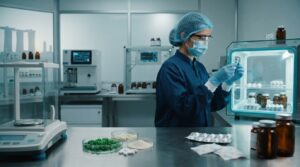

A liquid supplement’s success depends on more than its formula. Nutraceutical liquid contract manufacturing can bring formulation, ingredient planning, blending, production, filling and quality documentation together. Decisions about flavour, stability and packaging shape the process, while requirements depend on where the product will be sold, including Singapore and any intended export markets.
Product teams need to understand how these decisions connect before moving from concept to commercial production. This guide explains the manufacturing stages, how custom formulas and ingredient sourcing fit in, and which compliance and quality considerations matter. It also covers how packaging, testing and production requirements affect a project, helping you assess the process clearly.
Key Takeaways
- Map the liquid dosage form to your product brief, intended use and packaging needs before moving into production planning.
- Clarify how a supplied formula and ingredients will be assessed, sampled and incorporated into a manufacturing workflow.
- Build quality checks around ingredient identity, product stability and documented production controls.
- Compare manufacturing options by their format capabilities, minimum order quantities and support for product development.
- Align Singapore compliance considerations with the markets where the finished supplement is intended to be sold.
What Does Nutraceutical Manufacturing Involve?
Nutraceutical manufacturing turns a product brief into a defined supplement format, production process and finished pack. Oral liquids suit consumers who prefer a measured liquid serving to tablets or capsules. Other formats include powders, tablets, hard capsules, soft capsules and gummies. Format affects ingredient compatibility, processing choices and how consumers take the product.
Liquid product development starts with the intended ingredients and serving format. Teams then consider how the ingredients behave together and whether blending or emulsification suits the formula. Stability matters throughout the product’s shelf life, so manufacturers assess whether the formulation retains its intended characteristics over time. A sample lets teams evaluate the product before production moves forward.
Flavour and colour are product decisions, not just finishing touches. For example, a citrus flavour creates a different consumer experience from a neutral-tasting liquid. Teams can choose an existing flavour or develop a new one, then assess samples before launch. Colour also contributes to appearance. Each choice should suit the formula and intended brand presentation.
Supplement demand also overlaps with functional foods and beverages, although these categories can involve different product formats and manufacturing requirements. Functional food and beverage contract manufacturing accounted for more than 64.0% of the global market’s revenue share in 2025. That figure describes a global market segment, not consumer demand in Singapore. For product teams, the practical step is to define whether the brief is a dietary supplement or a functional food or beverage.
Packaging affects how a supplement is filled, presented and labelled. Liquids may be packed in bottles or sachets, while other supplements may use pouches, unit doses or blister packs. Bottle labels need a legible layout that fits the container and communicates the product information. Some manufacturers also provide packaging graphic design. Align the artwork, container and product presentation before packaging begins.
COVID-19-related supply-chain disruption is a useful scenario for testing a production plan. If an ingredient or packaging component becomes difficult to source, a change may affect the formula, product presentation or production schedule. Teams can map critical raw materials and packaging components, identify acceptable alternatives during development, and document any approved changes. This planning helps reveal dependencies before a disruption reaches a production run.
The manufacturing workflow connects formulation, sourcing, processing, filling and quality assessment. For a liquid supplement, blending or emulsification prepares the product for filling into the selected bottle or sachet. Stability assessment evaluates the liquid over its shelf life, while packaging review checks that the finished presentation matches the intended design. Together, these steps turn the product brief into a repeatable manufacturing plan.
Competitive landscape and company developments
In Singapore, product teams can work with B2B nutraceutical manufacturers offering liquid production, including blending, emulsification, and bottle or sachet filling. The relevant comparison is each manufacturer’s formulation support, production capabilities, quality controls, and ability to move from development into scale-up.
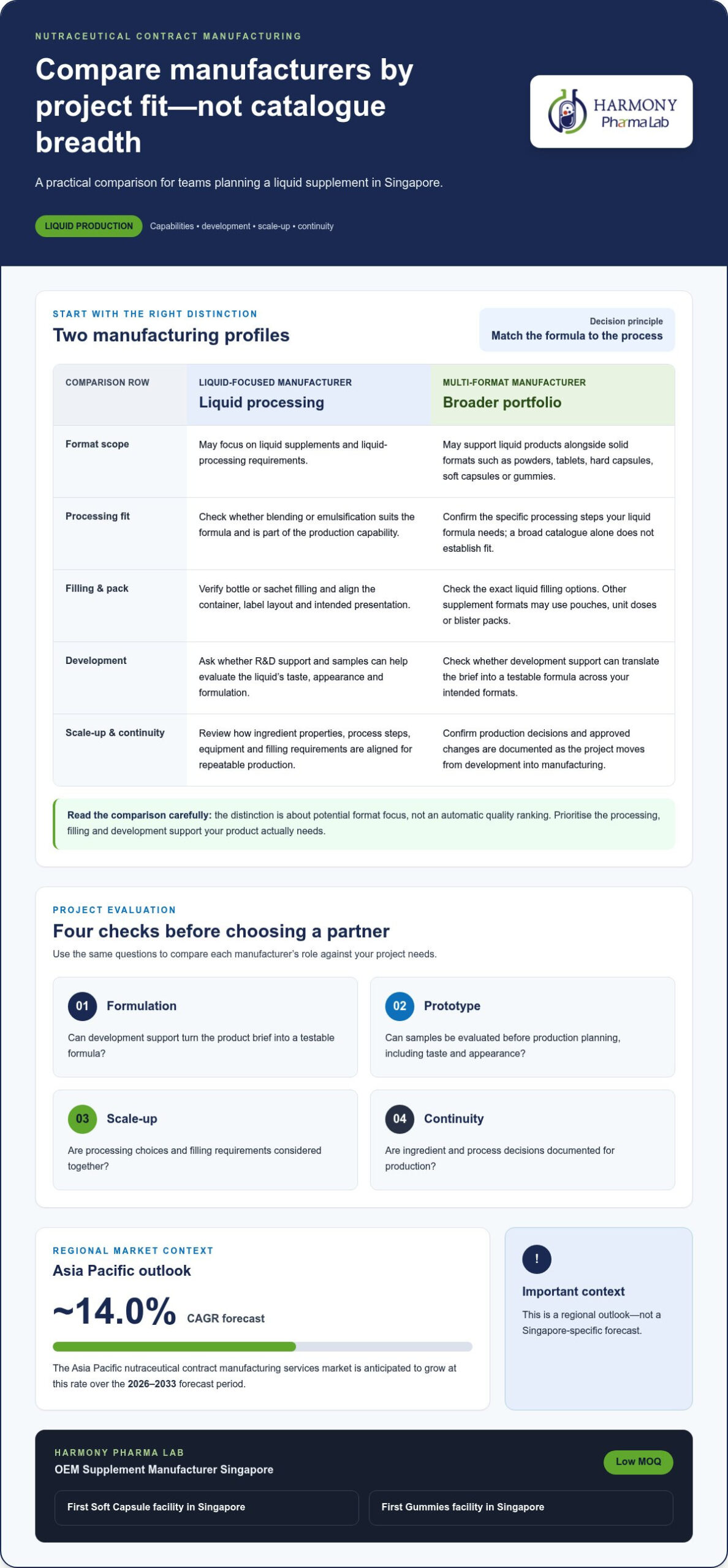
Some manufacturers focus on liquid supplements, while others produce both liquid and solid dosage forms. This distinction affects how a team plans a wider portfolio: one partner may support multiple formats, while a specialist may focus on liquid processing. When comparing capabilities, prioritise the specific processing and filling steps your formula needs over the breadth of a product catalogue.
Research and development support can turn a product brief into a testable formulation. A manufacturer may develop a product and launch it on a pilot basis to gather customer feedback. For example, a team developing a botanical liquid could assess a prototype’s taste and appearance before settling on the production formula. A sample also gives the team an opportunity to carry out custom testing.
Scale-up means translating the approved formulation into a repeatable manufacturing process. Align ingredient properties, processing steps, equipment and filling requirements, then review how each decision affects production consistency. Changes in ingredient form or concentration can affect blending or emulsification. Prototype work helps identify these effects before moving to larger-scale manufacturing.
Company developments can reshape the wider supply landscape. In May 2024, Ashland Inc. signed a definitive agreement to sell its nutraceuticals business to Turnspire Capital Partners LLC. The planned sale was expected to close in the calendar third quarter of 2024, subject to customary closing conditions. This illustrates why product teams should consider continuity and communication across development and production, rather than treating a manufacturing relationship as a single transaction.
Regional growth also helps explain manufacturers’ investment in capabilities. The Asia Pacific nutraceutical contract manufacturing services market is anticipated to grow at a CAGR of around 14.0% over the 2026-2033 forecast period. That regional outlook is not a Singapore-specific forecast, but it highlights the importance of assessing operational readiness alongside development support.
For a practical comparison, map each manufacturer’s role against your project needs:
- Formulation: Can development support translate the product brief into a testable formula?
- Prototype: Can samples support evaluation before production planning?
- Scale-up: Are processing and filling requirements considered together?
- Continuity: Are ingredient and process decisions documented for production?
For a Singapore project requiring liquid production, review liquid supplement manufacturing capabilities alongside these development and scale-up considerations.
Can I provide my own formulation or raw materials?
Yes. A product team can bring an existing formulation or ingredients into a manufacturing project. The next step is to align these inputs with the intended dosage form, production process and product requirements.
Customer-Provided Formulations and Ingredients
A supplied formula gives the manufacturer a starting point for planning production. Share the ingredient list, proportions, processing instructions and target format so the development team can understand how the components fit together. For a liquid supplement, consider the formula alongside blending, emulsification and filling requirements. Ingredient sourcing can also be discussed as part of the project.
If you provide raw materials, organise the ingredient information and the intended role of each component. A botanical extract, for example, may need different handling from a flavour ingredient. Clear records help the manufacturer plan how materials enter the process and assess how formulation adjustments affect the finished product. This review also brings outstanding decisions to light before production planning advances.
Private Labelling and Custom Formulations
Private labelling lets a brand sell a supplement under its own identity while manufacturing and packaging are handled through a contract arrangement. The product team still defines the formulation, presentation and label content. For example, a brand that prefers a liquid format can align its formula and bottle label with a specific consumer preference.
Custom formulation is relevant when a product concept needs development rather than direct transfer into production. Teams define the intended ingredients, dosage form and product characteristics, then consider how these choices shape manufacturing. Private labelling and custom formulation can be combined, but serve different needs: one concerns brand presentation, the other product composition.
Custom Formulation and Sample Testing
After formulation, a manufacturer may provide a sample for testing. This gives the product team a practical way to assess the proposed formula against its brief before proceeding. For a liquid, the review might cover taste, appearance and how well the sample reflects the intended concept. Feedback can then inform formulation adjustments and the next development decision.
Record specific observations during sample testing rather than giving general approval. Note whether the flavour matches the brand preference, whether the liquid’s appearance suits the intended presentation, and which ingredients or characteristics need further attention. This gives the development team actionable direction and helps distinguish formulation issues from packaging or label design concerns.
Before development begins, organise the project inputs into a shared brief. Include the current formula or ingredient plan, desired dosage format, private-label requirements and sample-testing objectives. This connects product development with manufacturing capabilities and keeps formulation decisions visible as the project progresses. If the team has a pre-researched formula, it can assess that option against product requirements before choosing a development route.
Regulatory compliance and quality assurance
Yes. Contract manufacturers in Singapore can support formulation, packaging and labelling, while export requirements depend on the destination market. Align each product’s documentation and controls with the markets where it will be sold.
Regulatory Compliance
Regulatory review connects product composition, manufacturing records and label content to the intended market. In the United States, 21 CFR Part 111 sets cGMP requirements for dietary supplement manufacturing, packaging, labelling and holding. Manufacturing records can document a product’s formulation, equipment and process parameters. These U.S. requirements apply to products entering that market, not automatically to Singapore sales.
For export planning, identify each destination early and map its requirements. The FDA is one example of an authority that sets dietary supplement requirements. Review labels against the formulation and intended market, and keep packaging and production records aligned with the approved product details.
Quality Control and Batch Release
Quality control combines documented production steps with testing of ingredients and finished products. Identity, potency and contaminant testing can help assess whether materials and products match specifications. Quality control may include in-process checks and attention to blend uniformity. Subpart K requires label review against the master label before release and packaging-material testing.
Batch release should follow a review of relevant production and testing records. For tablets, for example, teams can connect the batch record with in-process results and finished-product checks. This provides a traceable basis for release decisions and helps identify deviations that need investigation before distribution.
Raw Material Sourcing and Checks
Ingredient quality begins with sourcing records and checks that establish material identity and suitability. Under 21 CFR Part 111, Subpart E requires identity testing of every dietary ingredient lot; a certificate of analysis alone is insufficient. Teams should retain records connecting each lot to its supplier, test results and use in the finished batch.
For a liquid formula, ingredient characteristics can affect blending, emulsification and the finished product. Define acceptance criteria for each material, then record checks at receipt and before production. This makes substitutions visible and helps preserve traceability when a raw material changes.
HACCP and GMP Standards
HACCP focuses on identifying hazards and establishing controls at relevant process steps. GMP supports controlled, documented manufacturing, including equipment, sanitation, records and production procedures. Together, these frameworks connect risk assessment with routine operational controls, rather than treating quality as a final inspection alone.
Certification schemes are distinct from general quality practices. NSF/ANSI 173 is a voluntary dietary supplement certification involving facility audits, product testing, label verification and annual recertification. USP Dietary Supplement Verification is also voluntary and verifies active content, purity, dissolution and manufacturing-site review. These programmes describe specific verification approaches, not universal market-entry requirements.
For export projects, build a market-by-market requirements matrix covering formula, label, packaging and supporting records. A product intended for Singapore and another country may need separate label reviews even if its formula is unchanged. This planning connects regulatory requirements with manufacturing controls before a batch is scheduled.
Keep the review practical: link each material specification to its test evidence, each production step to a record, and each label version to its approved formula. For example, a label change should prompt a check that the ingredient declaration still matches the current product. This document trail supports controlled updates and consistent quality decisions.
Nutraceutical contract manufacturing
In Singapore, liquid supplement contract manufacturing can include formulation, ingredient procurement, blending, emulsification, bottle or sachet filling, packaging and labelling. Depending on the project, the workflow may also include sample development and product testing.
The value lies in coordinating these steps around one product brief. A brand can supply a formula or request development, then align ingredient specifications with processing and packaging requirements. For example, a liquid designed for sachet filling needs a production plan that accounts for both the formula and the chosen pack. Each decision shapes the next stage.
Manufacturing methods depend on product characteristics and format. Blending combines ingredients into a consistent mixture, while emulsification helps disperse components that need to be combined in a formula. The formula, ingredient properties and intended production method guide the process choice. Equipment and process parameters are then documented to support consistent execution.
Packaging belongs in production planning, not as a final administrative detail. The choice between a bottle and sachet affects filling requirements and label layout. Coordinate the pack format, label artwork and product information before production. If a label or packaging component changes, assess whether the manufacturing plan or product records also need updating.
Contract manufacturing can connect development with a pilot run. A prototype or pilot product lets a team assess customer feedback before moving to broader production. Feedback on flavour, appearance or packaging can guide product adjustments. The production process should then reflect the agreed formulation and any changes accepted during development.
Define the scope before comparing manufacturing proposals. Specify whether the project needs a supplied or developed formula, ingredient sourcing, liquid processing, filling, packaging, labelling or testing. This clarifies which activities are included and where the brand needs to make decisions. It also makes it easier to compare manufacturing capabilities with the actual product brief.
Global market forecasts provide context, but they do not determine a Singapore project’s requirements. One forecast projects the global nutraceutical contract manufacturing services market to grow at a CAGR of 12.0% from 2026 to 2033. For an individual supplement, practical planning still depends on formulation, packaging choices, production needs and target markets.
Keep nutraceutical products distinct from pharmaceutical manufacturing in the project scope. A dietary supplement brief should define its ingredients, intended dosage form and label needs, while the manufacturing plan sets out production and quality steps. A clear scope prevents unrelated services from being assumed.
For a liquid supplement project, discuss your production requirements as the next step in turning the product brief into a manufacturing plan.
Harmony Pharma Lab: Soft Capsule
Harmony Pharma Lab is a natural next step for Singapore product teams developing supplements in formats such as Soft Capsule, Gummies, Hard Capsule or Tablet. Its low MOQ can suit brands planning an initial production run or evaluating a new product format.
Harmony Pharma Lab has the first Soft Capsule facility in Singapore and the first Gummies facility in Singapore. These options may suit product teams considering a format beyond liquid or building a wider dosage-form portfolio. The right direction depends on the formulation, product requirements and intended consumer experience.
Bring your product concept and preferred dosage form to a discussion about OEM supplement manufacturing. Contact Harmony Pharma Lab to discuss your project or visit harmonypharmalab.com.
Move Your Product Brief Toward Production
The next step is to turn your product concept into a clear manufacturing brief. Set out the intended dosage form, formulation direction, target market and packaging preferences. These details frame a practical discussion about development and production requirements while keeping your commercial objectives in view.
For teams considering a broader supplement portfolio, Harmony Pharma Lab offers Soft Capsule, Gummies and Hard Capsule formats alongside liquid production. This range can support planning around one product concept or related products in different dosage forms. The right approach depends on your formulation and brand objectives.
A focused discussion about nutraceutical liquid contract manufacturing can connect your product requirements with an appropriate production approach. Prepare the key details your team has defined, including formula status, ingredient plan and packaging direction.
Contact Harmony Pharma Lab to discuss your project. A well-structured brief is a practical starting point for moving your product forward.
Frequently Asked Questions
How long does liquid production and filling take?
Production timing depends on formulation readiness, ingredient availability, packaging selection and testing requirements. A project using an approved formula and ready materials follows a different path from one that needs formulation development or sample revisions. Filling also depends on the pack, such as bottles or sachets. Map the stages and approval points so your launch plan accounts for development decisions as well as the manufacturing run.
What is the minimum order quantity for liquid supplements?
Minimum order quantity depends on the product’s formulation, production setup and packaging format. Harmony Pharma Lab offers low MOQ for supplement manufacturing, which can suit brands planning an initial run. A liquid filled into bottles may need different production planning from one filled into sachets. Define the product format and packaging early, as these choices affect how a production batch is organised.
What types of nutraceutical liquids can be contract manufactured, such as syrups, shots, and drops?
Liquid supplement projects can include concentrated formats such as vitamin drops and herbal tonics, as well as energy shots and functional beverages. Distinguish ready-to-drink products from concentrated liquids in the product brief, since intended use informs formulation and packaging decisions. Syrups are another liquid concept teams may explore, with the formula and manufacturing process shaped around product requirements.
What are the minimum order quantities and typical lead times for liquid supplement manufacturing in Singapore?
In Singapore, Harmony Pharma Lab offers low MOQ, while production timing depends on the project’s formulation, sourcing, packaging and testing needs. These factors determine the preparation needed before filling and how the production run is planned. For a useful project estimate, define the formula status, bottle or sachet preference, and any outstanding sample or label approvals.
What quality certifications and testing should a Singapore liquid supplement manufacturer have?
Harmony Pharma Lab is GMP-certified and a US FDA-registered manufacturer, with a compliance framework aligned with Singapore HSA requirements and relevant international standards. For a liquid supplement, quality planning should cover ingredient identity, potency and contaminant testing, as well as stability assessment. Match the test plan to the product and intended markets: certification and product-specific test results serve different purposes.
What are the steps to develop and manufacture a custom nutraceutical liquid product?
A practical workflow moves from concept and brief to format selection, formulation, production, quality documentation and market-ready preparation. At each stage, assign a decision owner and record the approved version of the brief. Finalising the bottle or sachet format before production, for example, keeps packaging decisions connected to filling requirements. Clear approvals also help teams manage revisions and track the current product specification.
How should buyers compare nutraceutical liquid contract manufacturers in Singapore?
Compare manufacturers against the work your product needs: formulation development, liquid processing, filling format, packaging and quality documentation. Check that these capabilities connect into a single production workflow rather than evaluating each service in isolation. A project involving emulsification and bottle filling, for example, requires planning across both steps. Also assess how the manufacturer supports sample evaluation and communicates formulation changes during development.
What are the risks in liquid supplement formulation, stability, packaging, and shelf life?
Formulation risks include ingredient incompatibility, changes in appearance or separation that affects the finished liquid. Stability testing helps assess product characteristics over its intended shelf life. Packaging matters too: the selected bottle or sachet must suit the product and filling process. Assess the formula, container and label together, since a packaging change can affect presentation and may require product documentation to be reviewed.