

A label claim isn’t proof that every unit contains an identical dose. For supplement brands, supplement dosing consistency describes how reliably the intended amount is represented across individual units and production batches, not whether consumers remember to take a supplement on schedule. The distinction matters: the label claim describes the declared content, the serving dose tells consumers how much to take, and unit-to-unit consistency reflects how reliably manufacturing delivers the intended formula.
Ingredient handling, formulation characteristics and production processes can all influence dose uniformity, so controls need to suit the dosage form. This article explains where variation can arise, how manufacturing controls support reliable products, and why those controls shouldn’t be presented as a guarantee of identical content in every unit. It also compares considerations across capsules, tablets, gummies, powders and liquids. Harmony Pharma Lab provides custom formulation, blending and production across these formats, and identifies precise dosing and batch consistency as capabilities for capsule and tablet manufacturing.
Key Takeaways
- Separate the label claim, serving dose and unit-to-unit consistency when discussing supplement dosing consistency.
- Review how ingredient selection and blend distribution can affect the intended dose before a product is formed or filled.
- Match consistency considerations to the format, since tablets, capsules, gummies, powders and liquids have different production characteristics.
- Define the dose specification, then review production records and finished-product information against it.
- Align formulation, blending and production with the product specification. Harmony Pharma Lab identifies precise dosing and batch consistency as capabilities for capsule and tablet manufacturing.
What supplement dosing consistency means for a finished product
Supplement dosing consistency describes how reliably finished units deliver the intended amount of an ingredient across servings and production batches, within the product’s defined specification. It is a manufacturing concept, not a consumer habit. Taking a supplement on schedule is routine consistency; producing tablets that align with the intended formula is product consistency.
A label communicates an intended amount, while individual units are the physical product. The label claim alone does not explain how much of an ingredient is present in each tablet or how unit content may vary. Consistency means controlling and assessing production against the product specification, not asserting that every tablet is perfectly identical.
Dose consistency, serving size, and label claim
These terms describe related but separate things. A dose is the intended amount of an ingredient to be consumed. A serving is the quantity of product designated for one use, which may consist of one unit or multiple units. The label claim is the declared ingredient amount for that serving. General background on supplement forms and terminology is available in the Dietary supplement overview.
For example, imagine a label that declares a serving as two tablets and states an ingredient amount per serving. The serving claim refers to the combined amount in those tablets, while the manufacturing specification may also address the intended contribution from each tablet. If a serving contains one tablet, the serving and unit are the same quantity; if it contains several, they are not interchangeable. This distinction helps brands describe the formula clearly and define what consistency means for the finished product.
Why consistency matters to supplement brands
A clear specification gives product, quality and operations teams a shared reference point. It supports production planning, review of manufacturing records, and communication about what the product is designed to contain. It also gives brands a more useful basis for assessing whether production aligns with the formula than the label claim alone.
Predictable product composition can support customer confidence because the declared serving has a defined relationship to the units consumers take. It also helps teams discuss variation without overstating what controls achieve. Consistency does not mean every person will experience the same effect. Individual responses can differ, and manufacturing consistency cannot guarantee a particular consumer outcome. It supports confidence in the product specification, not a promise of identical results.
For tablet brands, keeping these concepts distinct makes conversations more precise: the label states the intended amount per serving, the serving defines how much product is taken, and manufacturing consistency concerns how finished units align with the intended specification.
How formulation and production can affect supplement dose uniformity
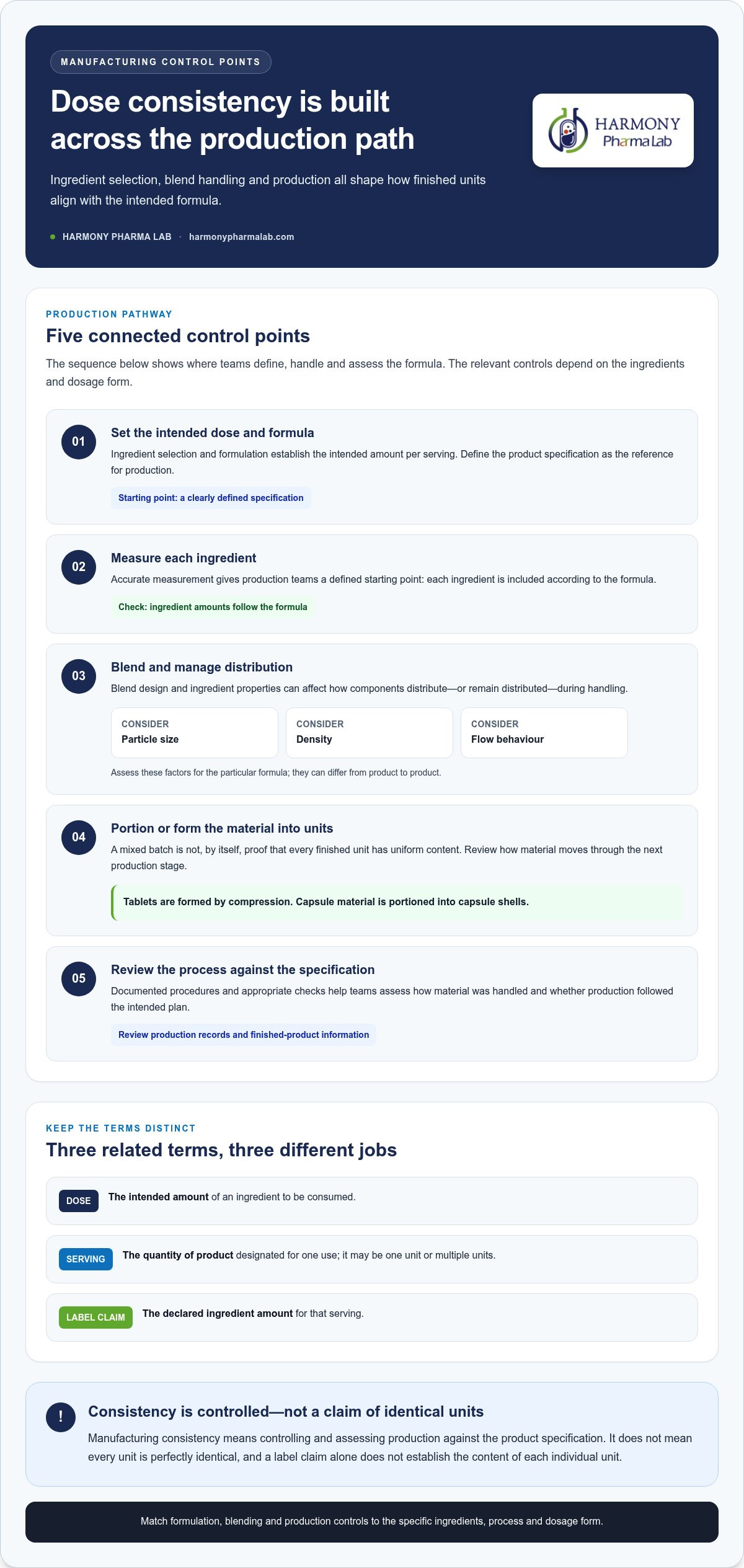
Dose uniformity begins before a tablet is formed. Ingredient selection and formulation establish the intended amount per serving, while measurement, blending and production determine how that formula carries through to finished units. Sources of variation depend on the ingredients, dosage form and process, so supplement dosing consistency relies on connected decisions rather than one control alone.
Formulation decisions also shape how practical the intended dose is to produce. Ingredients can have different physical properties, and the blend must be designed so its components can be handled and distributed appropriately. A change to an ingredient or its proportion may affect blend characteristics and prompt a review of the production approach. Considering these interactions early helps teams plan around the specific formula.
From ingredient measurement to a uniform blend
Accurate measurement gives production teams a defined starting point: each ingredient is included according to the formula. Next comes blending, where ingredient properties and blend design matter. Differences in particle size, density or flow behaviour may affect how components distribute or remain distributed during handling. Assess these considerations for the particular formula rather than assuming they are the same across products.
A mixed batch is not, by itself, proof that every finished unit has uniform content. Blending prepares material for the next stage; production then portions or forms it into units. Review both stages and whether the blend remains suitable as it moves through the process. Documented procedures and appropriate checks help teams assess how material was handled and whether production followed the intended plan.
Where dosage-form production introduces different considerations
In tablet production, a prepared blend is formed into tablets through compression. Formulation and process conditions can influence how the blend feeds into production and how the resulting units align with the intended specification. Capsule production is different: material is portioned into capsule shells rather than compressed into a tablet. The relevant considerations depend on the product design and the steps used to produce each format.
Other formats have their own formulation and handling considerations. Gummies are formed from a prepared mixture, powders are produced and handled as loose material, and liquids require a formula suited to their intended presentation. These differences do not establish a ranking of accuracy. They show why controls should be selected for the formula and dosage form, rather than transferred automatically from one process to another.
For brands developing a tablet formula, aligning formulation, blending and production provides a practical basis for planning. Harmony Pharma Lab provides custom formulation, blending and production, and identifies precise dosing and batch consistency as capabilities for tablet and capsule manufacturing. Explore supplement manufacturing options to consider how a product specification connects with its manufacturing approach.
How dosing consistency considerations differ across supplement formats
Supplement dosing consistency depends partly on how a product’s intended serving is presented and produced. A serving may be one tablet, several capsules, a measured amount of powder, or a portion of liquid. The format does not determine accuracy by itself; it affects which formulation and production considerations matter for the finished product.
Use the comparison below as a planning framework, not a ranking. A suitable specification reflects the product design and how consumers are instructed to measure or take a serving.
| Format | Consistency consideration | Serving communication |
|---|---|---|
| Tablet | Forming the prepared material into individual units | State the intended amount per tablet or per serving, including how many tablets make a serving |
| Capsule | Filling the capsule in line with the product’s formulation and unit design | Clarify whether one or multiple capsules make a serving |
| Gummy | Relating the prepared mixture and finished pieces to the intended serving | Define the serving by piece count or another specified measure |
| Powder | Considering the blend and the way a serving is portioned | Provide a clear measure for the serving, as established by product design |
| Liquid | Considering the formula and how a serving volume is presented | Specify the intended volume per serving |
Solid formats: tablets and capsules
Tablets and capsules are both solid formats, but their production steps differ. A tablet is formed as a unit, while a capsule is filled into a shell. For tablets, define whether the dose is communicated per tablet or across several tablets in a serving. For capsules, make clear how many units are intended per serving. The hard capsule manufacturing guide offers format-specific context for capsule planning.
These distinctions help teams connect the formula and unit design with clear label communication. They do not establish a particular test result or tolerance. Harmony Pharma Lab identifies precise dosing and batch consistency as capabilities for capsule and tablet manufacturing.
Gummies, powders, and liquids
For gummies, consider how the intended serving relates to the finished pieces; the custom gummy manufacturing guide provides further context on this format. Powders and liquids are presented differently: a serving may depend on a specified measure or volume rather than a count of discrete units. Clear serving instructions connect the intended dose with how the product is portioned.
Across all five formats, consistency planning should follow the formula, process and serving design. Standards and reference materials, such as USP Standards for Dietary Supplements, can help brands understand broader quality considerations. No format is inherently more accurate or more effective; the relevant question is how its production and serving definition support the intended specification.
Practical controls brands can use to support consistent supplement dosing
Supporting supplement dosing consistency calls for a connected control sequence, from defining the intended dose to reviewing production. The objective is to make the product specification clear, apply it consistently, and retain information that helps teams assess whether the finished product aligns with it. Controls should be tailored to the formula, dosage form and applicable requirements.
Set clear dose and serving specifications
Start by recording the intended amount of each relevant ingredient and how it relates to the serving. Define the serving composition, such as the number of tablets per serving, alongside product attributes that affect manufacture and dose presentation. Keep formulation documents, production instructions and finished-product specifications aligned so teams are working from the same intended formula.
Before production, identify details that need product-specific technical or regulatory review. These may include how the ingredient is expressed in the formula, how the serving is described, and which acceptance criteria apply. Criteria should reflect the product’s characteristics and applicable requirements, rather than being assumed to be identical for every product.
Review production and quality information
Documented procedures translate the specification into repeatable activities. A practical review can follow the production sequence:
- Confirm the inputs. Review ingredient identification, handling records and the relationship between the materials used and the approved formula.
- Follow the blend. Check that documented blending steps were completed as intended and that relevant observations or deviations were recorded.
- Review production activity. Examine records for the steps that form or fill finished units, including how issues and process changes were handled.
- Assess finished-product information. Review planned sampling and testing results against product-specific specifications, then document how any result outside established criteria was assessed.
In-process checks can help teams identify process concerns before production is complete, while finished-product review provides another point of assessment against the specification. Neither should be treated as a universal checklist detached from the product. Sampling plans, test methods and acceptance criteria need to suit the ingredient, formula and dosage form. A tablet blend and a liquid formula, for example, may call for different assessment considerations. There is no single test frequency or tolerance that applies to every supplement.
Production records are most useful when they connect decisions and results: which specification applied, which procedures were followed, what checks were performed, and how exceptions were resolved. That documented chain supports informed quality review without implying that any one control guarantees identical content in every unit.
For brands aligning tablet specifications with formulation and production, discuss your supplement manufacturing requirements with Harmony Pharma Lab.
How a manufacturing partner supports consistent supplement dosing
A manufacturing partner helps translate a product concept into a specification that guides formulation, blending and production. For brands, the value lies in connecting the intended dose and serving design with the selected format, then keeping those requirements clear as the product moves toward manufacture. This alignment supports supplement dosing consistency without implying that a process can guarantee identical content or outcomes in every unit.
The discussion is most useful when brand and production teams share a precise product brief. Include intended ingredient amounts, serving composition, dosage form and relevant product attributes. These details give formulation and production teams a common basis for planning, while product-specific technical and regulatory decisions remain subject to appropriate review.
Aligning product requirements with production format
Serving design and format influence how a product specification is expressed. A tablet brief may define the intended amount per unit or across a serving made up of multiple tablets. A powder or liquid may define a serving by measure or volume, while a capsule or gummy may use a unit count. Clarifying these points early helps ensure the formulation and production plan address the product the brand intends to bring forward.
Harmony Pharma Lab is a Singapore-based B2B contract manufacturer offering custom formulation, blending and production across soft capsules, hard capsules, gummies, tablets, powders and liquids. The production approach should suit the selected format and the requirements of the specific formula, rather than rely on assumptions from another product type.
Moving from a dosing brief to a production plan
A clear brief connects the intended dose with the formulation and steps needed to produce the chosen format. It also gives brand and operations stakeholders a reference for discussing specifications, documentation and product review. As the plan develops, keep the intended serving, ingredient composition and finished-product requirements aligned so changes to the concept can be considered in relation to production.
For capsule and tablet manufacturing, Harmony Pharma Lab identifies precise dosing and batch consistency as capabilities. These statements relate to those formats and should not be extended into claims about specific testing methods, tolerances, certifications or guaranteed results. Consistency remains a product and process objective evaluated against the relevant specification.
For supplement brands, a coordinated manufacturing relationship gives teams a clearer path from dosing concept to production plan. Formulation, blending and manufacturing can be considered together, with the product format and serving design kept in view. This helps teams discuss the intended product accurately and responsibly.
Brands developing a supplement concept can explore Harmony Pharma Lab’s contract manufacturing capabilities as a next step in planning formulation and production.
Turn dosing requirements into a production-ready plan
Treat dose requirements as a design input, not a detail to resolve after choosing the formula and format. Clear priorities help brand and operations teams make decisions in sequence, from the intended serving to the production approach, while keeping product claims grounded in the specification. This gives supplement dosing consistency a practical role in development: it informs planning without promising identical results for every consumer.
For brands moving from concept to manufacture, Harmony Pharma Lab provides custom formulation, blending and production across supplement formats, with precise dosing and batch consistency identified for capsule and tablet manufacturing. These capabilities support a considered discussion of how a product brief translates into a format-specific plan.
Take the next step with a clear view of your product requirements. Explore Harmony Pharma Lab’s contract manufacturing capabilities and consider how your intended serving and chosen format can guide development. A well-defined plan gives your team a stronger foundation for responsible product communication and commercial readiness.
Frequently Asked Questions
Does consistent supplement dosing mean every unit contains exactly the same amount?
No. Consistency means finished units are assessed against a defined product specification, not that each contains a mathematically identical amount. Small differences can occur in manufacturing, and acceptable limits depend on the product and applicable requirements. A brand may define how unit results are evaluated rather than claim every tablet is identical. Product communication should reflect the specification and supporting quality information, not imply absolute sameness.
Can consistent supplement dosing guarantee the same results for every consumer?
No. Consistent dose content supports reliable product composition, but it can’t guarantee a uniform response across consumers. Individual factors, including diet, health status and how a person uses a product, may influence their experience. Two people taking the same serving may report different results even when the product meets its specification. Brands should describe manufacturing consistency as a quality objective, not a promise of identical benefits.
Why might supplement dosing vary between production batches?
Batch results may differ because ingredient lots can have different characteristics, or because handling, weighing, blending or production conditions change. A formula adjustment or process deviation can also affect how materials move through production. A useful investigation compares the batch record with the approved formula and documents, then considers whether an ingredient, process step or specification changed. This helps teams identify a plausible source rather than assuming all variation has one cause.
Does ingredient potency change while a supplement is stored?
It can, depending on the ingredient, formulation, packaging and storage conditions. Heat, moisture, light or exposure to air may affect some ingredients, but the effect is not the same for every formula. Brands should base storage directions and shelf-life decisions on product-specific stability information rather than assume potency remains unchanged or declines at a fixed rate. Consumers should follow the storage instructions on the product label and avoid using products beyond their stated expiry date.
How often should supplement manufacturers test dose consistency?
There is no single testing frequency that suits every supplement. The plan should reflect the product’s formula and dosage form, manufacturing process, relevant specification and applicable requirements. Sampling choices also matter, since a result is meaningful only in relation to the plan and method used. Manufacturers and brands should establish and document an appropriate approach for each product instead of applying an arbitrary schedule or assuming one test represents every unit.
Is supplement dosing consistency the same as taking a supplement consistently?
No. In manufacturing, supplement dosing consistency concerns how finished product content aligns with its specification. In everyday use, taking a supplement consistently means following its directions as a regular routine. A person may take a tablet every day, but that habit says nothing by itself about how the tablet was produced. Keeping these meanings separate helps brand teams explain product quality without confusing manufacturing controls with consumer behaviour.