

A tablet press can compress powder, but that alone doesn’t make a supplement ready for commercial production. A compressed tablet manufacturer coordinates the work around the press, including formulation, blending, dosing, and production, to turn a brand’s concept into tablets made to its requirements.
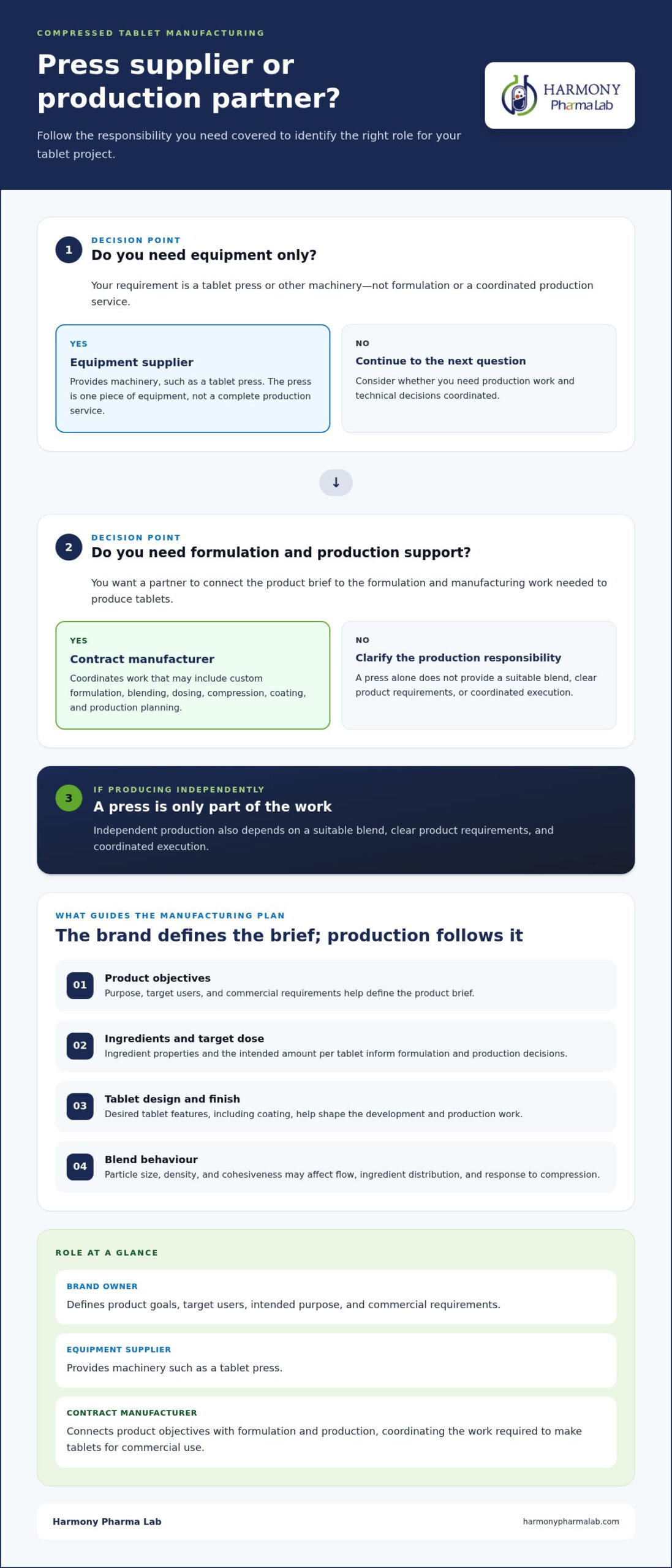
It’s easy to confuse a press supplier with a contract manufacturer, since both play a role in tablet production. Their responsibilities differ: a press supplier provides equipment, while a manufacturer supports production and the technical decisions that shape the finished tablet. Ingredient properties, dose requirements, coating, and tablet design all influence how a project is developed.
This guide explains what a manufacturer does for a dietary supplement brand, how formulation and production fit together, and which project details help establish a practical manufacturing plan. It also covers factors that affect tablet structure and consistency, from the ingredient blend to the target dose. Harmony Pharma Lab is a Singapore-based B2B contract manufacturer producing custom compressed tablets for supplement brands, with coordinated formulation, blending, and production support.
Key Takeaways
- A compressed tablet manufacturer coordinates work from formulation through production, while a tablet press supplier provides equipment.
- Ingredient properties and formulation objectives affect how a blend compresses and the characteristics of the finished tablet.
- Clarifying target users, product purpose, and core formulation objectives helps define a practical project brief.
- Compare equipment supply, in-house production, and contract manufacturing by their responsibilities and intended customers.
- Harmony Pharma Lab supports supplement brands with custom formulation, blending, tablet production, dosing, coating, and batch consistency.
What a compressed tablet manufacturer does for supplement brands
A compressed tablet manufacturer coordinates the work needed to turn a supplement brand’s product brief into tablets for commercial use. Depending on the project, that work can include custom formulation, blending, dosing, compression, coating, and production planning. Each decision is tied to the intended product and the brand’s requirements.
A compressed tablet manufacturer connects a brand’s product objectives with the formulation and production work needed to make supplement tablets for commercial sale. This is different from buying a tablet press and operating it independently. A press is one piece of equipment. Production also depends on a suitable blend, clear product requirements, and coordinated execution. Contract manufacturing gives brands a production relationship, not simply a machine to operate.
The relationship is business-to-business. The manufacturer produces tablets for the brand, while the brand is responsible for its product’s commercial positioning and consumer-facing sales. Harmony Pharma Lab is a Singapore-based B2B contract manufacturer producing compressed tablets for supplement brands, rather than selling retail-ready supplements directly to consumers.
Manufacturer, tablet press supplier, and brand owner: distinct roles
These roles contribute at different stages of a project. The brand owner defines the product goals, target users, intended purpose, and commercial requirements. Those decisions guide development, including formulation objectives and the tablet format that best fits the product brief.
An equipment supplier provides machinery, such as a tablet press, but buying a press does not provide a complete supplement production service. A contract manufacturer connects the brand’s goals to formulation and production, coordinating work such as blending and tablet production. Harmony Pharma Lab’s tablet capabilities include custom formulation, blending, production, precise dosing, and coating, with a focus on batch consistency.
Where compressed tablets fit in supplement manufacturing
Compressed tablets are one option in a broader range of supplement formats. Brands may also develop capsules, gummies, powders, or liquids, depending on the product objectives and intended user experience. Choosing a format is part of product planning, not simply a choice of machinery. It influences the development and production work that follows.
For a general overview of tablet forms and processes, including compression and the role of excipients, see the Tablet (pharmacy) Wikipedia article. Brands considering hard capsules as an alternative can also refer to a dedicated hard capsule manufacturing guide. At this stage, compare how each format fits the product brief; detailed format trade-offs can be assessed separately.
Understanding these responsibilities helps brands distinguish equipment acquisition from outsourced production. It also offers a clear starting point: define what the product should achieve, then align formulation and manufacturing work with those objectives.
How formulation and compression shape a supplement tablet
A tablet’s characteristics are shaped before the press applies pressure. Formulation determines how the ingredients combine and behave as a blend, while compression forms that prepared material into a solid tablet. The stages are connected: the formulation needs to suit the product objectives and support a production process that can be repeated consistently.
Formulation determines how the blend behaves, and compression turns that prepared blend into tablets with characteristics the production process is designed to repeat. For a brand, this means considering the active ingredients alongside the practical requirements of producing a tablet, rather than treating them as separate decisions.
Why ingredient and blend properties matter
Ingredients differ in physical characteristics, and those differences can affect how a blend moves through production. Particle size, density, and cohesiveness, for example, may influence flow, how evenly ingredients are distributed, and how the blend responds to compression. If material flows inconsistently or separates during handling, producing tablets with consistent characteristics may be more difficult.
Formulation development considers ingredient compatibility alongside the product requirements. Excipients are supporting ingredients used alongside active ingredients. Depending on the formulation, they can help support the blend or the finished tablet’s structure and production. They aren’t interchangeable, and no single excipient or formula suits every supplement. The appropriate formulation depends on the ingredients and product objectives.
This is why a compressed tablet manufacturer considers formulation and production as connected parts of development. A brand’s intended dose, ingredient profile, and desired tablet features inform formulation decisions, while the blend’s behaviour helps guide how it can be processed. The approach is project-dependent, not a universal recipe.
What dosing, coating, and batch consistency mean
Precise dosing is the manufacturing objective of delivering the intended amount of the formulation in each tablet. It depends on coordinated formulation and production, not on the press alone. Defining the target amount per tablet is therefore an important product requirement to establish during development.
Coating is an optional tablet feature that adds a layer to the tablet. Whether to include it, and what the project requires from it, depends on the product brief and formulation. It isn’t a default step or a guarantee of a particular result.
Batch consistency means aiming for repeatable production across batches, with tablet characteristics aligned with the project’s defined requirements. It relies on connecting formulation, blending, dosing, and production. Harmony Pharma Lab supports supplement brands with custom formulation, blending, compressed tablet production, precise dosing, coating, and batch consistency. Brands developing a tablet brief can learn about custom tablet formulation and production as part of a coordinated manufacturing project.
What separates a tablet press from a compressed tablet manufacturer
A tablet press is important to tablet production, but owning one does not by itself create a complete supplement manufacturing capability. The equipment is part of a broader process that brings together product requirements, formulation, material preparation, and production. Understanding the roles involved helps brands choose an operating model that fits their project.
Equipment supplier
Provides machinery and related technical specifications. Its primary customer is the organisation purchasing or operating the equipment. Formulation and supplement production are separate responsibilities.
In-house production team
Uses equipment owned or operated by the brand to carry out production. The brand’s team manages formulation and production internally, with the scope shaped by its resources and setup.
Contract manufacturer
Produces supplement tablets for a brand as a B2B service. Depending on the project scope, the work can connect formulation, blending, and tablet production. The customer is the brand developing a product for its market.
Equipment supply versus end-to-end production support
Equipment suppliers focus on machinery, its specifications, and its intended operation. That expertise addresses the equipment itself. A brand that purchases a press still needs to plan how ingredients are formulated and prepared, how production is managed, and how the tablets will meet the project requirements.
A contract manufacturer can coordinate formulation, blending, and tablet production within an agreed scope. This gives brands a production relationship rather than equipment alone. The project’s product goals and required support should guide how responsibilities are organised. A compressed tablet manufacturer brings production activities together for commercial supplement brands, while the brand owner defines the product and its market requirements.
Compressed tablets and other supplement formats
Tablets are one format among capsules, gummies, powders, and liquids. Each offers a different way to deliver a supplement, and the right format depends on the product goals, ingredients, and intended user experience. Choose based on the product brief rather than assuming one format suits every formulation or audience.
For example, a brand can assess whether a tablet fits its intended product presentation or explore a capsule as an alternative. The aim is to align the dosage format with the product requirements and the production work it entails. Readers considering a soft capsule can explore a soft capsule manufacturing guide for more detail on that format.
In practice, the distinction is about responsibility: a machinery provider supplies equipment, an in-house team manages its own production, and a contract manufacturer delivers agreed manufacturing support. Harmony Pharma Lab is a Singapore-based B2B contract manufacturer producing compressed tablets for supplement brands, with project support spanning formulation, blending, and production.
What to prepare before planning a compressed tablet project
A clear project brief gives formulation and production planning a useful starting point. It translates a product concept into decisions about ingredients, tablet characteristics, intended users, and commercial requirements. You don’t need every technical detail finalised before planning begins, but distinguish firm requirements from preferences that can be refined during development.
Use this checklist to organise the information your team will need:
- Define the target user and product purpose. Describe who the supplement is intended for and the role the product is designed to serve. Keep the description focused on product intent rather than unsupported performance claims.
- Set formulation objectives. Record the proposed ingredient profile, the purpose of each ingredient, and the intended serving plan. Note which elements are essential and where your team has flexibility.
- Describe the tablet you envision. Document preferred size, shape, appearance, coating, and other physical characteristics. Treat these as design objectives for discussion, not assumed production specifications.
- Identify sales markets and commercial scale. List intended destination markets and the scale your brand is planning for, such as an initial launch or a later expansion. Regulatory requirements can differ by jurisdiction, so market-specific requirements need a jurisdiction-specific review.
- Align launch and operational needs. Establish internal expectations for packaging, launch planning, and batch documentation. Identify who owns each decision and which details still need discussion.
Define the product brief and formulation objectives
Bring the audience, product concept, ingredient profile, and serving plan together in one brief so they can be considered as a whole. Include tablet size and shape preferences, coating preferences, and any other physical characteristics that matter to the intended user experience. A compressed tablet manufacturer can use this information to align formulation and production planning with the product brief, while distinguishing essential requirements from preferences that may need refinement.
Plan for production and destination markets
Identify where the product is intended to be sold early in planning. This helps the project team establish which jurisdiction-specific regulatory considerations need review, without assuming the same requirements apply across markets. Describe the commercial scale the brand is planning for, but leave detailed production parameters to project planning rather than assuming a standard quantity or capacity.
- What packaging format and product presentation does the launch plan require?
- Which launch milestones depend on formulation and production decisions?
- What batch documentation does the internal team need to support its processes?
- Who is responsible for reviewing destination-market requirements and approving product decisions?
These inputs help a manufacturing discussion focus on the product and its intended route to market, not only on the tablet itself. Prepare the brief with your team, then discuss your compressed tablet project with Harmony Pharma Lab, a Singapore-based B2B contract manufacturer supporting supplement brands.
How Harmony Pharma Lab supports compressed tablet manufacturing
Harmony Pharma Lab is a Singapore-based B2B contract manufacturer serving dietary supplement brands. Its compressed tablet work connects a brand’s product brief with custom formulation, blending, and production, so development decisions are considered alongside the practical requirements of making tablets for commercial use.
A project can begin with the brand’s intended users, product purpose, ingredient profile, serving plan, and preferred tablet characteristics. These inputs help shape the formulation and production discussion. As the brief develops, details such as target dose and coating preference can inform the approach. The final plan is specific to the project, rather than based on a universal formula.
From formulation requirements to tablet production
Formulation and blending help prepare ingredients for tablet production. The ingredient profile and product objectives guide formulation work, while the resulting blend needs to be considered in relation to the intended tablet. This connection matters because development choices influence how the project moves into production.
Harmony Pharma Lab supports compressed tablet projects with custom formulation, blending, and production, alongside precise dosing, coating, and batch consistency. These capabilities address different parts of the project: dosing relates to the intended amount per tablet, coating is a potential tablet feature, and batch consistency focuses on repeatable production aligned with the project’s requirements. The agreed scope and objectives guide how these elements come together.
A useful brief makes priorities clear without assuming every production detail in advance. A target dose, ingredient profile, preferred tablet form, and intended sales markets give the development process practical direction. The compressed tablet manufacturer can then coordinate formulation and production around the project requirements, rather than treating a press or a single technical choice as the whole manufacturing process.
A manufacturing partner for supplement brands
Harmony Pharma Lab works with commercial supplement brands and business customers. It supports brands developing products for their own markets, rather than selling finished supplements directly to consumers. This B2B focus keeps the work centred on the brand’s objectives and the manufacturing requirements of its product.
Tablets are one of several supplement formats Harmony Pharma Lab produces. Its broader format experience also includes soft capsules, hard capsules, gummies, powders, and liquids. These options provide context for brands planning a product portfolio, while formulation and production requirements remain specific to each format and project.
A well-prepared brief connects product intent with manufacturing decisions. For information about Harmony Pharma Lab’s contract manufacturing service and tablet project support from formulation through production, visit Harmony Pharma Lab.
Move your tablet concept towards a defined project
A product concept becomes easier to plan when your team turns its priorities into a clear brief. Set out the intended users, product purpose, ingredient objectives, and market plans, then identify which tablet details are essential and which can be refined through development. This gives the manufacturing discussion a practical foundation and connects commercial goals with formulation decisions.
The right compressed tablet manufacturer supports that progression by aligning development and production around the project. Harmony Pharma Lab works with supplement brands on custom formulation, blending, and tablet production, with support for precise dosing, coating, and batch consistency. Consider these capabilities in relation to the product brief, rather than as isolated production steps.
To define your compressed supplement tablet project, explore Harmony Pharma Lab’s compressed tablet manufacturing capabilities.
Frequently Asked Questions
What is a compressed tablet manufacturer?
A compressed tablet manufacturer produces supplement tablets for brands, carrying out the production work defined for a project. Depending on the agreed scope, its role may extend beyond pressing prepared material to include development and preparation activities. For example, a brand with an existing formula may need production support, while a new concept may also require formulation work. The term describes a B2B manufacturing role, not a retail seller of finished supplements.
How does a compressed tablet differ from a tablet made by other methods?
A compressed tablet is formed by applying pressure to prepared material, whereas other tablet-making methods may shape material through a different process, such as molding. The method affects how the tablet is formed, but the name alone doesn’t establish its ingredients, coating, or intended use. For a supplement project, the key consideration is whether the production approach suits the formulation and the tablet characteristics the brand aims to achieve.
Can dietary supplement ingredients be compressed into tablets?
Some supplement ingredients can be used in compressed tablets, but suitability depends on the ingredient profile and formulation. A powder that flows or compresses poorly may present different development considerations from one that handles more readily. Ingredient compatibility and the intended amount per tablet also matter. Formulation work assesses these factors for the specific product; a blend shouldn’t be assumed suitable for compression simply because its ingredients are used in supplements.
What information is needed to develop a custom supplement tablet?
Prepare a product brief that identifies the intended user, product purpose, proposed ingredients, target amount per serving, and preferred tablet characteristics. A draft formula or ingredient specification can make the discussion more concrete, while a draft label can help clarify how the serving plan is presented. Also note target sales markets, packaging plans, and intended commercial scale. These inputs help separate confirmed product requirements from early assumptions that may need refinement.
How does tablet coating affect a dietary supplement product?
Coating adds an outer layer to a tablet, and its purpose depends on the product design. It can influence features such as surface appearance, texture, or how the tablet is presented to users. A coating shouldn’t be assumed to provide a particular functional effect, since that depends on the material and formulation chosen. Brands should define why they want a coating, then consider that objective alongside the tablet’s other requirements.
What can affect consistency between tablet production batches?
Consistency can be influenced by variation in incoming ingredients, how well materials are blended, and whether production conditions are repeatable. Differences in material flow or compression behaviour may also affect the resulting tablets. For example, a change in an ingredient’s physical properties could require attention during production planning. Clear specifications and controlled, documented processes help teams assess whether successive batches align with the product’s defined characteristics.
Is a tablet press supplier the same as a contract tablet manufacturer?
No. A tablet press supplier provides equipment and information related to that machinery, while a contract tablet manufacturer carries out production work for a brand under an agreed project scope. The manufacturer’s responsibilities can vary, so the project agreement should define which activities are included and which remain with the brand. This distinction helps teams plan whether they need equipment, production support, or both.